


THE GOAN NETWORK
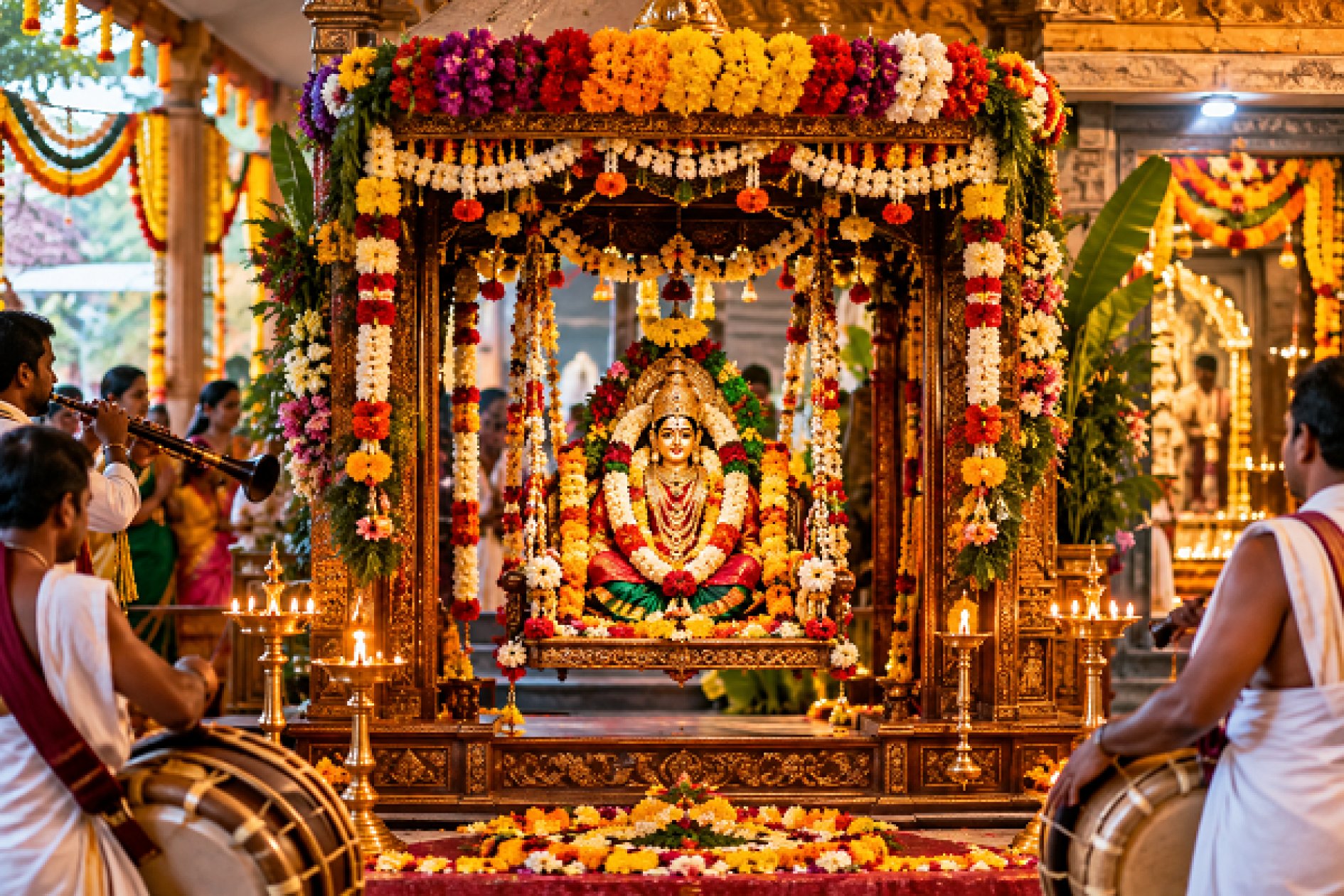
During Navratri, many Goan temples offer a sight that is as beautiful as it is deeply connected to faith. Elaborately decorated Makhars, the fragrance of flowers and the sound of traditional musical instruments fill the temple premises as the presiding deity is placed on the ceremonial swing.
TEMPLE TRADITIONS
As evening approaches, devotees gather to witness the ritual, with each temple following its own customs and musical rhythms. Ponda, often regarded as Goa’s temple town, and its surrounding areas, including Kundaim, Mangueshi and Mardol, see families visiting temples to witness the Makhar. Some begin their visits early in the evening and move from one temple to another, hoping to catch each celebration before the night comes to an end. Known as Makharutsav, the tradition gives Navratri in Goa a distinctive expression, bringing together devotion, music and the artistry of the Makhars.
SACRED TEXTS
“Navratri means nine nights. Generally, it is celebrated over nine nights, though this year it spans ten calendar days,” explains Pujari Ajinkya Joshi. He points to the significance of the Saptashati, the sacred text associated with the worship of the Goddess. “The Navachandi ritual that we perform, or the paath that we read, in that, there is a sacred text called the Saptashati. It contains 700 shlokas traditionally attributed to Markandeya Rishi, written with the blessings of the Goddess,” he explains.
The stories of the Goddess defeating demons are central to the observance. Through the daily worship and remembrance of her valour, devotees honour her victories over evil. The rituals also carry a symbolic lesson: just as the Goddess destroys the forces of evil, people are reminded to overcome negative and corrupt tendencies within themselves.
While the devotion remains central, the way the festival unfolds differs from one temple to another. Some temples have distinct musical beats accompanying the Makhar, while others hold kirtans and bhajans before the Makhar. Certain temples place five deities, or Panch Murti, on the Makhar on specific days, while the manner in which the swing is moved may also vary.
CHANGING VAHAAN
At Shree Devi Navdurga Devasthan in Kundaim, the celebrations begin with the rhythmic Jhaptaal and include a special tradition of assigning a different vahaan, or vehicle, to the deity each day. “On the first day, it is a swan; on the second, a horse; the third day features an eagle. On the fourth day, it is Gajant Lakshmi, seated on a lotus with elephants on either side. The fifth day features elephants, the sixth a peacock, the seventh a swan, the eighth a tiger and the ninth a lion,” shares Pujari Atmaram Joshi, whose family has served the deity for generations. The changing forms give each evening its own significance, offering devotees something different to witness as the festival progresses.
The timing of the Makhar at the Kundaim temple is also guided by ritual observances. “Two things are given importance here: Ghatasthapana and Ghatauddhapana. According to the Panchang, when the time for uddhapana arrives, the ghat is lifted. That is when we have our Makhar,” he explains. The Makhar is thus not simply a decorated swing or a festive gathering, but part of a sequence of worship that follows the temple’s own traditions.
As Navratri draws to a close, the ‘foolancho ashirwaad’ marks the end of the celebrations, followed by Dussehra. At the Kundaim temple, the conclusion carries its own ritual significance. “The Taranga of Lord Mallikarjun comes to this temple, where prayers are offered. They then take the kaul, which marks the sangata of the festival,” explains Joshi.
LIVING HERITAGE
From the first evening’s music to the changing vahaan and the final rituals, Makharutsav unfolds through customs preserved across generations. The decorated swings may catch the eye, but it is the devotion, craftsmanship and care behind each observance that give the celebration its lasting beauty.
In Goa, Navratri is not only a festival of nine nights, but also a reminder of how faith continues to find expression through traditions unique to each temple and community.


