


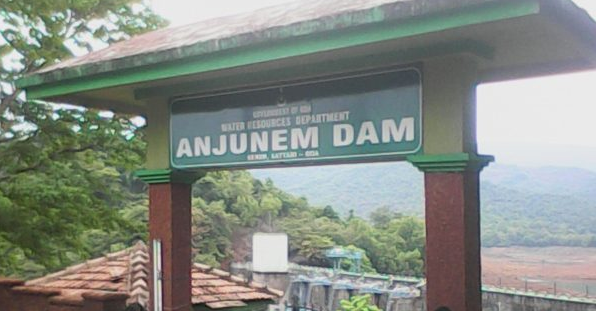
Most Goans know the story of the submerged Curdi. But very few know that, hidden beneath the Anjunem Dam, lies another story of four submerged villages that still live on in memory and tradition.
The pain of leaving behind the heritage will be known only to the village and the villagers. The presence of the village spirit can still be felt. Chandrashekhar Gawas, a villager of Kelawade Sattari, recounts his experience. “I had never seen my village back then. Two years back, when I visited our village, my companions pointed out where our hutment used to stand and told me that there was a jackfruit tree right in front of it. The moment was truly emotional for me,” he says, adding further, “When people visit, they should respect the sentiments we associate with our village and remember that people lived here once upon a time.”
The traditions of these villages were closely connected to the forest. Environmentalist Rajendra Kerkar, who is also from Keri, mentions that 4 villages got submerged. The construction of the masonry dam called the Anjunem irrigation project was completed in 1989. It was inaugurated by the then President Neelam Sanjiva Reddy and the former Chief Minister of Goa, Shashikala Kakodkar. “The main intention was to provide the irrigation and drinking water since Goa needed that. When the dam was constructed, four villages, Gullem, Pansuli, Kelawade, and Anjune, were submerged,” Kerkar mentions. The villagers, engaged in primitive agriculture, later shifted to cashew plantations. “When the waters recede in the summer, you can see the old temple ruins in Gullem. Most of the sculptures that were intact were brought to Ravona,” he states.
Remembering the happy vacations he spent there as a child, Kerkar mentions his work as a poder. “Afterwards, when the cashew productivity declined, the next generation got government jobs, etc. Their attachment to the village grew less,” he remarks. “When people visit now, they find peace of mind,” he notes further.
What now appears as a vast reservoir was once home to thriving communities with houses and fields. Temple festivals brought communities together, and life followed a rhythm that was shaped by nature and tradition.
Chintamani Hulankar, a villager from Kelawade, recollects the conflicting opinions regarding the dam’s construction. Meetings used to be held at Baravansh. At one such meeting, some locals objected to the dam. “Since I had stayed away from the village, I was aware of the issues. I told them why the dam was necessary, and instead of objecting to it, we should be putting forth our demands,” he mentions. Water shortage was a major issue in the village back then. “We left with a heavy heart; the elders felt it even more. But things have definitely improved after the dam was built,” he notes. The affected were provided plots, and houses were built, while some were even given jobs. A village is much more than houses and fields; it is the people, the tradition, and the memories that continue to shape life long after the landscapes have changed.
Krishna Vitthal Gawas, a villager from Gullem, reminisces about his time in the now-submerged village. “We lacked basic infrastructure, there was no school then, and we learnt from private tutors at home,” he mentions. Over 150 families had left their houses. They were later rebuilt by the government and served as shelters. They were initially allotted on lots. The house number and the number allotted to each family had to match. Accordingly, the new houses in Morlem colony were allotted. Similarly, agricultural plots of 2.5 acres were allotted, as were 400 square meters for houses. “Yes, the dam resulted in good water and development. We have 2 temples here of the same deities. These were shifted from the village of Gullem. All the major rituals are performed in the bigger temple,” he notes.
Though the villages were left behind, much of their spirit travelled with the people. Many of the traditions that once defined life continue to thrive even today.
Ramnath Fati Parab, a villager from Gullem, remarks how their traditions still continue. “Even after shifting, some elders remember the old village and get emotional as they were much attached,” he notes. The village always worked in unison with nature. “Our Gullem has Vagheri hills, people used to go there for farming. There is still some divine presence there,” he remarks. The village has continued several traditions, such as the Shigmo celebration, which includes a unique art form known as the ‘Bharnool,’ where a man dresses up as an old lady. While the primary motive is entertainment, it also provides social commentary on the village and its customs.
Though separated from their ancestral land, these villages remain connected through shared traditions even today. As the water recedes and pieces of the past begin to emerge, they serve as a silent reminder of a world that still lives on in memory. Every year the waters rise, and villages disappear once again, but for those who once called it home, the connection remains as strong as ever.


