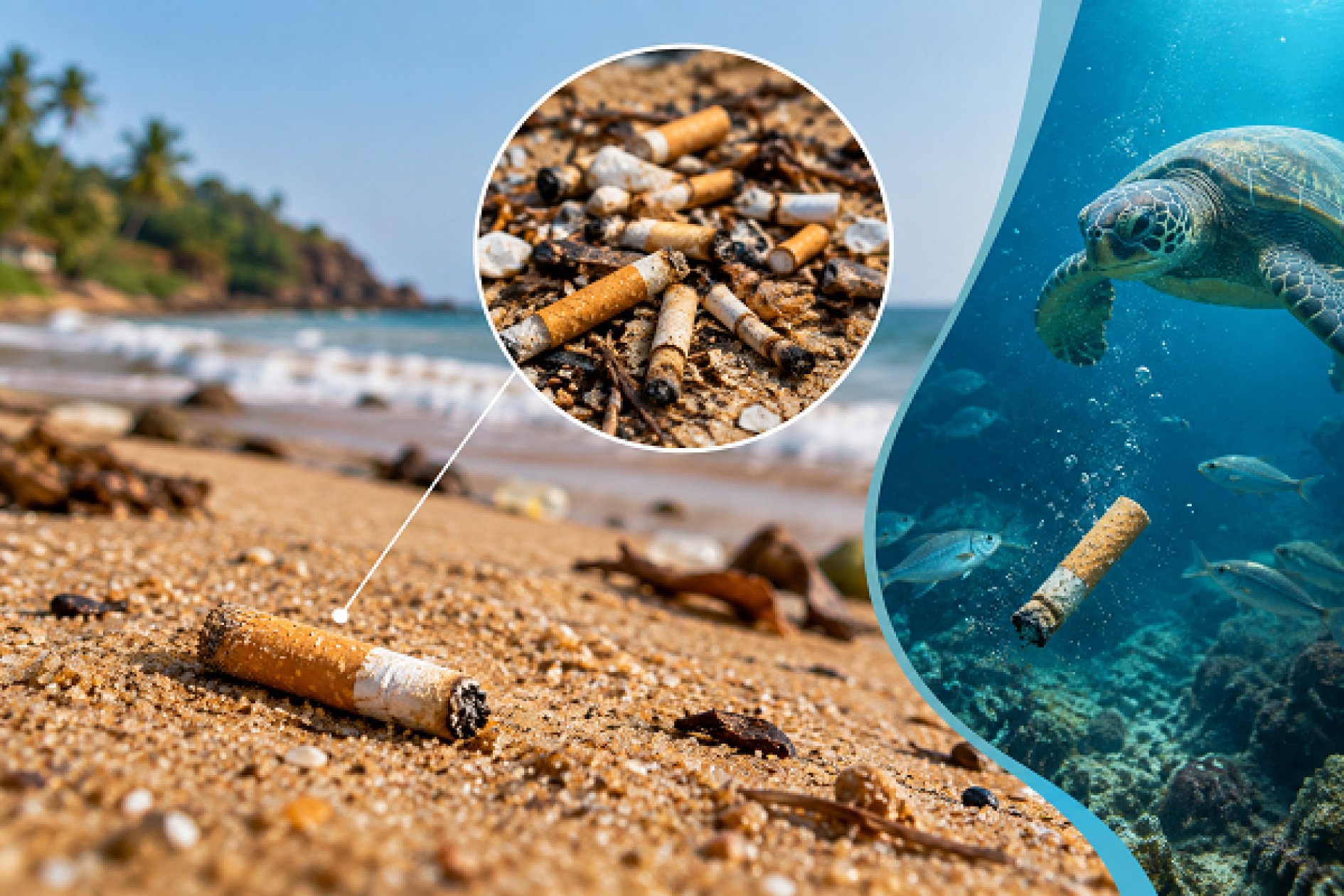
A discarded cigarette butt lying in the sand is easy to overlook. On Goa’s beaches, where larger debris often dominates the shoreline, it can seem like an insignificant piece of waste. However, with International Coastal Cleanup Day being observed today, attention must shift to the hidden dangers of this common litter. A cigarette filter is not made of paper or cotton; it is plastic. And what happens to it after it is stubbed out is part of a much larger, insidious environmental crisis.
ECOLOGICAL THREAT
As The Goan reported on September 16, cigarette butts constitute a massive portion of the waste found along Goa’s coast. But the concern goes far beyond what is visible on the surface. Dr Aditi Naik, a researcher from Goa University, warns that these discarded filters are a compounding ecological threat.
Dr Naik speaks from a position of deep expertise. She recently completed the prestigious Mare Balticum Fellowship at the University of Rostock, Germany, where she conducted advanced research on microplastics in the Baltic Sea at the Leibniz Institute for Baltic Sea Research in Warnemünde (IOW). Selected as one of only eight researchers worldwide, and the only researcher from India, she gained extensive exposure to microplastic sampling, processing, and advanced analytical approaches like micro-FTIR under the guidance of top international scientists.
“A cigarette filter may look like cotton, but it is predominantly made from cellulose acetate, a plastic polymer,” Dr Naik explains. Exposed to sunlight, moisture, waves, and physical abrasion, the filter gradually degrades into thousands of microscopic plastic fibres. Simultaneously, it leaches a toxic cocktail of nicotine, heavy metals, and polycyclic aromatic hydrocarbons into the water. “It is not simply unsightly beach litter,” she notes. “It becomes a persistent source of both microplastic fibre and chemical contamination.”
TOXIC TRAVELLERS
Microplastics are generally defined as plastic fragments smaller than five millimetres, but Dr Naik stresses they are much more than simply tiny pieces of plastic. The polymer itself contains chemical additives like plasticisers, pigments, flame retardants, and UV stabilisers, which leach into the ocean as the plastic ages.
Once in the marine environment, these particles become highly interactive. They adsorb organic pollutants and heavy metals from the surrounding water. Meanwhile, microorganisms and organic matter settle on their surfaces, forming a living biofilm known as the plastisphere. “An environmental microplastic particle can therefore be seen as a small and changing physical, chemical, and biological interface,” Dr Naik explains.
DANGER TO MARINE LIFE
The danger is not just that marine animals mistake these particles for food. Microplastics permeate entire marine systems, from surface waters to deep-sea sediments, making them accessible to organisms at every level of the food web. Studies reveal that ingesting these particles causes reduced feeding, physical irritation, oxidative stress, and inflammation, ultimately stunting growth and reproduction. Alarmingly, the smallest particles can even cross biological barriers and embed themselves in tissue.
Furthermore, this pollution disrupts the foundational elements of coastal ecosystems. Microplastics interact with phytoplankton, seaweeds, seagrasses, and mangrove environments, potentially impairing vital ecological processes like photosynthesis. “The concern is not merely that marine organisms eat plastic,” Dr Naik adds, “but that microplastics become interwoven into a wider network of physical, chemical, and biological interactions.”
CHALLENGE AHEAD
Cleaning up this microscopic mess is a monumental challenge. “Removing a floating bottle is relatively straightforward; filtering millions of microscopic particles dispersed through seawater is far harder,” she says. Attempting to filter them from the open ocean risks accidentally removing plankton and other essential natural biomass.
The solution, therefore, lies in preventing plastics from reaching the sea in the first place. This requires better wastewater and stormwater treatment, filters to capture synthetic fibres from textiles, control of tyre-wear runoff, and stringent management of everyday waste like cigarette butts. While emerging technologies like membrane filtration, biochar-based adsorption, and enzyme-based degradation hold promise, Dr Naik emphasizes that "for now, the most realistic strategy is source reduction combined with capture through wastewater and runoff pathways."
LOCAL UNDERSTANDING
For Goa, developing a localized understanding of the ecosystem is paramount. “Our rivers, estuaries, mangroves, beaches, and coastal waters are all closely interconnected,” Dr Naik notes. Long-term, localized research is vital to track how microplastics move and transform across these specific habitats. Building that knowledge locally, rather than relying entirely on data from vastly different global environments, is the key to developing effective monitoring and preventive strategies.
A cigarette butt may be small enough to disappear into the sand, but its plastic filter never truly goes away. As global research illuminates, protecting Goa’s connected coastal ecosystems depends on recognizing the severity of these small pollutants and stopping them before they reach the tide.