Perched on the Holy Hill of Old Goa, the Museum of Christian Art (MoCA) is a gem, nestling reverently in the scenic precincts of the 17th-century Convent of Santa Monica. Expecting to see Indo-Portuguese art, I discovered so much more- I found the true spirit of Goa, my home. While the MoCA houses many liturgical heirlooms, some resonated powerfully as a symbol of Goa’s pluralism. I was fortunate to be introduced to a selection by the curator, Natasha Fernandes, whose love for every artefact shone in her insightful narration.
Art imitates life, and indeed, the MoCA reflects the cultural integration and religious accord that Goans live with. The Portuguese brought European merchants and Jesuit missionaries to Goa. As recorded in Jesuit letters and the Akbarnama, the Mughal emperor Akbar invited Jesuit delegations from the Estado-da-Ãndia for inter-religious dialogues (munazara), underscored by his Sulh-i-kul (universal harmony) policy. His son, Emperor Jahangir, continued the tradition, as documented in Tuzuk-i-Jahangiri. Father Antonio Monserrate tutored Prince Murad (one of Akbar’s sons) in Portuguese and Christian principles, also establishing a Portuguese school for couriers. As for the Jesuits, they gained authority, learnt Persian and returned to Goa with Mughal craftsmen who taught local artisans zardozi (gold-thread embroidery), carving, and ivorywork. This cultural exchange prompted art blending Portuguese, Mughal, and Hindu traditions.
Drifting through the galleries, the poignant reminder of the origins of MoCA struck me, and how it upholds the power of cultural partnership. In the 17th century, Filipa Ferreira, a lady from Hormuz (yes, the same one) and her daughter Maria de Sá, built the first Catholic convent for cloistered nuns in Asia (the Convent of Santa Monica) with the Archbishop of Goa. In these polarised times, the significance of such artworks cannot be overstated. While these artefacts are fabulous Christian artwork, they are radiant in their fusion of faiths cradled in Indian hearts. Walk with me through the corridors of time spanning the 16th to 20th centuries, and uncover all-embracing glory.
Processional banner of St Joseph with Infant Jesus
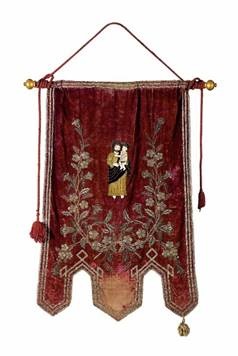
This banner added grandeur to many processions of the Orlim church. The Mughal stylistic influence is prominent with majestic Zardozi-embroidered florals. The meticulously carved ivory figures stand out against the polychrome silk backdrop. An attestation of Catholicity, it weaves Mughal aesthetics into the fabric of Goan society. One can imagine what a sight of shimmering devotion it must have made in the candlelit church.
Cabinet chest
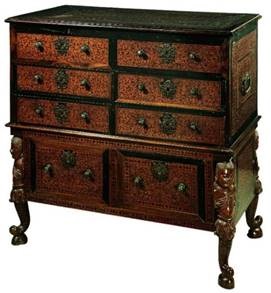
This 17th century piece was originally from the Basilica of Bom Jesus. Typical of the Euro-Portuguese style of the time, such pieces were commissioned to store valuables and paperwork in churches and homes. The Indian rosewood and teak, typical of colonial furniture is embellished with ebony inlays. The arabesque floral scrollwork motifs are reminiscent of miniature paintings from the early Mughal Golden Age. Also called “Mughal boxes” in the art world, it sits on caryatid-like Hindu mythology Nagas and clawed feet, rarely seen in typical European furniture.
Tabernacle Monstrance
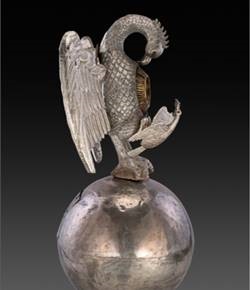
Made for the Convent of St Monica, this was used for Eucharistic (sacrificing for humanity) adoration during Mass. Representing 17th-18th century Goan church commissions, it depicts the Christian iconography of the Pelican in Piety (bird wounding itself to sustain its young). While the halo signifying divinity is European Baroque, the bird itself fuses with Krishna, Saraswati, and Lakshmi’s Mayura- the peacock, personifying immortality and godly benevolence. The lavishly decorated feathers (purity) and ornate talons (power) reflect the courtly aesthetics of the Mughal Golden Age. This is a telling example of Christian theology translated through Hindu and Muslim vocabulary in the Goan landscape.
Nirmala Matha
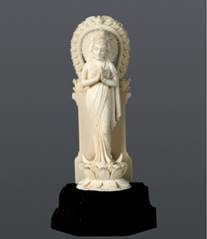
This ivory sculpture of the Madonna has similarities to a sari-draped Hindu goddess from the 20th-century Mysore-Travancore Raja Ravi Varma style. Adorning an Indian crown, long wavy hair, jhumkis, churis, and a conch shell aureole like Lakshmi, she stands barefoot on a Hindu and Buddhist-inspired inverted lotus base, in the anjali mudra. Typical of Madonna imagery, her crown has a halo, and she is perched on a crescent moon. This poetic piece, reminiscent of Mughal miniature art, exudes serene elegance, echoing the depictions of Mother Mary in the earlier Jahangir-era art.
Infant Jesus, the Good Shepherd
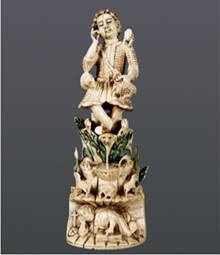
The Good Shepherd was a popular European portrait of Christ endorsed by the Estado-da-Ãndia Jesuits. Suggestive of Indian influence, the 17th-century Shepherd Jesus is likened to Krishna the Cowherd in pastoral metaphors. The Tree of Life, on which Christ is enthroned, is a steadfast Mughal representation of Jannat (paradise) and Aakhirat (afterlife), as consistently seen in their lush gardens. Carved from one piece of ivory, this is a unique cultural amalgamation of faith and love of the divine.
A culmination of centuries of dialogue and coalition, these masterpieces symbolise the splendour of cultural harmony through the mingling of three faiths on our soil. To this day, as conflict tears through Filipa’s homeland, MoCA holds a candle to the imperishable hope of peace through spiritual openness and mutual respect. First a sanctuary of quiet devotion, it is now a sanctuary of artistic freedom of expression - upholding all that’s generous and great about humanity.
The writer is a Human Capital Strategist and Educator; meaning she invests in humans like blue chip stocks and teaches them how not to crash the market