


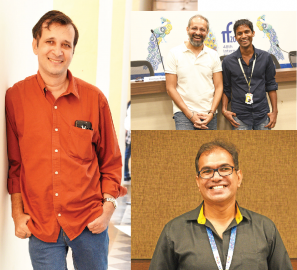
What is the one thing which filmmakers keep in mind while making a film? The directors of four films arrived at different answers, however one thing was common and that was the strength of the content. A strong, appealing story is important for all of them to make a film, though the style of its narration may vary. In the ‘Meet the Directors' event at IFFI, Rajesh Mapuskar, Bidyut Kotoky, Manouj Kadambh and Miransha Naik opened their hearts to the audience for a cordial dialogue as they shared their individual experiences in the making of their films.
For Bidyut, who has directed over 100 short films on human interests, lesser known facts and unsung heroes from all over India and abroad, the issues of his homeland Assam lay close to his heart. Set in the backdrop of violence and disrupt in Assam in the 1980s, Bidyut's film Xhoihobote Dhemalite is a film about children growing up in the violent places, war torn zones with brutality all around them.
Sharing his thoughts with #TGLIFE, Bidyut expressed, "I want to bring the issues in the Northeast to forefront as it is not the problem of our children in Assam that I am addressing, but it's a universal problem faced by all the children who grow up in violent atmosphere, be it Iran, Iraq, Israel or Palestine. As a film is a good medium to reach out to people, I do films on stories that disturb me from within and give me sleepless nights."
But films made in regional language, have limited audience. Sadly, in Assam where there were 90 theatres, now only 50 odd have remained, and the rest are turned into godowns, laments Bidyut, who still, is not deterred by the situation and continues doing films in his own language. "Less number of theatres means less collection at the box office," admits Bidyut who has spent a crore on this film and has yet to recover his investment.
"Bidyut is a great director and a sensitive writer who remains committed to his story from beginning to end," says Dipannita Sharma who has acted in the film. "Though I have done around a dozen Hindi films, Xhoihobote Dhemalite is my first film in my own language, Assamese," says Dipannita.
"Indeed, it is in regional cinema that one has the freedom to tell a story," feels writer and director Rajesh Mapuskar, whose comedy-drama film Ventilator made waves earning 250 million rupees at the box office and as of October 2017, was the 10th highest-grossing Marathi film of all time. "Bollywood' films are big budget films and hence while making them one has to keep in mind all that would make it a hit. But it is in regional cinema that one has the freedom to tell a story. It is only after the huge success of ‘Ventilator' in Marathi that I can now think of making it in Hindi," admits Mapuskar.
For Miransha Naik, the director of Juze, a Konkani film, storyline is the soul of the film.Miransha states that cinema is cinema and there should be no comparison between the languages or regions from which it comes. In his first feature film, Miransha has tried to touch the subject of migrants. This regional story has reached the film fraternity abroad making Miransha a celebrited Goan director in his debut venture.
"Cinema is the language of images and all those who watch it know the meaning. The language of emotion is the same all across the world," asserts Manouj Kadambh, director, Kshitij - A Horizon.
The protagonist in Kshitij is a girl Vacchi who wants to educate herself and usher in change. She fights with the situations that life poses before her, and not with the people who create those situations. "Films are the mirrors of society and I want to bring a change in the societal mindset through my film," states Manouj who feels that cinema is the best medium to highlight social issues subtly.


