


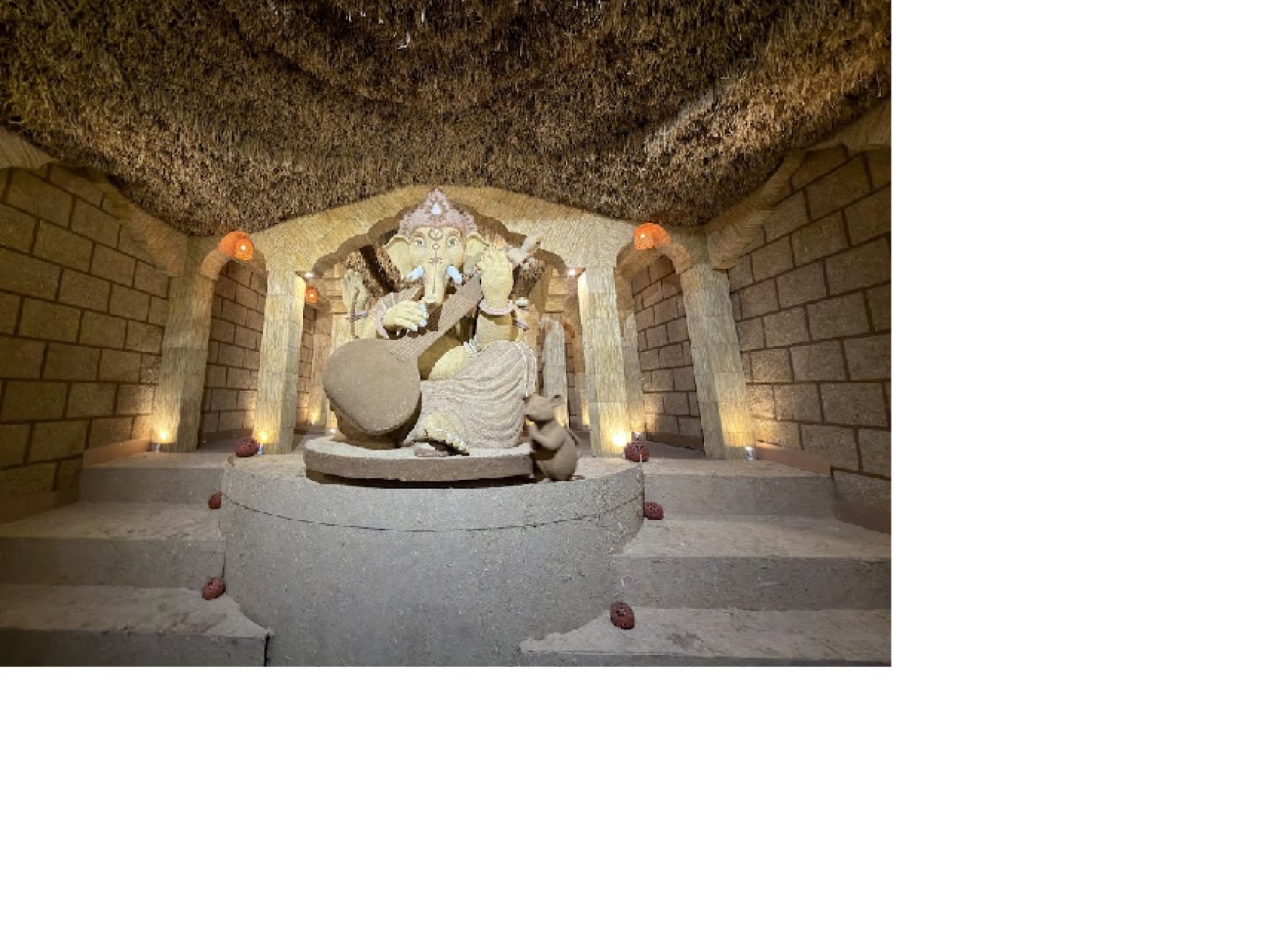
While Goa may not have extravagant pandals or larger-than-life decorations, the humble yet distinctive Sarvajanik Ganapatis across several neighbourhoods are worth a visit. Chovoth is largely a homely affair here, with families celebrating in their own homes. Still, over the years, the tradition of Sarvajanik Ganapati has continued to find its place in the festivities.
PUBLIC TRADITION
Once the dedh disancho Ganpati is immersed, families often head out to visit these public Ganapatis during the remaining days of Chaturthi, admiring the dekhavos and offering their prayers.
At Yuva Panjim, an alleyway lined with paintings is one of the attractions of the dekhavo. For the last four years, the group has held an All-Goa Canvas Art Competition, with around 120 participants from across the State this year. “All the artworks have been displayed as part of the décor,” says Sarvesh Shetye of Yuva Panjim, who has been involved in creating their Ganesh dekhavo for the last 10 years. This year’s theme features Bal Ganesh performing abhishek on a Shivling inside a cave-like setting. “When you come and touch the Nandi, that is when the motion starts,” he explains. They have also used air conditioners to recreate the cool and soothing feel of a cave, bringing technology and creativity together.
CREATIVE MATERIALS
At Sai Kala Mandal, creativity takes a different form, with the focus once again on the materials used to create the idol. The group has been making dekhave for the last 25 years, and Samir Tari of Sai Kala Mandal says, “This year’s Ganapati dekhavo is one of its kind. We were among the first to start making different and unusual types of Ganesh murtis in Goa.” Now in its 26th year, the mandal has gone eco-friendly with this year’s idol too. “We have made it using maize. The entire body is made of corn kernels, while the ‘dhoti’ and shawl are made from the corn peel,” he explains. The idol is placed atop a moon, surrounded by painted clouds, giving it the appearance of floating in the sky. Their first Ganapati in 2001 was made using coconut husk. “There has been no looking back since. One year it was spices, another year it was ‘hariyali’, among others. So far, we have made almost 25 idols using different materials,” says Tari. Last year, to mark their 25th year, they created a grand murti incorporating elements from their previous idols. “People praised us a lot for it. They really liked the idea and the murti too,” he says, hoping that as many, if not more, people visit their pandal this year.
COCONUT COIR
The Shree Ram Devasthan in Cumbharjuva has also turned to an unusual material, creating a murti out of ‘sonna’ or Coconut coir. Having practised the craft of making murtis for the last 24 years, the team is well-versed in the process. “People generally throw this part of the coconut away, so we thought, why not collect it and use it? Hence, the dekhavo is made with that,” they say, adding that it took them 34 days and around 20,000 pieces of sonna or coir.
“We have cut and used the coir, and we have also used the flowers which we get on the coconut,” they add. The group had earlier created a Ganapati using seashells and, the following year, bamboo, winning prizes for both. “While our main artist is Suraj Tari, everyone helps and contributes towards the making of it,” the members remark.
ECO FRIENDLY ART
The focus on natural materials continues at Brahmeshwar Yuvak Sangh in Akhada, St Estevem. Varad Phadte explains the inspiration behind their dekhavo: “We were inspired by the farmers, and hence decided to keep the theme and make it out of ‘gavat’. All the material used is eco-friendly,” he says, adding that it took them more than three months to complete.
With every strand of hay placed by hand on the pillars, the process was certainly not an easy one. The group has been creating dekhave since 2005 and began using strictly eco-friendly materials from 2015. This year too, they hope their effort draws visitors from across Goa.
From grass and corn to paintings, technology and carefully crafted murtis, these dekhavos show the many ways in which Sarvajanik Ganapati continues to be celebrated in Goa. Behind each one is the time, effort and creativity of groups who come together to build something for the community. For families stepping out after their own Chovoth celebrations, these dekhavos offer another way to experience the festival and celebrate together.


