THE GOAN
PANAJI
In Goa, Diwali celebrations stretch beyond the usual festivities, with the festival drawing to a close only after Tulsi Vivah, when families prepare and share the traditional naivedya of poha, jaggery and sugarcane. Known as Tulsiche Lagin or Vhadli Diwali, the occasion marks the ceremonial marriage of Tulsi, the sacred basil plant, to Lord Vishnu in his Shaligram form. According to one popular legend, Tulsi was once Vrinda, a devoted woman whose husband Jalandhar was defeated after Lord Vishnu intervened. Following her death, she became the sacred Tulsi plant, and Vishnu promised to marry her in his Shaligram form. Other versions of the story associate Tulsi with the demon Shankhachuda or identify her with Goddess Lakshmi. The ceremony is performed around Prabodhini Ekadashi or Dwadashi, and in some traditions, up to Kartik Purnima. It also marks the end of Chaturmas and the beginning of the Hindu wedding season.
Preparations begin
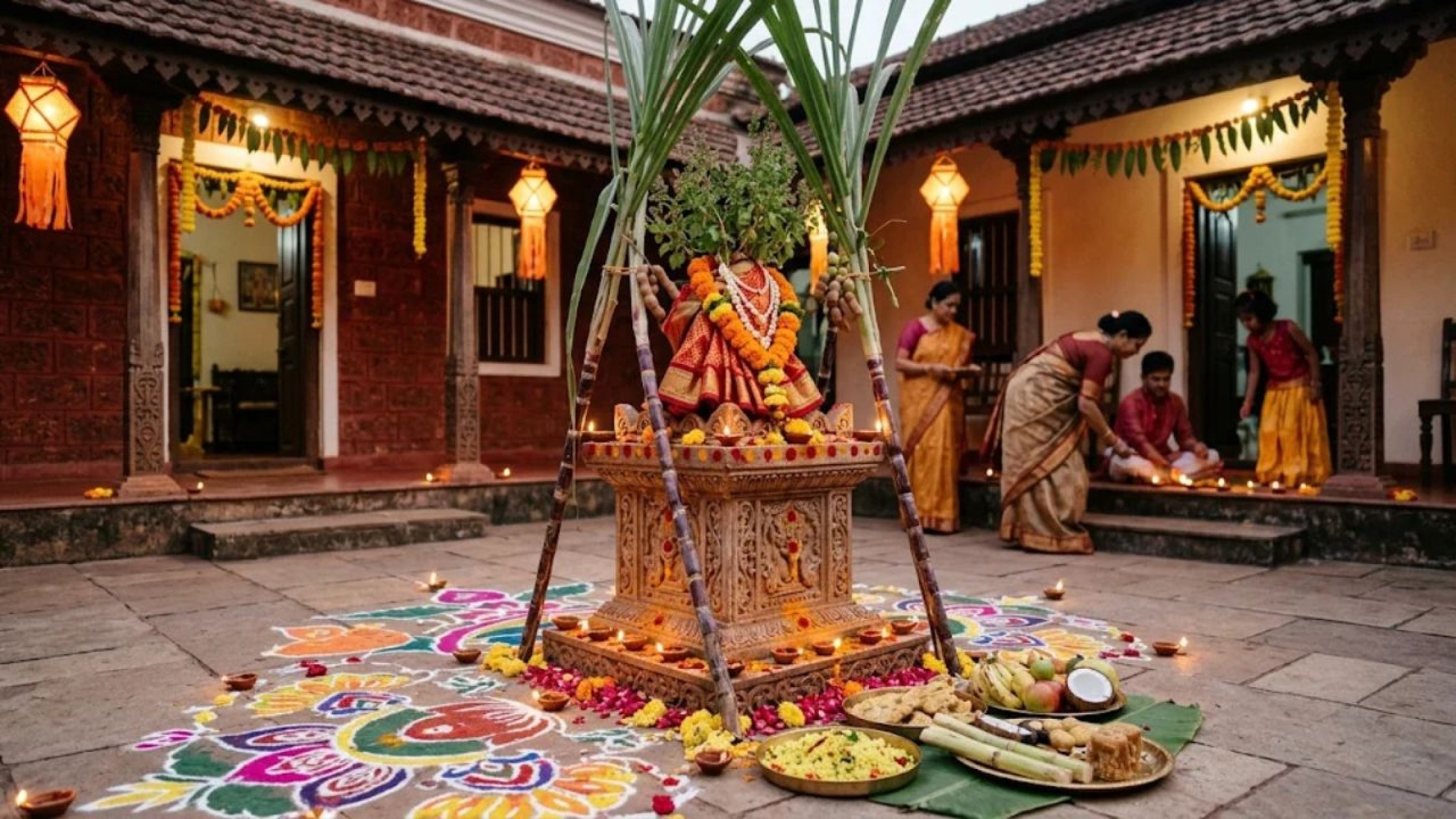
In Goa, the occasion is as much about the preparations as it is about the ceremony itself. While homes are already illuminated for Diwali, the Tulsi Vrindavan, usually placed in the courtyard of Hindu households, receives special attention. For a day, the sacred plant becomes the bride, dressed in all her finery as the family prepares to conduct the wedding rituals.
For several households, the days leading up to the wedding are just as exciting as the occasion itself. Courtyards are cleaned, Tulsi Vrindavans are scrubbed and freshly painted, and families begin putting together the decorations. “We clean the entire courtyard, scrub it down and wash everything. My younger brother and I paint our Tulsi Vrindavan every year without fail. This year, I was a little unsure whether I would get enough leaves for the decorations, but I managed to find some, and here we are, painting it,” says Shreeya Pai. The siblings also plan the designs together, making the annual exercise a creative family activity.
Different traditions
The date of the ceremony, however, varies between households. While most families observe it on Dwadashi, some follow the tradition of celebrating it a day earlier, on Ekadashi. “We celebrate our Tulsi Vivah on Ekadashi, while most others observe it on Dwadashi,” says Siddhesh Dessai. Although he is unsure how the tradition began, he says it has been followed in his family for generations, even before his grandparents' time. “We do not know exactly why it is celebrated a day earlier. It could have something to do with the availability of priests or other reasons, but this is how it has always been in our family,” he says. Pujari Ganesh explains that the ceremony does not have one fixed day across all households. “Some families perform it on the preceding Ekadashi, while others observe it on Dwadashi. The celebrations can also extend up to Kartik Purnima. However, most families celebrate it on Dwadashi, which falls on November 21 this year,” he explains.
Wedding rituals
When the day finally arrives, the house is a hub of activities. The prasad has to be prepared, the Tulsi Vrindavan needs to be decorated, akshata have to be arranged and the antarpath, the traditional cloth placed between the bride and groom during a wedding needs to be painted with the auspicious swastika. As evening approaches, the pantyos are lit, casting a warm glow across the courtyard and around the decorated Tulsi Vrindavan.
A community affair
For some families, however, the occasion extends well beyond their own homes. It is a community celebration, with neighbours and villagers joining in the rituals and festivities. “It is not just a family affair for us. The entire village comes to our house, and we visit theirs as well. It is like a proper wedding. Earlier, we would visit every house personally to invite people, but now we do it over the phone,” says Ramakant Naik. His daughter Ritika Naik also looks forward to the occasion, with her own set of responsibilities. “My work for the day is to light all the pantyos, arrange them beautifully along the corridor and prepare the traditional prasad of poha, coconut and jaggery, to which we also add sugarcane,” she says. Distributing the prasad is another part of her duty, although she admits to having a little personal motivation behind it. “That way, I can keep a few pieces of sugarcane for myself, as it has always been my favourite,” she laughs.
Beyond the celebrations
By the time the last guests leave, the wedding festivities give way to the quiet task of putting everything away. The akashdiva is taken down, the pantyos are brought inside and the courtyard slowly returns to its usual appearance. Yet, the occasion leaves behind more than just the memories of another Diwali. For these families, Tulsi Vivah brings together generations, neighbours and an entire community in a celebration that is as much about shared traditions as it is about faith. With the wedding season now beginning, the celebrations may be over, but there is already another reason to look forward to family gatherings in the months ahead.