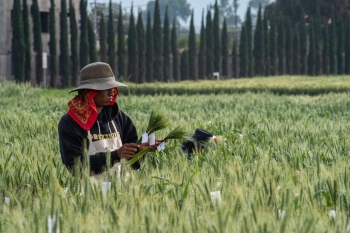
An “unprecedented” spread of a fungus infecting wheat across the globe has led scientists to call for greater international collaboration in genetic surveillance of crop species to minimise their destruction.
Wheat blast fungus was first identified in Brazil in 1985 and gradually spread to neighbouring countries. More recently pandemics have appeared in Bangladesh and Zambia.
In Bangladesh in 2016, it destroyed around 15,000 hectares, spreading to more than 16% of the country’s cultivated wheat area and consuming up to 100% of yields, while in Zambia outbreaks have continued to occur with varying severity since its arrival in 2018.
Scientists are worried the fungus could spread to other countries through the importation of infected seeds or through spores travelling on the wind.
Wheat blast has already moved from eight to 21 districts in Bangladesh and scientists are particularly concerned it will spread to China and India, the world’s two largest wheat producers.
In a new study, an international team of scientists led by University College London and the Sainsbury Laboratory, East Anglia, confirmed that the fungus afflicting Bangladesh and Zambia “ Magnaporthe oryzae “ is of the same genetic lineage as that in South America, although the exact source could not be identified.
The authors wrote: “The occurrence of wheat blast on three continents with climatic conditions highly conducive to its spread is unprecedented and represents a very significant threat to global food security which is exacerbated by the twin challenges of climate change and armed conflicts in major agricultural regions.”
They said the global community must learn lessons from the Covid-19 pandemic and follow the spread of the fungus using similar methods of genetic monitoring used to track the spread and mutations of coronavirus.
Publishing their work in the journal PLOS Biology, the scientists analysed wheat blast’s genetic make-up using 84 simultaneous PCR tests.
Aside from tracing its international spread, the team found the gene Rmg8 is resistant to the fungus while the disease is sensitive to the fungicide strobilurin.
They stressed that genomic surveillance, particularly in countries neighbouring infected areas, provides the best method for understanding how to control the fungal spread.
Professor Nick Talbot of the Sainsbury Laboratory said: “Only by really understanding the enemy and understanding the pathogens that cause these diseases will we be able to really preemptively control them.”
“We have to assume that plant diseases are going to spread all over the world through the impacts of climate change and globalisation and we have to be prepared for them.”
The researchers said further work is needed to understand how plant diseases like wheat blast fungus may evolve to become resistant to pesticides and fungicides and to investigate other potential strategies as alternatives to using chemicals.
Professor Sophien Kamoun of the Sainsbury Laboratory said: “This project builds on the paradigm “ best illustrated by the Covid-19 pandemic “ that genomic surveillance adds a unique dimension to the coordinated response to infectious disease outbreaks.
“We need to remain vigilant and continue genomics surveillance of wheat blast in Africa and Asia to identify variants of concern as soon as they emerge.”