The last five days I have been busy visiting the ancestral homes of my friends to partake in the ‘Chavath’ celebrations. The traditions that mark the festival have never ceased to amaze me. All these years, every outing has been a sort of revelation for me. Garnering new titbits, I have been able to piece together the extensive, but simple, range of rituals and inherited customs that mark the festival.
When at Paikul village, predominantly an area of ‘Kulagars’ and lately in news for the reconstruction of the bridge which helped relink the hamlet to the outside world, I learnt that Lord Ganesha is the deity related with agriculture and biodiversity. It has thus become a practice among farming communities to pay obeisance to the elephant-headed God seeking His blessings for a bountiful harvest.
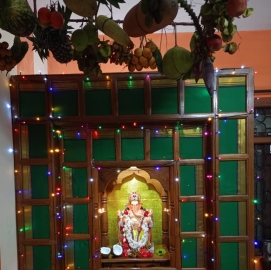
Tying ears of paddy either to the entrance of the house or on the ‘Matoli’ thus has its own significance I am told. The wooden frame laden with wild and seasonal produce which forms a canopy over the idol of Lord Ganesha is known as the ‘Matoli’.
Ancient texts have it that the indigenous communities of Goa once foraged forests for food and medicinal plants. It is believed that the ‘Matoli’ is an ecological tradition stemming from these practices. The ‘Matoli’ tradition is an informal way of imparting education about plants through culture.
It is indeed a wonder that we have been celebrating festivals without understanding what the various rites and ceremonies involved actually suggest.
As promos from the Department of Art and Culture inform us, ‘the diversity which prevails in various parts of Goa is deeply rooted in the traditions. All these traditions are not always based on scientific temperament but rather relied on the faith and feelings of the people from various generations. The people follow them as they are transferred by their forefathers.’
As I traversed across Goa enjoying the hospitality of my friends at their family homes during this year’s Chavath, I couldn’t stop marvelling at this rich diversity which was evident in the manner in which the festival was celebrated.
During the Ganesh festival it is usual to have villages resplendent in festive aura. As that time of the year which brings together families from distant corners of the land under one roof to celebrate the festival, the Ganesh Chaturthi has its own relevance.
The importance of jointly celebrating any festival with family members has its own charm.
The festival has come a long way since its inception. Having evolved over the decades to its modern avatar where demands of the time have seen drastic alterations in the celebrations have however not hampered the spirit of celebrations.
Nevertheless, the claim that every festival is celebrated with more enthusiasm in the cities than in villages cannot be accepted on face value. The ‘shift in culture’ is too obscure a matter to be even commented upon.
I however find it difficult to concur with the view that traditional values rooted in village soil have shifted to the city’s buildings simply for the reason that the urban lifestyle characterized by its fast-paced routine has made navigating everyday life quite cumbersome for the residents.
Some years back I had made comments on the absence of vivacities celebrating various festivals.
It has been a general tendency of late to conveniently forget the delights of a festival and refer to it as a calendar event that may -- or may not -- warrant a public holiday! Working even during such pleasurable days perhaps gives a false sense of pride to those people who can’t stop telling the world how busy they are.
The apathy of the people in general towards the revelries associated with various festivals portends a disturbing trend. The rat race that today has shorn all such gala occasions of its traditional fervour has made every individual irrespective of his religion insensitive to these social and community activities.
But this year’s Vinayak Chaturthi celebrations helped one conjure up visions of the past where coming together and celebrating festivals was essentially seen as a cultural and social obligation - one that was enjoyed to the fullest!
The large presence of youngsters in the ranks of family revellers who had united to make their ‘Chavath’ a grand success hints at a participation that will henceforth be a permanent affair.
The elders had gleefully stepped back allowing the younger generation to carry forward the traditions associated with the festival, albeit under their watchful eyes.
I was pleasantly surprised to see kids as young as ten and twelve skilfully playing the traditional percussion instruments, ‘Ghumot’ and ‘Shamel’ during the ‘aartis’. They were keeping pace with the more seniors in the group and matching them beat for beat in rendering a sonorous rhythm.
This trend is indicative of a marked difference from the celebrations of the preceding years where the customary nature of the festival overshadowed any keenness in participation by the younger family members.
At a time when the ‘modernness’ of the present era has been redefining and re-shaping established norms and social mores, the emerging trend where the present lot of youngsters have no reservations about accepting the age-old practises and customs as legacies handed over to them by their predecessors will help preserve the rich culture and traditions of the region. If looked at from another viewpoint, festivals are all about celebrating life. The cultural or religious reasons are but excuses which attach more significance to the festivities.
Festivals mirror the cultural heritage of a region and are an expressive way to celebrate it. As joyous occasions which call for active participation by the people, they help the locals embrace their culture and religion. It thus becomes imperative to have festivals evolving over the years to touch new dimensions that are in keeping with the changing times, and yet manage to hold the essence of its true nature across generations.