I remember having read ‘Pygmalion’ by Irish playwright George Bernard Shaw during my high school days. The narrative primarily revolves around the theme of social class and transformation.
“As a period of history characterized by a particularly rigid social hierarchy, but one that was beginning to decline as social mobility became increasingly possible, Shaw’s play depicts people’s ability to advance through society regardless of the social distinctions that exist.”
Pygmalion, it is said, is one example of a myth that one can take interest in, as it corresponds to philosophical and social issues that extend to our day.
But co-relating the play with a psychological phenomenon is something that had failed to register with me until a chance ‘discovery’ of an article in a foreign publication effectively cleared away the cobwebs from my head.
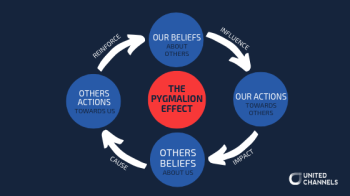
The ‘Pygmalion effect’ is a powerful psychological phenomenon that demonstrates the profound influence expectations can have on performance; how expectations can modify behaviour.
Even then, while the play Pygmalion demonstrated that one’s behaviour and social class can be false in nature, it becomes difficult to envisage how a Greek mythology could translate itself into a psychological concept that finds great relevance in present times.
Besides the article, I have also borrowed extensively from other sources to make the subject of expectations and performance more comprehensible.
It is believed that the Pygmalion effect became a psychological concept after Harvard psychologist Robert Rosenthal and school principal Lenore Jacobson conducted an experiment in 1968.
The experiment tested the idea that teachers’ expectations of their students can influence the students’ performance. The researchers found that students who were told that they had great academic potential performed significantly better than students who were not told this.
The Pygmalion effect, also known as the Rosenthal effect, continued to be studied in a variety of contexts, including the classroom, military, and workplace.
Whether in education, professional environments, parenting or personal growth, it is further observed that the expectations we set for ourselves and others play a significant role in shaping behaviour and outcomes.
The effect occurs because we tend to internalize the labels others place on us. We try to conform to those labels, whether positive or negative.
More importantly, the concept of Pygmalion is that when a leader, authority figure, or role model believes that we can succeed in a certain area, we will work hard to meet their expectations.
This also implies that we do better when more is expected of us. The Pygmalion effect works by forming expectations, communicating expectations and adapting behaviour.
Writing at length about Pygmalion effect, the author of the aforesaid article who is also a certified mental health and awareness practitioner specializing in narcissistic abuse recovery, has made things amply clear.
Commenting that while this effect offers significant potential for fostering growth, the writer also opined that there are potential risks and drawbacks if these expectations are unrealistic, rigid or poorly managed.
In my article last week, I broadly dealt with parental expectations where the misuse of high expectations can have lasting impact on children leaving them scarred for life, the trauma becoming a permanent aspect of their personality.
While we do have to admit that many parents push for success with good intentions, ‘an unbalanced approach that prioritizes achievements over effort and learning can lead to negative outcomes’.
It is generally observed that unrealistic expectations can damage self-esteem. Children for instance, beginning to see themselves as failures, soon cultivate traits that may be detrimental to their growth and development.
In this culture of high expectations, it is the child who faces the brunt of the negative impacts brought about.
The Pygmalion effect can stunt a child’s growth by causing them to fall behind if they are not the target of high expectations. It however came as news to me that the Pygmalion effect does affect the performance of elders adversely as well. The mere expectation of a certain outcome increases the likelihood that it will happen.
For instance, reminding the elderly that cognition typically declines with age can make them perform worse in memory tests than those who had no such reminders.
Now that one comes to think about it, this contention does seem to have a ring of truth about it. In fact, it is an observation that largely goes unnoticed.
This is where one gets to hear of another term, another psychological phenomenon, the ‘Golem Effect’, a counterpart to the Pygmalion effect, which is said to occur when low expectations lead to underachievement.
The Golem effect describes the progress where superiors (such as teachers or managers) anticipate low performance from a subordinate/student causing the very behaviour they predict.
The Pygmalion and Golem effects, as complimentary psychological phenomena, I learn, describe what happens when superiors communicate their feelings about their subordinates’ abilities to achieve.
If leaders have high expectations, people raise their performances to meet those expectations. If leaders however have low expectations, people lower their performances to meet those expectations.
It is nevertheless imperative to understand that the Pygmalion and Golem effects stem from the world of education where it is important to ensure that everyone has an equal chance of success regardless of their backgrounds.
According to Rosenthal who did the research on this subject, the expectation that one has of another person’s performance “comes to serve as a self-fulfilling prophecy”.
Hence, as Napoleon Hill said, “Think twice before you speak, because your words and influence will plant the seed of either success or failure in the mind of another.”