India observes the first week of October as ‘National Wildlife Week’, to put focus on the invaluable diversity of life teeming in our wilderness, and to foster and honour custodianship of this galactic repository of colourful life sharing space with us.
For the expansive Indian landmass and waterscape, the task of protecting and conserving wild endowments becomes challenging, given that we are a populous country. Our priorities, policies and prescriptions being homocentric, the legitimate entitlements of wildlife often get deferred and denied. If after 76 years of independence; the policy makers, planners and people’s representatives here view wildlife as obstacle to progress, then it is a bald-faced antithesis to the chant of ‘Vasudhaiva Kutumbakam’ that underscores the intrinsic value of every life form on earth, extending beyond humans to encompass the natural world.
Sacrificing wilderness to accommodate intensive agricultural landscapes cannot be legitimized, though India ranks 107th out of 121 countries in the Global Hunger Index 2022 rankings, with a level of hunger that is serious. In fact, in areas where episodes of crop raiding by wild herbivores occur routinely, proximity of cropland to wilderness is the mainspring of conflict. Such conflicts enter a vicious cycle of natural fodder deprivation, intrusion of wildlife into human dominated spaces, conflict and resultant loss of livelihoods and life; culminating in hostility and anti conservation public attitude. The red tapism further aggravates the agony of the aggrieved.
A major threat to wildlife habitats in present times is the aggressive push for linear infrastructure across the Indian territory. While connectivity has become a defining feature of the modern economy and resources have to be invested in linking communities, economies and countries; linear infrastructure fragments wilderness, disrupts wildlife corridors, and opens pristine and inviolate areas to exploitation.
Of course, strategic connectivity for movement of armed forces and equipment cannot be compromised with, but so is the criticality and integrity of habitats of high conservation value species and small relictual populations. A balance becomes necessary to ‘walk the tight rope’ in such instances, and a reasonable and realistic scale of impact assessment cannot be bypassed.
Union Road Transport and Highways minister is on record to suggest that India now has the second largest road network after the US, with 59% increase in the total length of national highways in last nine years. While the ruling dispensation flaunts this to their credit, it would be interesting to audit this investment against the ‘road ecology’ costs accrued.
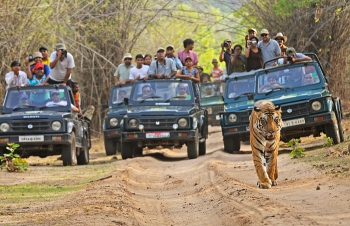
The seemingly benign wildlife tourism also must be within limits of visitor carrying capacity, if it has to be sustainable. Excessive tiger tourism and its infelicitous consequences in states like MP have clearly established the ‘rule of diminishing returns’.
Invasion by exotic species that progressively eliminate the native biodiversity is a realistic threat to India’s B17 status (one among the 17 mega-biodiversity countries). Prosopis, Acacia, Lantana, Chromolaena and Parthenium have occupied vast acreage of Indian wilderness, displacing native flora and altering ecology of habitats. Senna spectabilis for instance is one of the deadliest trees that has invaded elephant habitats in the Western Ghats.
The threat of invasives also prevails in the coastal habitats, best exemplified by the ‘Kerala Silent Invader’, a mussel that has probably got introduced through ballast water and has now clogged the estuaries and backwaters. An inventory of invasive alien species compiled by Sandilyan of Centre for Biodiversity Policy and Law (CEBPOL) records 173 species in India! The situation calls for stricter controls at borders with respect to travel and trade portals that offer passage to these unwanted visitors from foreign lands. Maritime operations like ballast water discharge must be monitored and stringent protocols put in place, since India has an EEZ measuring 2.37km2 ; a vast playground for marine invasive species.
Huge swathes of the tribal belts of Central and North East India have ‘empty forests’ because the wildlife therein has mostly been killed off, eaten or sold. The provisions of IWPA 1972 must be implemented in letter and spirit to dissuade this slaughter of our precious wildlife, along with sensitization of the forest-dependent communities. The tribals must be convinced on food alternatives alongside incentivization for switch over from ‘hunters to protectors’. Even in a state like Goa, we intermittently come across snares and traps set by the locals, in forested areas frequented by wildlife. Such ‘silent poaching’ is hard to detect and forestall, because there are no gunshots heard; but the scale of damage inflicted is significant.
The human settlements inside our wilderness pose a serious dilemma of priorities; in that the developmental aspirations of these communities cannot be fulfilled depriving them of amenities of urban counterparts. Such isolation can frustrate people leading them to take a confrontationist stance with forest brigade. They view forest staff as putting spoke in their wheel of progress, and then oppose even routine surveillance and necessary management for betterment of forest and wildlife. Delay in settlement of forest rights also invites resentment and adds to the prevailing trust deficit.
The recent decade marked by erratic weather patterns has confirmed that climate change is real, rapid and ruinous. The forest and wildlife will be hit the most due to these meteorological aberrations that render wild landscapes and their inhabitants vulnerable to infernos, hurricanes, flashfloods, droughts, and other detriment. The changing forest phenology poses challenges to wildlife in finding food, water, cover and even mates. Any wildlife management planning sans action plan towards adapting to climate change will be ineffective and incomplete. Emerging recalcitrant pollutants and novel contaminants entering wild environments can complicate the situation further.
The greatest threat to Indian wildlife however is a complacent citizenry that suffers a chronic disconnect, insensitive bureaucracy that invests in political appeasing by diluting the interest of wildlife, and impetuous politicians who suffer from dearth of ecological prudence. The pristine wilderness of India is not an inert piece of land that can be smothered with real estate, hospitality industry and linear infra. It is our living heritage!