Fire safety cannot be treated as decorative compliance, and licensing cannot be reduced to administrative ritual
There was a time in the late nineties, and then again in 2013, when my daily life in Finland required long walks along pathways lined with birch trees. The journey between the school, the library, the town hall and the modest family residence was often traced through stretches of woodland where birch trunks stood in quiet formation. The greyish white bark peeled away in thin curls that crumpled with the slightest touch. Even as a child, it was evident that the bark possessed an unusual dryness. It could ignite with remarkable speed, and it was explained that this flammability posed a natural hazard even in a land covered by snow. Those memories ensured that birch bark was always regarded as something that demanded respect and caution.
Familiar image in
unfamiliar place
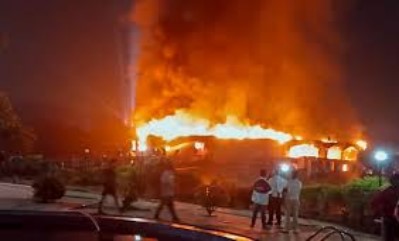
It is therefore difficult to ignore the irony now observed in Goa. A nightclub, meant to function as a centre of controlled entertainment, has instead revealed the characteristics of birch bark. The venue that promised curated pleasure has behaved like a structure waiting for a spark. The blaze in Arpora has shown that aesthetic ambition continues to triumph over basic safety, and that public spaces have been permitted to operate in a manner that disregards even the simplest principles of fire behaviour. The imagery of birch bark returns unexpectedly in a tropical landscape, not through the presence of the tree itself but through the choice of materials and the absence of robust oversight.
The reference to Romeo’s in the title is deliberate. Romeo Lane, associated with a hospitality magnate, has come to represent a culture of stylised indulgence. Such venues market an experience that suggests a form of immunity from mundane realities. The environment promises luxury, rhythm and abandon. This aesthetic, however, appears to have widened the distance between glamour and safety. In this context, the tragedy at Arpora is not merely an operational failure but a symptom of an industry reliant on the belief that appearances can substitute for compliance.
Calangute’s laissez
faire legacy
The reference to ‘Babus’ highlights the other end of Goa’s nightlife spectrum. The informal, instinct driven and historically permissive approach of Calangute has shaped a culture where regulation is often viewed as a negotiable inconvenience. The laissez faire ideology has persisted through successive seasons, fuelled by the assumption that the tourist economy will balance itself. Yet this permissiveness has created a landscape in which public safety has become a matter of chance. Whether a venue belongs to a magnate or to a local entrepreneur, the underlying risk remains identical when oversight is treated as optional.
The law of torts views such incidents through the lens of duty, breach and damage. A nightclub that invites individuals onto its premises is under a clear duty of care. That duty extends to the structural design of the building, the installation of fire safety equipment, the maintenance of proper exits and the procurement of statutory licences. When such a duty is breached and loss of life results, liability arises irrespective of the owner’s intention. In this instance, the victims were present in the course of their employment. They were not in a position to evaluate the safety of the premises or to compel corrective measures. Their vulnerability strengthens the claim that the operational management of the premises carried a heightened duty of care.
Vicarious liability and
multiplier of negligence
The doctrine of vicarious liability extends this responsibility further. When multiple entities participate in an enterprise, the failures of each actor are imputed to the others. The owner, the contractor, the manager and the designer may each bear liability for structural and functional defects. The Panchayat member who issued occupancy certification, the fire safety officer who granted clearance and the licensing authorities responsible for commercial permissions may also attract scrutiny. When public authorities participate in a chain of decisions that enable the functioning of an unsafe establishment, their actions may fall within the scope of misfeasance in public office. This forms a crucial component of the liability landscape.
In the aftermath of the Arpora blaze, the discussion on damages cannot be avoided. The victims were ordinary employees performing their duties within the expectation of safety. Damages in tort serve not only to compensate but to acknowledge the gravity of the breach. The loss of life cannot be quantified, but the law requires that the financial consequences borne by the families be addressed. This includes loss of dependency, loss of future income and compensation for the trauma endured. Such damages are traditionally borne by those whose negligence created the harmful conditions. In this case, the complexity of the operational structure means that liability may be shared across private actors and public officials.
Legitimate expectation
of safety
A further principle emerges from administrative law. The doctrine of legitimate expectation recognises that members of the public are entitled to expect that authorities will perform their duties in accordance with statutory norms. Visitors and employees at any licensed establishment are entitled to expect that fire clearances are genuine, that structural inspections are competent and that regulatory oversight is meaningful. When these expectations are defeated, the State bears responsibility not only for administrative failure but for the erosion of public trust. The Arpora incident exposes a collapse of this expectation and demands a re-examination of how regulatory assurances are communicated to the public.
It has been reported that some government functionaries have been suspended. Such measures may create an impression of responsiveness, yet they do little to identify the root causes of the regulatory failure. The families of the deceased lack the institutional power to challenge the processes that licensed the establishment. Their ability to secure justice depends on whether the investigation addresses the systemic weaknesses rather than the actions of a few individuals. The tragedy illustrates that suspensions are symbolic unless accompanied by wider structural reform.
Call for reform
Reform must address the entire chain of accountability, from private operators to public authorities. Fire safety cannot be treated as decorative compliance, and licensing cannot be reduced to administrative ritual. The losses endured by the victims and their families demand a collective recognition that public entertainment must be anchored in responsibility rather than indulgence. Only then can the imagery of a birch bark remain a fond memory and not a metaphor for preventable tragedy.