Innovations being the order of the day, the awareness campaigns organized by various government departments too seem to emulate fanciful novelties to gain public attention. But it is generally observed that these so-called ‘uniqueness’ actually serve to amuse people more than they do to caution them about public behaviour ‘incongruities’ that they are prone to exhibit rather too often.
Concerned by the rising number of road accidents and related fatalities in the state, the government has roped in local governing bodies for creating road safety awareness in their respective villages and municipal areas for which financial assistance of Rs 10,000 each will be provided. The initiative is part of the State Road safety Week celebration from October 14-20.
“In a communication to the Director of Panchayat and Municipal administration, the Directorate of Transport has informed about the decision to observe State Road Safety Week through Road Safety Traffic Management Committees, constituted at the Village Panchayat and Municipality level.” (The Goan, October 14)
They are to organize various Road safety activities/programmes in their areas to spread awareness amongst students and local communities about Road safety and Traffic Management.
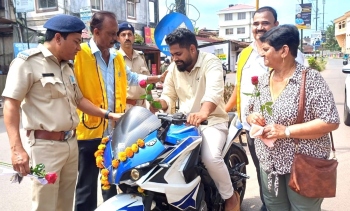
Accordingly, at Navelim in South Goa; traffic violators, much to their amusement, were welcomed with flowers instead of being penalised. The officials and members gave traffic violators roses while trying to educate them on the importance of complying with the provisions of the Motor Vehicles Act.
Similarly, reports in a section of the press speak of petrol pumps across Sattari taluka having adopted the “No helmet, No fuel” policy for the ongoing State Road Safety Week, encouraging riders to wear helmets to reduce the risk of fatal injuries in accidents.
But how do all these gimmicks actually help curtail accidents and fatalities on the roads! Will these freshness of ideas really bring about the desired results!
Our problem is that we don’t learn from mistakes and continue to act with gay abandon. If the worst of disasters cannot bring the commuting public to their senses, will such niceties and courtesies really have any effect on them?
If vehicle drivers have to be repeatedly reminded about using helmets and fastening seat belts while commuting, one can well understand the importance motorists and two-wheeler drivers attach to their own safety. How then can one expect such ‘miscreants’ to value other lives on the thoroughfares?
With helmets serving to be mere ‘appendages’ hanging over the side-glass of two-wheelers which need to come over one’s head only at the sighting of a traffic policeman, it is as if the ‘protective’ aspect of the headgears is completely lost on the people.
Similarly the use of seat belts! Many motorists consider it as an impediment and pull it on only when a traffic cop is spotted. What ‘safety protocol’ are we adhering to!
With the car and bike rental operators having ensured that travelling across the length and breadth of the state is now an enthralling experience for tourists, it is not unusual to have two and four-wheelers sporting yellow number plates easily outnumbering the private vehicles and taxis plying on the Goan roads at any given moment of time.
It is however the haphazardness which characterizes the movement of these rented vehicles that becomes a serious cause of concern. The way the two-wheelers ‘fan’ out on the highways, and especially at traffic-light junctions, makes driving a very scary proposition these days. The four-wheelers fare no better!
Not to say that the locals have been any different! With many of them exhibiting quirky mannerisms on the roads, manoeuvring the highways and thoroughfares in the state has become nothing less than a tactical exercise.
The Chief Minister Pramod Sawant's suggestion to those visiting the state to stop availing car and bike rental services and instead take advantage of the improved public transport system is indeed a very practical and sage advice which, if heeded, could well decongest the roads and highways in the state.
Roads have become everything but what they are actually designed for. Commuting is no longer a pleasurable practice. With vehicles crawling every inch of the way, it is the fight for space and the satisfaction of getting out of the commotion first that preoccupies every driver’s mind. I came across these lines on a shared WhatsApp post!
“Traffic jams can be significantly reduced if we stop tailgating. MIT research showed that journey times could be cut almost in half if everyone maintained a fixed distance from the vehicle in front and the one behind.”
How relevant the post is to the chaotic traffic scenario we are so accustomed to these days!
The matter of improving one’s behaviour and attitude while using the roads should be gaining precedence over everything else. People are well aware of the problems that hound sensible commuting. Yet, many, through their irresponsible road manners, put themselves and other road users at risk while driving.
There is this vantage point along the highway from Panzorconi to Cuncolim in South Goa where a traffic enforcement unit stations itself monitoring vehicular movement and addressing traffic infractions. This has become a permanent feature on this road.
The traffic virtually crawls at a snail’s pace on this stretch with motorists ensuring that they are driving within the prescribed speed-limits and are complying with all legalities on the roads.
So the presence of dedicated traffic personnel manning various expanses of the highway does keep unruly drivers in check.
The Motor Vehicles Act as a law that governs road vehicles and sets out rules and regulations for vehicle owners has enough teeth to ensure compliance by the public. But it is evidently the lack of effective implementation by traffic enforcers which allows for the blatant violations which makes life hell on the roads for commuters.
However, more than the enforcement, it is the strict adherence to traffic rules by the public which will pave the way for safer roads to commute on.