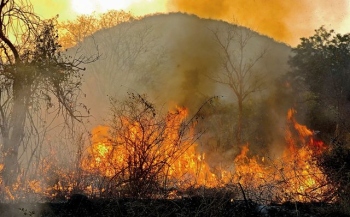
The continuing spate of wildfires in Goa is alarming and merits urgent cognizance; with immediate and long term consequences for the State, it’s natural and engineered capital and of course the people. This forest inferno is being debated, dissected and attributed arbitrarily to accidental conflagration, extreme weather, and arson.
Suspicions have also been expressed to suggest that these episodic forest fires are orchestrated by the ‘fire mafia’ seeking to destroy acres of wilderness and ease its commoditization for non-forestry purposes.
Fortunately, state functionaries have been responsive; with the Forest Minister putting his brigade on high alert and operational deployment. The Chief Minister has been in consultation with the Disaster Management Authority, Indian Navy for real time aerial surveillance and firefighting; and has also assessed the ground situation in some areas of the charred forest in Sattari that holds Mhadei wildlife sanctuary. Admirably the Fire Service personnel have been on their toes, with information on new fires and rekindling of extinguished fires pouring in from across the State by the hour.
The acreage of affected woodland, frequency of fire episodes on hills, forests and even Protected Areas, and the response of the state fire and emergency services and Indian Navy including aerial surveillance by the forest minister is simply unprecedented in this State that wasn’t thus far at the receiving end of disturbed panchmahabhutas.
Soon this catastrophe will lose its heat and normalcy shall return due to coordinated efforts of multiple agencies, intervention at the highest level of environmental governance and vigilant citizenry. But it is imperative that we learn a few lessons from this experience and integrate that wisdom in our future mitigatory planning.
Curiously, one aspect that is missing from the whole discussion is the ecological consequences of these forest fires, and critical assessment of loss of ecological goods and services of forests that have been destroyed in fire. For that purpose, an understanding of fire ecology is necessary.
While fire destroys monoculture timber plantations and cash crops of high trade value such as cashew; the imbalance ushered in by fires in forest ecosystem, resultant flawed nutrient flux, altered microclimatic regimes, annihilated climax community, changed species composition, red-carpeting for invasives, habitat shrinkage for relictual species, decimation of burrowing and arboreal animals; are all layers of a ‘degradation cascade’ that cannot be remedied or restored easily.
Let us first understand the genesis of forest fires. While only a thorough forensic investigation will bring to the fore the cause of these serial fire episodes in Goa’s forests and hills; one cannot rule out natural causes given the climate change that gave us the hottest February of the last half a century!
Presently the ‘fire triangle’ of heat, oxygen and fuel is available profusely, increasing vulnerability across heated landscapes that hold potentially combustible dry forest litter. On a warm day the piled up leaf litter can just go up in flames with combustion happening even due to a tiny drops of water held by trichomes (wax hairs) of plant leaves whose ‘focal region’ falls on the dry litter! It is imperative therefore to clear dry leaf litter and keep the ground free of fuel. The gums and resins in wood may aid in combustion too!
The global statistics suggest that slow-flaming campfires, lit cigarette butts, improperly burned debris, and arson are leading causes of forest fires. Eliminating these predisposing ‘fire-lighters’ will greatly reduce risk of fire-prone forests. Fire vulnerability assessment and mapping is long overdue for Goa’s forests in general and our PAs in particular. Forest Survey of India has a system in place to relay real time information on forest fire episodes to the States with little time lag in dissemination using satellite sensors. The forest brigade must be sensitized to fire surveillance, mitigation and management techniques.
As the forests burn, the wood ash flies smothering trees and interfering with critical plant processes and phenology. This can suppress productivity, suppress flowering and fruiting and confuse pollinators. The scalded trees are prone to pathogens, fungus, and insect attacks due to their lowered resistance following burn injuries. The trees burnt up to the canopy height eventually get uprooted and loosen soil that was held by their roots. It is important to remember that some of these areas have had landslides in 2021. The loose soil along with debris ends up as a sediment load in nearby water-bodies impacting aquatic biota.
Once denuded by fire, the climax community of tall permanent trees is destroyed and the land swivels back to early successional stages opening the ground for invasive species. The beneficiary fauna that associated with the earlier trees for food, roosting, and reproduction is mercilessly deprived and displaced.
Fire can displace and decimate a range of animals that dwell in the forest. Birds and bats roosting in tree hollows are vulnerable and their populations can crash. The fumes laden with carbon monoxide that linger on can interfere with wildlife’s olfactory abilities and pose difficulty in detecting prey, finding food, and water. Thick curtain of smoke can dissuade escape from fire as the vision gets blurred.
Depending on terrain and wind conditions, wildfires can spread fast at a speed of 10 kilometers an hour and wipe out critical habitat. Loss of habitat greatly impacts all animals, but the migratory species that annually return to the same forest for nesting are at high risk by wildfires.
On a positive note that in destruction lies a new beginning; forest fire also burns the mature biomass remineralizing it and improving soil fertility. Gradually new life begins to heal and spring forth. Fire is indeed the most tangible of all visible mysteries!