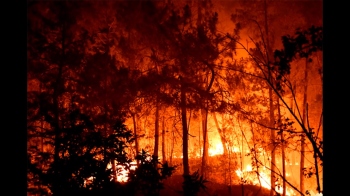
While forest fires have been routinely raging in the temperate forests of the world, tropical forest fires were rather rare giving these forests sufficient time to regenerate. The Western Ghats due to its predominant tropical evergreen and tropical moist deciduous forests were relatively free of the scourge of large forest fires, notwithstanding small ground fires in the dry deciduous areas. However during the last decade Western Ghats forests have been regularly affected by forest fires across the states of Gujarat, Maharashtra, Goa, Karnataka and Kerala. Poor land use management, climate induced hot and dry weather, abundant availability of fire fuel coupled with insufficient monitoring of ignition agents have caused these fires resulting in loss of precious biodiversity.
Increasing susceptibility
Older than the Himalayas, the Western Ghats, one of the world’s eight ‘hottest hotspots’ of biodiversity is also the most densely populated biodiversity hotspot. Due to extensive deforestation forest reserves are fragmented and limited in size, surrounded as they are by an intervening matrix of agricultural lands, commercial plantations and hydropower projects. Loss of natural vegetation, biotic pressures like logging and grazing and increasing demands over forests for firewood and non-timber forest produce has led to increased susceptibility of the remaining forests to recurrent fires.
Union Ministry of Environment & Forests says that nearly 55% of all Indian forests are fire-prone and approximately 3.73 million hectares get gutted annually. In protected areas of the Western Ghats, analysts place the figure at a conservative 17% per year, though outside protected areas the average burning percentage would be much higher. Though most of these forest fires are anthropogenic in nature, climate induced dry and hot conditions are making forests more prone to fires. Heat waves not only increase the chance of forest fires by creating a hotter and drier landscape but also by causing plants to shed more leaves providing fodder for fires and increasing their intensity.
Rising temperature alone not responsible
Fires are the result of interactions of ignition agents, fire fuel, topography and weather which includes temperature, relative humidity, wind velocity and the amount and frequency of precipitation. While increasing temperature alone does not necessarily mean fire disturbances, analysis have shown that high fire probabilities are associated with low levels of dry season rainfall, low average relative humidity and high daily average temperatures. These weather conditions are representative of low moisture levels of fire fuels suggesting that the occurrence of fires in moderated by environmental conditions that reduce the flammability of fire fuel.
Research has shown that fire regimes in the Western Ghats have changed fundamentally resulting in shorter fire return intervals (FRIs) mainly due to land cover transformation in the surrounding landscape where large tracts of forest land has been lost to agricultural plantations of coffee, tea, rubber, eucalyptus and hydropower projects. Studies on temporal trends suggest that the mean FRI in dry deciduous forests is 6 years, in tropical dry thorn forest mean FRI is 10 years while in tropical moist deciduous it is 20 years. Tropical dry deciduous forests burned more frequently and had the largest fires. Climate change induced dry and hotter weather is making FRIs even shorter.
Devastating effects
Forests fires can have a devastating effect on biodiversity by destroying trees, ecosystems, habitats, and adversely affecting livelihoods of forest resources dependent tribal and rural communities. By destroying the nutrient rich productive top soil, fires render the soil water-repellant hindering filtration and underground water recharge, while promoting soil erosion.
Forest fires affect the species composition and biomass of forests resulting in decreased diversity, dominance of certain species and eventual loss of native species. And although the tropical evergreen forests are resistant to fire propagation, they are sensitive to fire related damage with high mortality levels when fires do occur, because they are poorly adapted to fire with thin barks, buttressed trunks and stilt roots systems. Fires damage the carbon-sink functions of forests releasing large quantities of CO2 in the atmosphere.
With local communities largely alienated from forests ownership since government takeover of forest management, Joint Forest Management Committees notwithstanding, fire prevention and fire fighting has been an uphill task for the Forest Department. Despite remote sensing technology assisted fire alerts, lack of trained and specialized personnel have forced them to rely on quick-fix measures.
Planned response
Given the increasing frequency and intensity of forest fires, seasonal response should give way to planned preparedness and response through a systematic fire management programme centred around annual fire action plans prepared in consultation with all stakeholders including forest dependent tribal and rural communities.
Updated fire management policies & technologies should take into account the variability of fire regimes and ecological characteristics of species across the varied landscape of the Western Ghats. Integrating the human dimension of fire use in the landscape, and ensuring moderation of fire fuels through timely forest management decisions is critical.
Enlisting community participation specially of a voluntary youth cadre, committed to fire mitigation, trained and equipped with latest fire fighting technology and working hand in hand with the Forest Department will go a long way in improving the resilience of the Western Ghats and preserving its rare biodiversity.