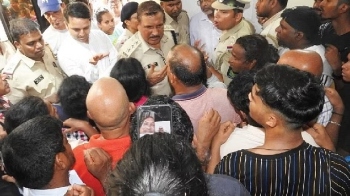
Even as I was wondering what might be a suitable and timely topic for this week's column, the 'conflict' over a priest's posting in Benaulim was being widely discussed in cyberspace.
But this is not a simple issue. It was hard to get a picture of what exactly was involved. Depending on who one heard, different perceptions were emerging. In fact, each report, comment, video emerging from there seemed to be describing an entirely different set of events. Or even different places.
One discussion was about posting the right priests in the right place. Connected with that was the query: who decides? Is a religious institution expected to be run on 'democratic' or 'majoritarian' lines? Truth, as an earlier Pope once famously said, is not decided by a majority vote.
On the other hand: are religious leaders accountable, or open to challenge? Even if the answer to the above is 'no' (or 'not necessarily'), how is consensus built in a community amidst our democratised, social-media crafted times?
Do a section of the villagers have the right to 'protest'? How does one determine whether this is a genuine, wider feeling or just the view of a well-organised small section?
These are all complex issues. No easy answers. Specially in times of transition.
We expect the man (woman) of religion to be above criticism and reproach. The Konkani music scene, which is so quick to respond to issues of the day (sometimes faster than a daily newspaper), came out with a song last weekend. In 12 hours, it had some 15,000 views. The song was titled 'Benaulim Padrik Dhanvddailo' (At Benaulim, A Priest Was Chased Away). Over 200 comments came up in the first 12 hours of it being online; of course, religion is an emotive issue.
It makes the case that a priest sacrifices a lot to take up his responsibility. He guides people and children. They deserve respect. And, if they get treated with disrespect, nobody would go to take up such postings (in Benaulim, I guess) in future.
But this does not mean that issues such as this need to be just wished away. Or that we pretend these don't exist. Or even that the man of religion can do no wrong.
After all, we are all only human; even if our motives are presumed to be superior. Everyone makes mistakes. Besides this, there have been increasing complaints coming up from diverse quarters. In places like Bombay (Mumbai), where land rates have spiralled even faster and more astronomically than those in Goa, charges of misuse and alienation of Church property are rife.
Two issues cannot be denied in our times. We live in over-commercialised and hyper-sexualised times. This is bound to affect the man/woman of religion too, at least to some degree.
Besides this, every religion (not just minority ones, which are easier to scapegoat) is in need of reform. A temple in Kerala (Padmanabhaswamy) has so many roomfulls of gold. Of six, one reportedly cannot be even opened, while there are no estimates of the value and worth held in the others. It's not even clear if religious property is properly documented and made tamper-proof.
All who take this seriously need to spend time thinking of solutions that could help them improve the situation.
Where are the problem areas? How can the system be tightened-up? If complaints come up, what is the best mechanism to tackle the same. Often, the tendency is to just respond defensively (as easily happens in our communalised times).
Years ago, I somehow got (for reasons I never understood) caught up with a network in the US. Its one-point agenda was to show how to keep church accounts in a proper way, with the minimum chance of problems cropping up.
Since, I lost contact with that group. But just do a Google search, and you'll see how tight financial reporting on not-for-profits, including religious groups, can be in some parts of the globe. (This is not an excuse for our corruption-prone political class to take control of yet another area. But it is for the good of the institutions themselves. It can help to keep rotten apples in check.)
Otherwise, the risk is that our institutions will simply attract the wrong persons, and go a bad way. An internet forward was talking the other day of the BCCI, the Board of Cricket Control in India. On revenue of Rs 48,390 crores it was paying zero tax, claiming is a charitable trust, and doesn't pay any taxes directly. And you were wondering why our politicians and their progeny flock to sport?
All this is not to simply prejudge the developments at Benaulim, to take sides or to point fingers. But one gets the feeling that this might just be the start of a wider trend of such questions and challenges. The faster that systems are put in place, and accountability is made to come in play, the better.
It is entirely possible that such requirements could be somewhat counter-productive. For instance, once doctors (and healthcare services) were brought under the consumer protection laws in India, they only started acting over-cautious. More tests were prescribed, to avoid any risks of consumer cases.
This, in turn, arguably pushed up healthcare costs. But, to argue that because of such risks (of over-caution) the system should be allowed to run as it is, is no excuse either. Maybe a clean-up with preventive action could help all concerned, and our wider society as well.