


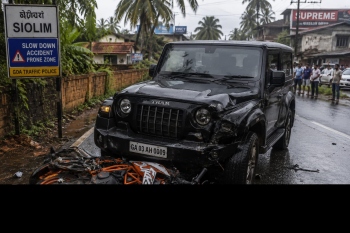
Within the span of a few days, Goa witnessed a series of road tragedies involving vulnerable road users. A woman in Vasco succumbed to injuries after being struck by a sport utility vehicle. A motorcyclist in Siolim lost his life after a collision involving a Mahindra Thar allegedly driven by an intoxicated tourist. A musician from Miramar succumbed to injuries sustained in a serious road crash at Campal. Although the factual circumstances of each incident remain distinct and continue to be investigated by the authorities, a common thread appears to emerge. Increasingly, some of Goa's most serious road crashes involve large and powerful sport utility vehicles operating upon roads that were never designed for such dominance.
For many years, the State's road safety discourse has centred upon speeding, drunken driving, helmet compliance and enforcement. These concerns remain legitimate. Yet an equally important question now deserves public attention. Are Goa's roads becoming progressively more dangerous because of the growing prevalence of large SUVs sharing public space with pedestrians, cyclists, scooter riders, motorcyclists and occupants of small passenger vehicles?
Physics of inequality
Road safety is often discussed as a legal issue. In reality, it is equally governed by the laws of physics. A collision involving a pedestrian and a two-tonne SUV is fundamentally different from a collision involving a pedestrian and a compact hatchback. Likewise, when a large SUV collides with a scooter, motorcycle or small passenger vehicle, the disparity in mass, height and momentum frequently determines the severity of the outcome before questions of negligence are ever examined.
Modern SUVs are deliberately engineered to protect their occupants. Reinforced cabins, elevated seating positions, advanced safety systems and robust construction enhance survivability for those inside the vehicle. Yet the same characteristics may increase the vulnerability of those outside it. The protection enjoyed by the occupants of the largest vehicles frequently corresponds with greater risks for pedestrians, cyclists and occupants of smaller vehicles.
The uncomfortable reality is that not all road users face equal consequences when collisions occur.
Goa's road network evolved through villages, settlements, paddy fields and market centres. Many roads were originally intended to accommodate pedestrians, bicycles, scooters and modest passenger vehicles.
Even today, substantial portions of the State continue to be characterised by narrow carriageways, blind curves, limited shoulders and inadequate pedestrian infrastructure. These conditions require caution, moderation and awareness from every road user.
SUVs were originally marketed as vehicles capable of traversing difficult terrain, steep gradients and challenging environments. Their size, torque, power and elevated driving position provide obvious advantages to their occupants. Yet these same characteristics can become problematic when introduced into densely populated environments where vulnerable road users remain in close proximity.
Tourism and the
rental SUV economy
The issue acquires an additional dimension in Goa because of its tourism-dependent economy.
Many vehicle rental operators maintain fleets of high-powered SUVs, particularly models such as the Mahindra Thar, which have become exceptionally popular among visiting tourists. Their popularity is understandable. They are spacious, visually appealing and capable of negotiating varied terrain. They also project an image of adventure and status that aligns with contemporary tourism marketing.
Unlike professional drivers, tourists may possess little understanding of village roads, sharp bends, monsoon hazards, local traffic culture or pedestrian activity. When such unfamiliarity is combined with speeding, distraction or intoxication, the consequences may prove catastrophic.
The objective is not to discourage tourism. Rather, it is to recognise that vehicle capability and driver responsibility must evolve together.
Lessons from Banastarim
The Banastarim bridge tragedy of October 2023 remains one of the most sobering reminders of the destructive potential of high-mass vehicles. The collision involving a Mercedes SUV resulted in multiple fatalities and left an enduring impression upon the collective consciousness of the State.
The legal proceedings arising from that tragedy will continue before the competent courts. However, the broader lesson extends beyond the particulars of any individual prosecution. The incident demonstrated the devastating consequences that can follow when a large and powerful vehicle collides with smaller and more vulnerable road users.
It also highlighted a reality that transport policy often overlooks. Not all vehicles present the same level of risk to the community. A powerful SUV travelling at excessive speed possesses a destructive capacity that differs substantially from that of a modest hatchback travelling under identical conditions.
The United Nations Decade of Action for Road Safety 2021“2030 and the Global Plan for Road Safety promote what is known as the Safe System Approach. This approach accepts that human beings inevitably make mistakes and therefore seeks to ensure that such mistakes do not result in death or serious injury.
India has endorsed these international objectives. The emphasis is no longer confined to punishing drivers after collisions occur. Greater importance is now placed upon identifying and reducing risks before fatalities occur. Vehicle design, licensing standards, enforcement mechanisms, road engineering and the protection of vulnerable road users are treated as interconnected elements of a comprehensive safety framework.
Reclaiming the roads
The recent fatalities reported across Goa should not be viewed as isolated tragedies. They should be understood as warnings. Roads are public spaces shared by individuals possessing vastly different levels of vulnerability. A transport system cannot be judged solely by how effectively it protects the occupants of the largest vehicle. It must also be judged by how safely it accommodates the weakest road user.
The pedestrian walking home in Vasco, the motorcyclist travelling through Siolim, the scooter rider navigating Campal and the family commuting in a modest hatchback possess the same entitlement to safety as the occupants of the most expensive SUV.
Until transport governance begins to acknowledge the disproportionate risks created by increasingly large vehicles operating upon increasingly constrained roads, the State's most vulnerable citizens will continue to bear the greatest burden of road safety failures.


