


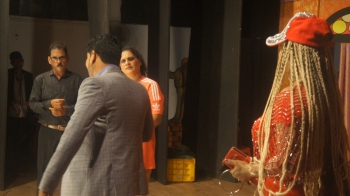
In recent weeks, I've turned a bit infatuated by the tiatr, Goa's charming if unusual form of Konkani theatre. In fashionable Goan circles, it's fashionable to look down upon this vibrant form of Konkani stage craft. Most of our agenda-setters will talk dismissively of it.
Yet, scholars like Pramod Kale (PhD from Wisconsin, and who taught at U/Minnesota) was perhaps the first to point to the uniqueness of the tiatr. He rated it highly. Kale was a Sanskrit, Marathi and Hindi scholar specialised in the field of Indian drama. Just read his somewhat complex-titled 1986 essay 'Essentialist and Epochalist Elements in Goan Popular Culture -- A Case Study of Tiatr'.
Goa-based researchers like Prof Andre Rafael Fernandes also did a PhD thesis and a book on this theatre form.
Some things struck me while watching the tiatr, and how it is staged. If you position yourself close to the stage, you can get other insights into how this operates. My lessons from from recent watching pushes me to list 'ten lessons' one has learnt from the tiatr:
1. Goans can be an extremely hardworking lot. Don't go by the stereotype. Take a close look at what goes into crafting and staging a tiatr. These ultra hardworking folk come in (mostly) all the way from Salcete. They stage one show Mapusa at 3.30 pm, and then go on to another at Arambol at 7.30 pm.
With them come their props -- from large ice blocks to an empty coffin, and even a make believe cut-out police patrol car. These are lugged around all over the place, and yet you mostly get your show and entertainment on time, without the audience whistles and grumbles. Amazing to see a section of Goans which is so non-susegad!
2. Tiatr actors are talented. In the past, they were dismissed as amateurish and unprofessional. Today, as they get a bit of the media spotlight (reviews and write-ups), the tiatr is showing itself as a genre increasingly worthy of being taken more seriously.
Some have criticised this theatre form for being "vulgar". Tiatrists themselves sometimes stress the need for removing this "blot". In some ways, the tiatr follows trends from performance forms like the lavani, which also have an element of sensuality and even sexuality in it.
3. Snobbery is part of Goan life: We Goans are quick to exclude, to criticise and to dismiss. Because the tiatr was born some 130 years ago amidst Catholic migrant circles in Bombay, Hindu Goans have largely not taken to it. The stereotyping of the Goan Hindu also didn't help. (There are a few prominent Hindu actors though, who are thoroughly accepted within tiatr circles today. They range from comedians to directors.) Things are changing of late, but only very slowly.
4. Yet, inspite of this, the tiatr offers a stage for Goa's humble and hardworking folk to prove themselves. Many of the stars of the tiatr stage are simple folk from modest backgrounds. Their hard work and talent has taken them to stardom at the level of our small state. They deserve it.
Anyone who wants to study the Catholic Goan permeability of class-caste boundaries should look at the tiatr. If earlier the village bhatkar (landlord) was the butt of jokes and ridicule in the past, today the misbehaving and mighty politician can also get the rough end of the stick.
5. Role for women: Tiatr opens up space for women, and it has been doing so long before other Indian regions allowed the same. Maybe that was due to family-member of the founder acting on stage. Today too women act as comediennes, singers, and playing lead roles.
6. It's popular: Without doubt, the tiatr has been able to manage things for itself. It has been hit by a whole lot of challenges, from the pandemic, to unsympathetic officialdom and a suspecting political class, and above all a lack of halls for enough shows to be staged. The Kala Academy and other official halls have been largely unenthusiastic about the tiatr. Some past politicians chided audiences for being unruly.
7. The Law of Unintended Consequences works: Sometimes, nice things happen even while it was not intended to. Many tiatrists, finding it tough to survive in Goa, have shifted over to places like the UK. This has spread the tiatr culture there too.
With some tiatrists based there, and others going in from Goa, regular tiatrs are being staged in Swindon, Wembley, Southall, etc. Some have also reached Scotland and Ireland!
There is also a Malad-Bandra-Matunga-Vila Parle circuit for the tiatrs, though for other reasons. Some have reached Pune and Gujarat too!
8. Catholic Goans and Konkani: The tiatr puts paid to the lie that that the Catholic Goan has little or no love for Konkani. Listen to what goes on there, see the intensity with which the tiatr is followed.
Of course, the Konkani that tiatr audiences want might not be the officially-sanctioned Antruzi dialect (in Devanagari script).
9. Goa lacks openness: So far, the tiatr has been largely restricted to its fan following. This blocks it from growing further and wider. Now, with tiatrists increasingly taking to the social media and the mass media, a lot of changes are happening. (See, for example, Francis de Tuem's tiatr called 'Reporter', which is available in full on his official YouTube channel.)
10 Financial viability: The biggest success story of the tiatr is its ability to maintain financial viability. Some tiatrists (including youngsters) are dependent on it for their full-time work. Of course, they all put in immense hard work to stay afloat.
Those who appreciate this can show their feelings by buying a ticket for a show, taking guests and visiting expat relatives for one, or even organising one (as many villages do). The need of the hour is perhaps having more private halls, which will not play favourites while leasing out their facilities, so that the show can go on. Not just for another day, month or year, but to continue the 130-year-old tradition it already has behind it.


