


Citizens' discussions online can act like a distorted mirror. They rake up issues which don't deserve a second look at, and bury concerns that could make a life-or-death difference to our future. Take a closer look, and you might agree.
WhatsApp, Twitter and some Facebook groups can be particularly notorious for this. But this trend is not entirely new. It has been around since the early social media days in the mid-1990s. This was also true of sections of the media, which have been sensationalist and agenda-setting.
Some editors (in Goa too) had a reputation for building their letters-to-the-editor column by promoting controversies related to religion or politics. Both these subjects are bound to stoke emotions and draw in a readership.
This happened in the Goa of the 1990s. If you look at some WhatsApp groups, things have really not changed.
Some of the groups I'm on have a staple diet of promoting Hindu-versus-Catholic hate-speech. Others repeatedly turn life into a BJP-versus-Congress conflict. Still others rake up issues which tell people why my-faith-is-better-than-yours.
At some stage, you get the impression that such debates are deliberately being stoked up, just to avoid attention going to more crucial issues.
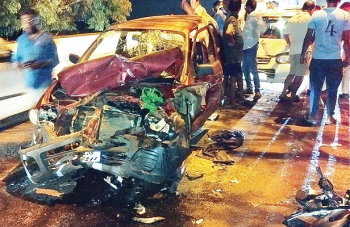
On the other hand, there are so many issues which need Goa's urgent attention. For instance, what is happening to road safety here, and why. It is not just a matter of getting outraged when a tragic and dramatic accident happens. Like at Banastarim then or Vagator now. But we need to really understand why things are going so drastically wrong at this point of time.
We have hints of an answer, of course. It could be that alcohol and drug-fuelled driving is going un-tackled for far too long. It might also have something to do with the fact that the new breed vehicles are simply too powerful for Goa's narrow and age-old roads.
Likewise, take the lack of police on Goa's roads (despite the over-bloated force, and so many oft expansions) for much of the day and the entire night. Then too, when the police are on the roads, their focus in entirely on fining traffic violators, rather than taking up the wider task of promoting road safety as a whole.
There are so many other crucial issues. Pollution at the Cuncolim industrial estate, unexplained kidney ailments at Canacona, the slow death of Goa's sporting talents (and importing sports-persons from other states for the National Games is just going to bluff ourselves further)....
A brief visit to Quepem recently showed how sugarcane farmers there were left high and dry by the closure of Goa's lone sugarcane factory, Sanjivani. It was built in the MGP days, when Goa was far more influenced by Maharashtra's politics and plans.
Then, Goa's education and career crisis hardly gets discussed. This, even while the jobs offered on many "vacancy" groups come with below-Rs20,000 salaries and wanting people to fit in unskilled slots.
Take the repeated land rackets, government-supported projects which deeply cut into the interests of local people, or fashionable projects like the marina at Nauxim, which Prof Ramrao Wagh recently explained the politics of.
The recent outrage against the noisy celebrations of festivals from many different quarters, shows how strongly its impact is being felt, across the State. Cutting across religious lines, many pointed to the ear-splitting music that was afflicting the ill, elderly, pets and general society. But this continued as a tiny minority took to bizarre forms of celebrating 21st century festivals.
Former journalist Sapna Sardessai commented in a Facebook post: "The Narkasur worshippers lose the plot a lil more, year upon year. Drinking, speeding, splurging, blaring of nonsensical music, to taking selfies with the narkasur... Something isn't quite right, no!?"
Others, with ailing family members, spoke of the trauma caused to them, leading to a further discussion over the social media. Pet-owners often speak about lost animals after a festival of noise. Strangely, despite everyone broadly agreeing to what a nuisance this is, the same carries on unchecked by a tiny minority of noise-makers.
Many wondered what had led to this sudden spurt of noise. Or whether it was no longer possible to celebrate traditional festivals in the eco-friendly ways of the past.
One person posted a video, commenting: "Bhatlem Panjim. At about 00.35 sec watch the leaf flying like a shirttail in the wind. Imagine what happens to your sensitive ear drums. This is called infrasound, which can be felt. These type of frequencies are also used in warfare."
Another online poster commented: "Almost the same situation at Gaunsavaddo, Mapusa. Loud music with laser lights went on till 5:30 am. Horrible situation. Cops are paid to go deaf and blind. Getting worse every year."
Someone suggested that the need of the hour was to educate those violating cracker and sound bans.
Actually, what we need is far more than education. There should just be a clampdown on what is turning into an unmanageable noisy nuisance. Religious leaders should take a stand and lead the way, as noise is not one bit required for devotional purposes.
There should also be a campaign for devotees to distance themselves from noise-makers during the coming Christmas and New Year celebrations too. That tourists feel noise is an important part of the celebration is no excuse whatsoever.
Instead of sliding into a competition over who can make the most noise, there should be a "best practices" competition among different faith communities. Let's see what is possible. Just because technology makes unprecedentedly noisy fire-crackers and loudspeakers, there is absolutely no reason for us to pollute the environment with the same.
If indeed it is true that politicians and others are sponsoring these noise-making competitions, it is shameful on them. Likewise, this would indicate that they are bribing a few individuals, so they can influence voters and keep them in continued slavery without discussing the matters that are important to them.
We have so many critical issues facing us. Yet, a determined tiny lobby can distract us into focusing on emotive non-issues. We need to be smart enough not to get distracted, and, at the same time, also take the agenda back to what really matters. Our future is at stake.


