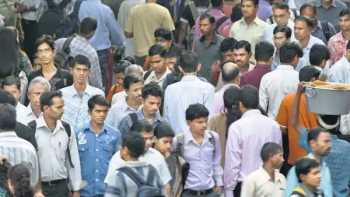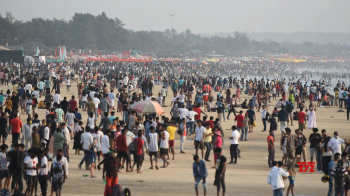
It's that time of the year when everyone and their dog seems to remember Goa. Nobody would like to be left out from visiting this small region in this last calendar month. And, it's only going to get more crowded -- in the last week of the last month of the year.
There are signs of it all around. People from across the country (sometimes from abroad too) get in touch. They announce their presence via the social media. Roads are crowded. This translates into traffic jams, accidents, and more.
It would seem obvious that the greater number of vehicles on the road are going to translate into a spurt in accidents. Some drivers are inebriated and "having a good time". Many in Goa might feel like minimising travel out of home in this season, and a few might even want to leave Goa. The other day, it took about five to six minutes to cover the distance between the Shivaji and Gandhi statutes in Mapusa, a distance of barely a hundred metres....
There is a general collapse of order in the State, and nobody's really enjoying it. Citizens face the pressures, local businesses can't cope. Even the tourists wonder why they are overcharged and given a raw deal in the wannabee desi version of Europe-in-India.
From irate villagers troubled by bikers flooding the Anjuna-Vagator area, to the crowds that jam up coastal Bardez with Sunburn, the many conferences which all prefer to visit in this month, and even the general roadside chaos on the Candolim-Baga belt, this hardly makes sense for anyone. Let's not even talk about the garbage mess. Yet, few questions are asked.
Goa is not alone in its problems. Others acknowledge theirs. The Office of Community Oriented Policing Services in the US, in a report titled 'Small Towns, Big Crowds: Policing Tourist Destinations', comments: "All of this can make policing tourist destinations challenging -- especially in small towns, such as beach or mountain resorts, whose populations may grow ten- or even hundredfold in peak season. Dealing with the additional load on their services and personnel may not be easy...,"
The Sustainable Tourism Cooperative Research Centre in Australia, reminds us that "some destinations at certain times have more tourists and visitors than they are able to accommodate, while at other times, there are too few tourists and visitors to the region."
Of course, comparing the situation in some affluent part of the world with that of a Third World region like Goa might not be apt. There, they have resources, and clear strategies, to cope. Here, we seem to be just wallowing in the situation, unable to control it, and not really caring about its long-term impact.
Efforts have been made to find solutions too. Sustainable Tourism points to ways in which the situation can be ameliorated. It mentions steps like pricing strategies, diversifying the attraction, and seeking assistance from the government and industry bodies. Increasing the length of the tourist season, recruiting temporary staff, and modifying the timing to school holidays have also been suggested. Social and environmental factors need to be kept in mind too, not just economic ones.
Seasonality can threaten tourism too, and the viability of local businesses.
But hardly any steps have been carried out here. Instead of diversifying the tourism product, a laissez faire and left-to-chance approach is followed. So many events are organised in the month of December itself, which draw humongous crowds here.
"Hinterland tourism" has long been spoken about, and oodles of money spent over it, but with little result. It is still the coastal areas which get bludgeoned by the adverse impacts of tourism.
Talk about levying a toll on vehicles entering Goa has been discussed from the time of the late Manohar Parrikar and probably earlier. But, for some reason, the State has been reticent about implementing this, giving any excuse to avoid the same. This is particularly relevant, as the Indian middle-class boom sees large armies of KA, MH, TN, UP, GJ and an alphabet soup of vehicles enter Goa every time there is a long weekend, or a few extra nationwide holidays.
In New England, one study (Tsundoda and Mendlinger) noted that most people in a small town did not want "increased tourism development even if it results in increased revenue". Tourism was seen as one of the causes of "divided social classes". Wealthier members of society generally viewed tourism as beneficial.
But such studies were also willing to look at the need to "preserve the distinct cultural atmosphere of the place". Or, the increased tax burden of developing infrastructure used primarily by tourists, social costs (increased crime rates, prostitution, even friction between tourists and residents). In our part of the world, we pretend as if we see no link between these issues.
Goa can't cope with such large swings in seasonal demand. Its infrastructure is collapsing. Surely, one starting point could be research studies on this issue. There are studies on tourism in Goa, but scattered all over the place, and written mainly by scholars from outside the region. How much of these reflect local concerns and priorities is itself open to discussion.
There are exceptions though. Writing way back in 1997, Kalidas Sawkar, Ligia Noronha, Antonio Mascarenhas, OS Chauhan and Simad Saeed commented: "The growth of coastal tourism has been rapid and uncontrolled."
This study also noted: "The seasonal nature of tourism has led to swings in employment and income... There has been no clear nor firm policy relating to tourism; most decisions have been on a purely ad hoc basis... ; there has been a marked spatial concentration of tourism development along the coast, which is leading to heavy demand for resources in these places; it poses major changes in land use, shortage of resources; the principles of sustainability and the norms related to the conservation of the environment and ecology are generally ignored; the coastal environment is becoming irreversibly degraded...."
If that was true then, you can imagine how much more it is now. We can overlook this only at our own peril.