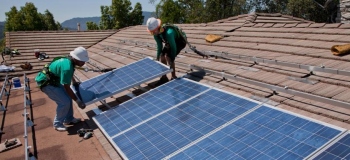
In the constantly evolving world of renewable energy target-setting, the Indian government has set a new objective for rooftop solar power. The aim is to install solar panels in over 10 million low-and middle-income households to promote its rooftop mission.
The official name of this initiative is the Pradhan Mantri Suryodaya Yojana (PMSY). On January 22, this year, the programme was announced by Prime Minister Narendra Modi and elaborated upon by Finance Minister Nirmala Sitharaman in her interim budget speech on February 1. It is the third attempt by the Modi administration in the past decade to promote rooftop solar (RTS).
The Pradhanmantri Suryodaya Yojana aims to install solar power systems on residential rooftops to provide electricity to households. This initiative also allows surplus electricity generated to be sold for extra income. Prime Minister Modi has emphasized that this initiative will reduce electricity expenses for the poor and middle class and contribute to India's self-reliance in the energy sector. The programme was initiated in 2014 to increase India's residential rooftop solar capacity by providing central financial assistance through the Ministry of New and Renewable Energy (MNRE) Guidelines and incentives to distribution companies (DISCOMs).
Sensible scheme (SUBHEAD)
The Pradhanmantri Suryodaya Yojana scheme is a strategic initiative to help India achieve its target of generating 50% of its total power capacity from renewable energy sources by 2030. This scheme is part of India's updated nationally determined contribution (NDC) as per the 2021 UN Climate Change Conference (COP26) in Glasgow. Currently, India's residential sector has installed only a fraction of its potential capacity of at least 637 GW for rooftop solar energy. The implementation of the Pradhanmantri Suryodaya Yojana is expected to speed up the adoption of solar energy, particularly in residential areas. This will significantly contribute to India's ambitious renewable energy targets.
India receives more than 2,000 hours of annual average solar radiation, surpassing the levels seen in countries like Germany and Japan. Several Indian states receive over 5 kWh/m² per day, including Rajasthan, Gujarat, Ladakh, and significant portions of Maharashtra, Madhya Pradesh, Andhra Pradesh, Telangana, and Karnataka. This vast, yet unexploited solar resource presents an opportunity for India to expand its solar power generation, particularly in a decentralized manner.
The large-scale implementation of rooftop solar systems in rural India presents a significant opportunity for green job creation, encompassing various sectors. It will lead to direct employment in the installation and maintenance of these systems, necessitating skilled labour such as technicians and engineers. Additionally, the growth of the domestic solar manufacturing industry will create jobs in production, supply chain, and logistics. There will also be an increased demand for professionals in sales, marketing, and customer service. Furthermore, the expansion of this sector will necessitate training and educational roles for imparting necessary skills, along with administrative and development positions for project management.
This initiative is expected to have a significant impact on reducing poverty, particularly in rural areas. It enables households to sell excess solar power, which provides a new and sustainable source of income. Additionally, this programme aligns with India's broader goals of becoming self-reliant in the energy sector. By reducing electricity bills for the poor and middle class, it also contributes to the economic empowerment of these groups. According to the interim budget, households will be able to obtain up to 300 free units, which can translate into annual savings of Rs 15,000-18,000. This is because households will also be able to sell electricity to others.
Distributed solar generation can aid electricity distribution companies (DISCOMs) in fulfilling their renewable purchase obligations. Enhancing economic incentives for DISCOMs to support rooftop solar deployment and encouraging innovative DISCOM-led business models are crucial steps towards this. Such measures can provide a win-win situation where DISCOMs can benefit from the adoption of rooftop solar in their operational areas, and consumers can access renewable energy sources.
Bumpy road ahead (subhead)
To achieve its goals, the new Suryodaya Yojana scheme must overcome several challenges that rooftop solar projects have faced since their inception. The Suryodaya Yojana is the fourth rooftop solar scheme to be announced since 2010 when the Jawaharlal Nehru National Solar Mission was launched. The second scheme came in 2015 to incentivize households and state power DISCOMs to install projects. In 2017, the government announced the Solar Transfiguration of India (SRISTI) scheme, which aimed to strengthen DISCOMs’ role as the nodal agency for implementing rooftop solar schemes by offering financial incentives.
Despite 13 years of policy support, the installed capacity of grid-connected rooftop solar is just 11 GW, with only 70,000 to 80,000 homes powered by solar energy. The deadline to achieve the 40-GW installed capacity target has been pushed from 2022 to 2026 due to several challenges, including a lack of awareness, high costs, poor availability of financing options, and DISCOMs’ reluctance to implement such projects. To be successful, therefore, the Suryodaya Yojana will have to work on convincing people of the benefits of rooftop solar, which would first require the demonstration of several successful projects. The cost to set up a rooftop solar plant can range from approx Rs 2.2 lakh to Rs 3.5 lakh, and the few available financing options are accessible only to the rich or upper-middle class.
It is observed that most Indian households consume less energy, which makes rooftop solar power generation challenging without substantial financial assistance. The reluctance of DISCOMs to provide funding for this initiative is also driven by the fear of revenue loss from high-value consumers due to the implementation of a net metering system. The Suryodaya Yojana is the first scheme to set a target for the number of households rather than the amount of electricity to be generated. While the target number seems ambitious, it is modest compared to the potential. As per a report by the independent think-tank Council on Energy, Environment and Water, over 250 million households across India have the potential to generate 637 GW of solar energy capacity on their rooftops.
To be sure, the government has now gained the institutional experience of implementing household infrastructure programmes for toilets, drinking water and cooking gas. However, bringing rooftop solar power to less affluent households might require addressing a new set of challenges.