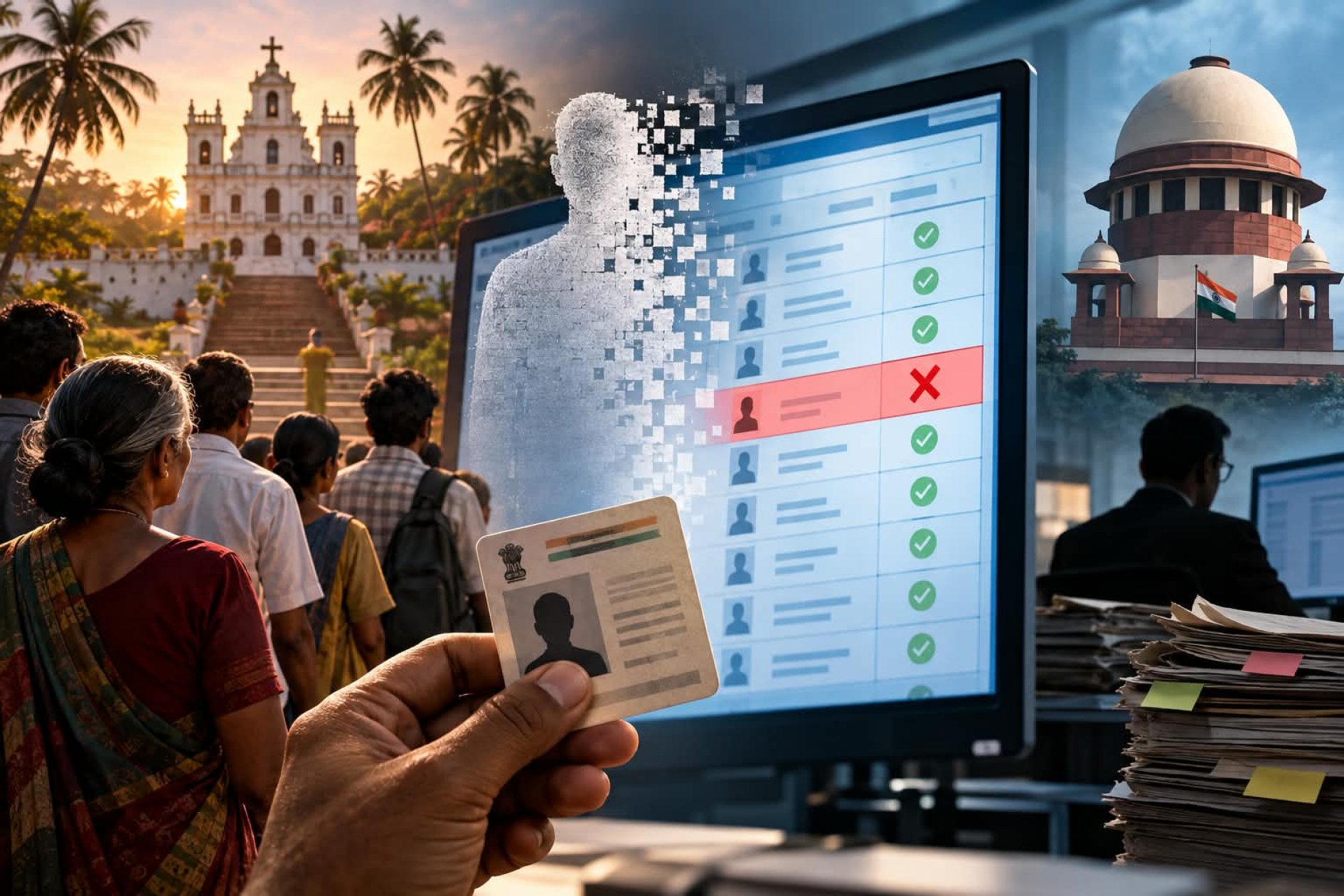
Democracy is celebrated through the ballot, but its first test occurs long before polling day: Whether a citizen's name appears on the electoral roll. A vote cannot be cast if the administrative machinery designed to facilitate its exercise fails to recognise the person entitled to cast it. Goa's recent electoral-roll controversy offers a disturbing illustration of this possibility, raising questions about technological control, constitutional responsibility and the limits of administrative accountability.
An investigation by The Indian Express reported that 97 voters, initially flagged during the Special Intensive Revision (SIR), were subsequently found eligible for inclusion by Electoral Registration Officers (EROs), yet remained absent from the final electoral roll. The controversy deserves attention not because every deletion is necessarily improper, but because the reported sequence exposes a fundamental question: What happens when an administrative decision cannot be implemented through the technology intended to give it effect?
When eligibility
meets software
Electoral-roll revision serves a legitimate public purpose. Deceased persons, duplicate registrations and individuals who no longer satisfy the applicable requirements must be addressed through prescribed procedures. Electoral accuracy, however, cannot be pursued at the expense of procedural fairness.
In the 97 reported cases, the relevant officers examined the discrepancies and determined that the voters were eligible for inclusion. The difficulty reportedly arose because the electoral software lacked the functionality necessary to reverse the earlier deletions.
Here lies the institutional paradox. An officer may possess the authority to determine eligibility, yet the practical effectiveness of that determination may depend upon a technical facility controlled elsewhere. The question is no longer simply whether a voter satisfies the law. It becomes whether the administrative system can translate that determination into an effective outcome.
Technology should facilitate the exercise of statutory authority, not become an obstacle to its implementation.
Eight emails
and a deadline
The chronology is particularly revealing. According to The Indian Express, the office of Goa's Chief Electoral Officer sent eight emails to the Election Commission of India between February 11 and 17 2026, seeking the functionality required to reverse the deletions. The matter was subsequently escalated. On February 18, Deputy Election Commissioner Gyanesh Bharti reportedly wrote to the Director General of IT, Seema Khanna, requesting that the necessary action be facilitated in accordance with relevant judicial directions and the electoral officers' decisions.
The final electoral roll was published on February 21, without the requested functionality having been enabled in time. The sequence raises questions that cannot be answered merely by describing the incident as a software problem. What technical limitation prevented the corrections? Who controlled the functionality required to implement them? What alternative procedure was available before publication? Why did the escalation fail to produce a timely solution?
The subsequent developments must also be acknowledged. On September 24–25 , the Goa Chief Electoral Officer's office reportedly stated that many of the 97 voters had since been enrolled, while the remaining cases were being processed. The cases were reportedly being addressed separately through house-to-house visits by Booth Level Officers and the submission of Form 6 applications.
This was an important corrective development. It would therefore be inaccurate to suggest that all 97 voters necessarily remain excluded today.
Beyond 97 names
The wider figures demand examination without inviting premature conclusions. Goa's final electoral roll, published on February 21, 2026, contained 10,57,566 voters, following a net reduction of approximately 1.27 lakh from the pre-revision electorate of 11,85,034. The reduction represented approximately 10.76 per cent of the earlier electorate.
Such a reduction does not, by itself, establish electoral wrongdoing. Legitimate deletions are necessary to maintain accurate rolls. The relevant questions concern the grounds recorded for deletion, the verification procedures followed, the distribution of exclusions and the effectiveness of the claims-and-objections process.
The 97 cases should therefore be treated as an investigative starting point, not as proof that every deletion was improper. A constituency-wise examination of the figures, supported by the reasons recorded and subsequent restoration data, would help establish whether the reported technical limitation was isolated or indicative of a broader administrative weakness.
Article 324 of the Constitution entrusts the Election Commission of India with the superintendence, direction and control of elections to Parliament and State Legislatures. Electoral-roll preparation and revision are governed by the Representation of the People Act, 1950, and the applicable rules.
The constitutional concern is whether the administrative arrangements adequately enable designated officials to discharge their statutory responsibilities.
Gyanesh Kumar, as Chief Election Commissioner, is a legitimate subject of institutional scrutiny. However, the available reporting does not establish that he personally ordered the deletions, caused the software limitation or deliberately prevented the restoration of the affected voters. Institutional accountability must not be confused with an unsupported allegation of personal misconduct.
The more substantial inquiry concerns the Election Commission's capacity to identify errors, implement lawful decisions, provide timely remedies and explain failures that affect electoral participation.
When democracy
must correct itself
Goa's experience also raises questions about the consequences of electoral exclusion beyond the ballot. The Indian Express reported that eligibility for the Goa Mediclaim Scheme, which provides assistance for specified super-speciality treatments, is linked to voter status in the state. The applicable scheme conditions and any actual denial of benefits arising from electoral-roll omissions must be independently verified before such consequences are asserted.
Nevertheless, the reported connection reinforces the importance of examining whether administrative errors can affect citizens beyond their immediate participation in elections.
The constitutional question arising in Goa is therefore not merely who deleted the names of 97 voters, but why the system could not implement the reported determinations of eligibility before the final roll was published, and whether the subsequent remedy was sufficiently prompt and effective.