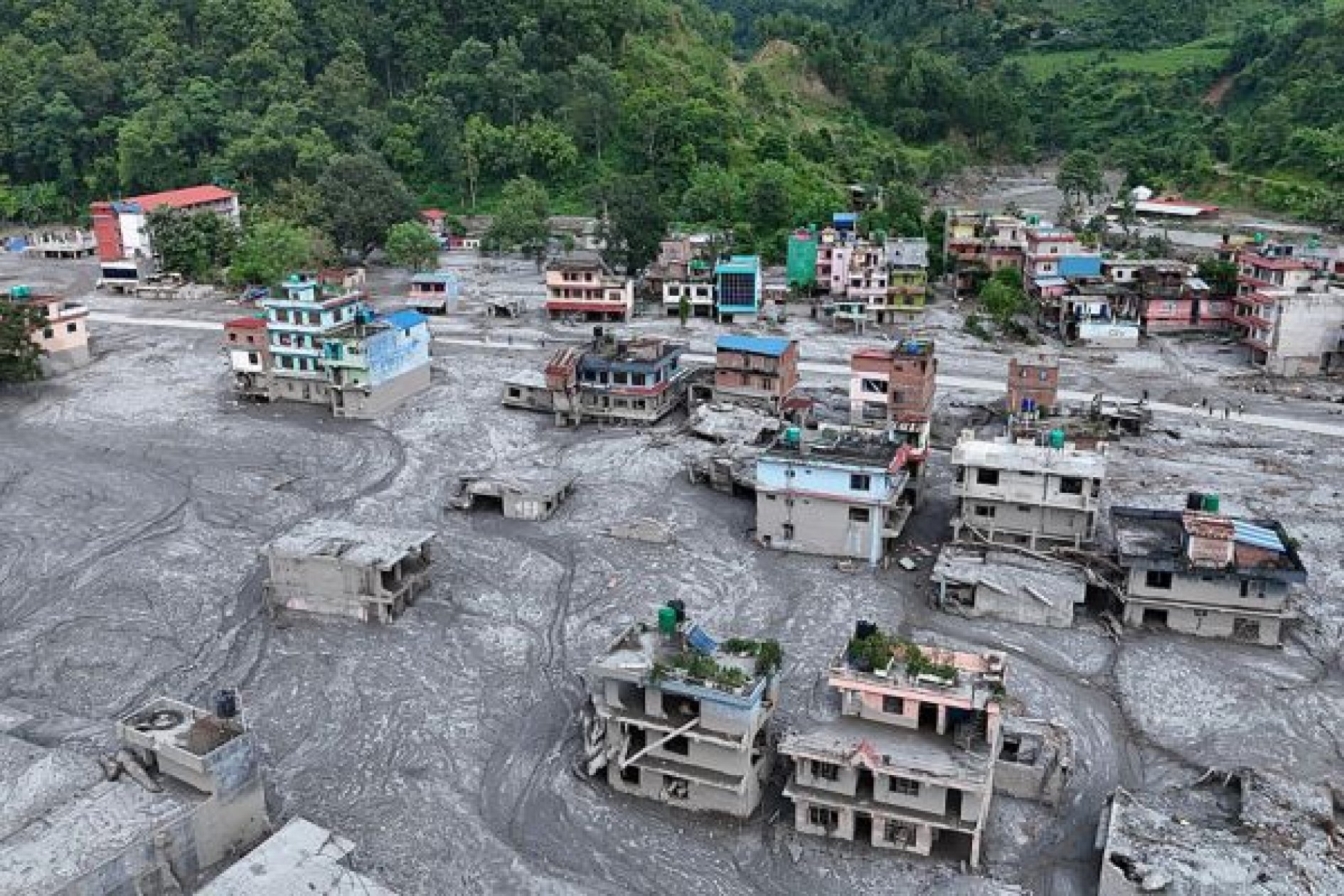
The images emerging from Nepal this past week have been devastating. Roads have disappeared beneath torrents of mud and water, bridges have been swept away and entire stretches of infrastructure have been damaged. Rescue teams are still searching for people missing after catastrophic flooding along Nepal’s border with Tibet.
The disaster began on August 26 after an ice-rock avalanche and glacier collapse in the Himalayan region triggered a huge surge of water and debris. The flooding struck communities and infrastructure on both sides of the Nepal–Tibet border. By Monday, August 31, the death toll across Nepal and Tibet had crossed 900, with thousands still unaccounted for. Rescue operations have been complicated by damaged roads, continuing bad weather and people believed to be trapped inside hydropower tunnels. India and China have both provided technical assistance to Nepal.
The floods have offered a dramatic reminder of why Tibet matters to global politics, and why its significance extends well beyond China's territorial boundaries.
Asia's water tower
Tibet's political importance begins with geography. The Tibetan Plateau is the world's highest and one of its most strategically consequential plateaus. It sits at the centre of Asia, adjacent to China, India, Nepal and Bhutan. More importantly, it is the source region of several major rivers that sustain hundreds of millions of people across South and Southeast Asia.
The Brahmaputra, known as the Yarlung Tsangpo in Tibet, begins its journey on the Tibetan Plateau before entering India and eventually flowing into Bangladesh. Other major river systems originating on or around the plateau include the Indus, Mekong and Salween. This makes Tibet much more than a remote mountainous region. It is effectively Asia's water tower.
For China, control over the plateau provides strategic depth along its southwestern frontier. For India, Tibet is inseparable from the security of the Himalayan border and the wider China–India relationship. For Nepal and Bhutan, developments north of the Himalayas have direct implications for their geography, economy and security. And increasingly, climate change is making this geography more consequential.
Glaciers are retreating and mountain environments are becoming more unstable. Sudden glacial collapses, landslides and glacial lake outburst floods can generate enormous volumes of water and debris with little warning. The recent disaster appears to have been triggered by a glacier collapse, with satellite imagery and expert analysis pointing to an ice-rock avalanche as the initial event. In other words, the Himalayas are becoming a place where climate change and geopolitics increasingly meet.
Water a geopolitical
question
The Nepal floods also raise a question that India cannot afford to ignore: Who has access to information about the rivers and glaciers upstream? This may sound like a technical question. It is actually a strategic one.
Nepal has renewed calls for greater cooperation with China on hydrological information and early-warning systems following the disaster. A news agency reported that Nepal had sought greater access to information concerning glacier movement, avalanches and other hazards upstream, while Chinese authorities maintain that they have shared relevant information promptly. The issue matters because in a Himalayan disaster, minutes can save lives.
A downstream country needs information about unusual river flows, glacial lakes, landslides and other hazards as early as possible. But the countries that control territory in the upper reaches of these river systems possess much of the relevant data. This is why water is becoming an increasingly important element of Asian geopolitics.
India's concern is particularly significant because the Brahmaputra crosses the Tibetan Plateau before entering Arunachal Pradesh. China's construction of hydropower infrastructure on the Yarlung Tsangpo has consequently generated considerable debate in India about downstream environmental and strategic risks. None of this means that every Chinese dam or every Himalayan flood should be interpreted as an act of geopolitical coercion. Natural disasters have natural causes, and hydropower is an important source of energy for developing economies.
But the strategic reality remains: The country that controls the upper reaches of a transboundary river possesses a significant informational and infrastructural advantage over downstream countries. That is why hydro-diplomacy will increasingly sit alongside traditional military diplomacy in Asia. The recent floods should encourage us to think differently about India's security. It is also about rivers, glaciers, data, infrastructure, climate and disaster preparedness.
A crisis in the Himalayas can affect India's northeastern states through flooding and water flows; it can affect national infrastructure and energy planning; and it can alter India's diplomatic calculations with both China and Nepal. The destruction of hydropower infrastructure in Nepal is particularly revealing. Nepal's enormous hydropower potential is central to its economic relationship with both India and China, yet the latest disaster has demonstrated the vulnerability of such infrastructure in a rapidly changing Himalayan environment.
A lesson for India
The response to Himalayan disasters cannot remain purely national. India, Nepal, Bhutan and China need stronger mechanisms for sharing hydrological data, glacier monitoring, satellite information and early warnings. The Himalayas are divided by political borders, but their rivers and climate systems are not.
The tragedy unfolding in Nepal should therefore prompt a larger conversation about Himalayan environmental diplomacy. The traditional geopolitical map of Asia shows borders, military positions and disputed territories. A more realistic map would also show glaciers, watersheds, rivers, dams, hydropower projects and vulnerable communities. On that map, Tibet occupies an extraordinary position.
It is a strategic frontier, a source of rivers, a centre of ecological change and an increasingly important arena of competition between Asia's major powers. The lesson from the Nepal floods is consequently larger than the disaster itself. Nature has once again demonstrated something that politics often forgets: Water does not recognise borders.
For India, that means Tibet cannot be treated as a distant geographical abstraction. What happens on the plateau can eventually flow downstream—to Nepal, India and Bangladesh, and into the wider politics of Asia. Hence, the “Roof of the World” may be remote, but its rivers, glaciers and geopolitics will surely shape the future of Asia.