Did you hear of the Byculla Mechanics? If you’re one of the Bomoicars (an expat Goan who lived, or lives, in Bombay, as Mumbai was then known), you probably did. Someone said recently: “We used to go to a lot of parties there.” The family running the prominent Goan-owned Bombay bakery, American Express in Bandra, recalled its early business connections with the Byculla Mechanics in a video interview.
On WhatsApp, another unusual video is doing the rounds. It depicted what Bollywood saw as a Western dance scene at the same venue. It’s a black-and-white film that showed a highly Westernised lot partying hard and dancing oddly, again at the Byculla Mechanics. Guess this dates back to Bollywood in the 1960s or even the 1950s. Once again, another video online prompted this columnist to wonder even more deeply about what this strange institution, with a quaint name, was all about.
A search in cyberspace tells us: “The Byculla Mechanics Institute was a prominent colonial-era educational and social hub in 19th-century Bombay (inspired by the British Mechanics’ Institutes movement). Built for the Great Indian Peninsula Railway (GIPR) community, it served as a technical training ground for engineers, drivers, industrial mechanics, as well as a community centre for social gatherings and lectures.”
But this YouTube video first whetted one’s curiosity. It is called ‘The Victorian Pivot: The Only Civilization That Solved Male Disengagement -- And How’. See https://www.youtube.com/watch?v=rfudfAayrAs
It argues that when Queen Victoria inherited the throne in 1837, the society she led got one thing right. It managed to rebuild the “male social contract” and involved men without compulsory legislation, funding or permissions.
This video goes on to say: “Every civilization before it failed. Rome legislated men into marriage and watched the population decline for two centuries. Sparta’s citizen count collapsed from 5,000 to 700. South Korea spent $200 billion on incentives and reached a fertility rate of 0.72. Victorian Britain is the single exception.”
As you know, the thing with online information is that you can never take it for granted. Some information is just fanciful, incorrect and badly collated. Not that others, including the media, don’t make mistakes. Not everything we find on the internet is false, but so much of it is presented without adequate evidence, context or intellectual rigour. Arguments are often poorly constructed. Selective facts are assembled to support predetermined conclusions rather than to discover the truth.
Correlation is mistaken for causation, sequence is presented as proof of cause and effect, and complex issues are reduced to simplistic explanations that ignore alternative possibilities. Sometimes facts are cherry-picked, exaggerated or stripped of context; at other times, they are simply misrepresented.
Headlines can be sensational. Repetition across multiple websites can make it seem like independent confirmation, even if all are drawing from the same dubious source.
But there is indeed something here....
The video argues that Victorian Britain’s working-class men led dull lives dominated by machines, losing their creativity. To restore their sense of worth, they established friendly societies, over 700 mechanics’ institutes, building societies, cooperatives and temperance halls, which encouraged male bonding beyond pubs and towards constructive causes. These networks shifted men’s self-perception from “a problem to be managed” to “an asset to be invested in”, giving them shared interests, responsibility and social recognition. Society reportedly benefited: marriage rates rose, illegitimacy fell from 7% to 4%, and working men became productive without state funding.
This takes us to an attempt to understand the Byculla Mechanics, its changing role over the decades, and what inspired it in the first place. Apparently, the Byculla Mechanics Institute (historically associated with the Great Indian Peninsula Railway, or GIPR, community in colonial Bombay) was directly inspired by and modelled after the British Mechanics’ Institutes movement. Originally, such institutes were founded in Britain during the early 19th century. Their goal was to provide technical education, lectures and social libraries to working-class industrial labourers and supervisors. The concept was exported across the then so-called British Empire.
Byculla had emerged as a massive railway, engineering and textile hub after the launch of India’s first passenger train in 1853. There, the institute functioned as a vital cultural and educational centre where railway drivers, engineers and mechanics could study technical skills and gather for community social dances and entertainment.
If this is accurate, it tells us about different understandings of society, the role the genders play, and how humans strive to find meaning in life. While gender studies have focused on the issues facing women in society—and this is much needed too—overlooking the other half of society doesn’t make much sense.
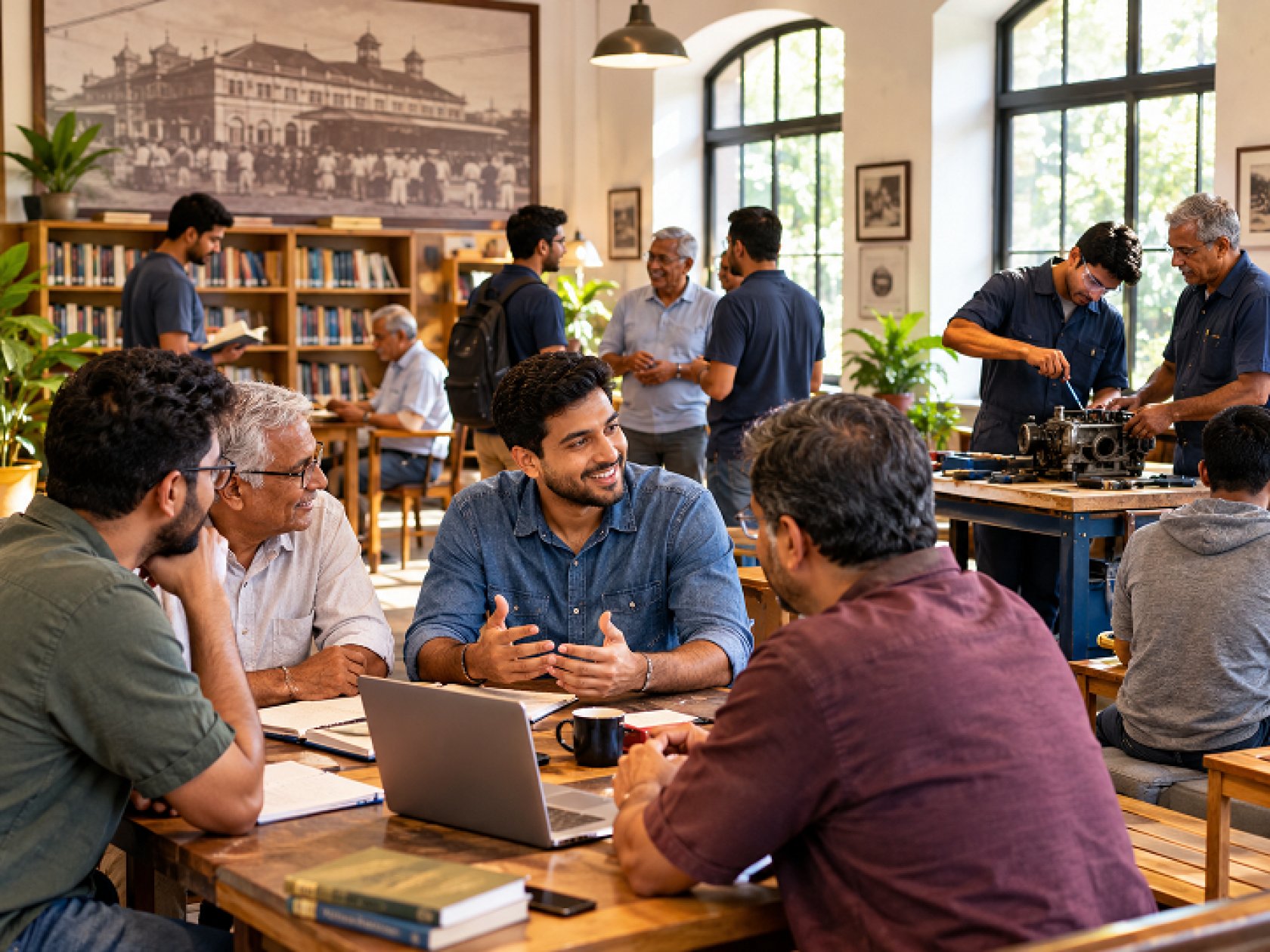
The lesson of Britain’s nineteenth-century Mechanics’ Institutes, and of institutions such as the Byculla Mechanics’, is that men undergoing economic and social change need more than just jobs. They also need places where they can learn, share practical skills, pursue intellectual interests, build friendships and feel useful to a wider community.
The British movement also created libraries (search YouTube for some studies on this aspect too), lecture halls, classes and opportunities for self-improvement. This came at a time when industrialisation was transforming traditional male roles. It is credited with having turned individual insecurity into collective learning, civic participation and purposeful association.
Today’s equivalent should be to build an inclusive network. At these places, men could develop new skills, mentor younger people, discuss work, relationships, fatherhood, ageing and social change. They could also undertake community projects and form friendships beyond the workplace or family.
Maybe it could combine practical workshops, reading groups, talks, volunteering, peer support and intergenerational exchanges. What is needed are low membership costs and a welcoming atmosphere for men from different educational and economic backgrounds. Men are more likely to find a relevant place in a changing society. They can find meaningful ways to contribute, keep learning and belong, rather than being simply told to adapt on their own. Maybe it is worth giving it a thought?