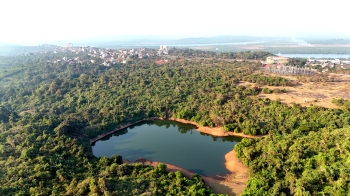
 An aerial view of Toyyar Lake in Chimbel, a wetland at the centre of opposition to the proposed Unity Mall project. Captured by : Narayan Pissurlenkar
PANAJI
Chimbel, nestled on the outskirts of Panaji, has suddenly found itself at the epicentre of Goa’s political and development debate with the government’s ambitious plans to build a Unity Mall and a towering Prashashan Stambh colliding head-on with the villagers’ determination to protect their land, their lake, and their way of life.
For months, the protests have simmered. Now, they are boiling over.
The villagers ” led mostly by members of the Scheduled Tribe (ST) community ”say the projects threaten to erase their heritage and devastate the fragile ecosystem and biodiversity around Toyyar Lake.
'This land is our identity'
At the heart of the resistance stands Govind Shirodkar, one of the lead protesters. His voice trembles with both anger and conviction each time he addresses crowds of protesters or the media in relation to the twin government projects in Chimbel village.
“This land is not just soil and water; it is our identity. The Toyyar Lake sustains our biodiversity, our livelihoods, and our traditions. We cannot allow concrete to replace these wetlands,” Shirodkar, who has also been part of the wider ST movement across the State, said.
The crowd roars in agreement, their placards painted with slogans like “Save Toyyar Lake” and “No Mall on Our Wetland.”
Chimbel panchayat’s stand
The Chimbel panchayat, too, has taken a firm stance. Sarpanch Sanjay Shirodkar minced no words: “I will always stand with the people of Chimbel. I am against the project. We rejected the proposal as soon as it was received,” Shirodkar said.
The panchayat and the villagers challenged the Block Development Officer’s order to issue a construction license, signalling that the resistance is not just emotional but institutional, as well.
Court quashes licences, permissions
The simmering conflict reached a decisive turning point in court this week when the Principal District and Sessions Judge delivered a landmark order quashing the construction permissions granted for the projects.
The legal battle had begun when villagers, led by members of the Scheduled Tribe (ST) community, challenged the Block Development Officer’s decision to issue a construction license despite the panchayat’s rejection.
According to Malissa Simoes, one of the counsels for the villagers, they argued that the projects violated environmental safeguards and highlighted procedural lapses, including the failure to consult the panchayat and disregard for ecological impact assessments.
The government defended the projects as symbols of progress, but the judge ruled that due process had been compromised. The verdict was met with jubilation in Chimbel, with Shirodkar terming it as a "victory for our land and our people” even as villagers celebrated outside the court building.
The ruling has not only halted construction but also boosted the protesting villagers' morale.
Govt's pitch for progress
The State government, meanwhile, insists the projects are vital in Goa’s quest for progress. At the very fulcrum of this government's conviction in favour of going ahead with the projects is Tourism Minister Rohan Khaunte, who argues that the Unity Mall will provide jobs.
"There are many people who want the project because they want to secure the livelihoods of their children. This project will provide that," Khaunte said. “Unity Mall is not just about infrastructure. It is about giving artisans and entrepreneurs a platform. We must balance development with sustainability, but we cannot afford to stall progress indefinitely,” the minister added.
However, as the protests intensified and Goa's political Opposition lent its strength to the villagers, even as the Goa legislative assembly carried on its business during the five-day winter session this week, Chief Minister Pramod Sawant tried to calm tempers with a dramatic late-night meeting with the protesters near the Merces Circle on Thursday night.
“The fate of the Unity Mall cannot be decided hastily. We will consult all stakeholders before moving forward,” he assured, asking villagers to give him time until Tuesday to convene a meeting with their leaders and MLAs.
The chief minister impressed upon the protesters that since the Unity Mall was a Central government project, he is not in a position to unilaterally decide on their demand to scrap it from Chimbel.
Sawant urged the protesting villagers to give him time to consult all stakeholders, including communicating with the Centre. Sawant’s words were measured, but the villagers continue to be wary and have decided to continue their chain hunger strike protest at the project's site.
Opposition weighs in
The protests and controversy surrounding the Unity Mall found a strong echo in the just-concluded winter session of the Goa Assembly, where Opposition MLAs staged a sit-in protest demanding that the project be scrapped from the present site as the Chimbel villagers are demanding.
“The government must not oppose any adverse judgment by the court against the Unity Mall project. The people of Chimbel have spoken, and their voice must be respected,” said RGP's lone MLA, Viresh Borkar.
Opposition leader Yuri Alemao accused the government of bulldozing grassroots concerns. “This administration listens only to contractors, not to citizens. Chimbel’s resistance is a wake-up call,” he said.
AAP's Benaulim MLA, Venzy Viegas, demanded an assurance from Sawant that the government will not challenge the District Court's order quashing the licences granted to Goa Tourism Development Corporation (GTDC) for the project.
Village divided?
Not everyone in Chimbel’s leadership is united. Panch Shankar Naik has openly supported the project, even circulating videos endorsing it. Villagers accuse him of sowing division between locals and migrants.
The split has deepened tensions, with some families, neighbours and acquaintances finding themselves on opposite sides of the debate.
Ecology vs concrete
The ecological argument is impossible to ignore. Toyyar Lake, a shimmering wetland, is home to migratory birds, fish species, and rare plants. It is nestled by the hill atop which the approximately 25,000 square metre site of the Unity Mall lies, and is just a 10-minute trek downhill away.
Environmentalists warn that large-scale construction could destroy bird habitats, pollute water sources and accelerate urban sprawl into this fragile ecosystem, which for the ST community is more than an ecological asset ” it is a cultural and spiritual landmark. Their rituals, festivals, and daily life revolve around this lake, several of the protesters told The Goan.
History repeating?
This is not Chimbel’s first battle. Nearly a decade ago, the government had proposed an IT Park on a larger tract of land at the same site. Khaunte, as Information Technology Minister then, was again that project's chief protagonist.
Villagers resisted it fiercely, staging sit-ins and marches, metamorphosing into a massive agitation forcing the then government to eventually shelve it. This "victory" achieved then has emboldened protesters today.
“We stopped the IT Park, and we will stop this too,” says Rupesh, a local who accompanied our team on a trek to the lake from the site where the villagers are carrying on with their chain hunger strike protest and have now completed three weeks.
What next?
The government has promised consultations, but villagers remain sceptical. “We have heard promises before. What we need is action -- scrap the projects and protect our wetlands," says Ajay Kholkar, another face of the villagers' agitation.
At the site where he is on a hunger strike alongside other villagers, Kholkar told The Goan: "The CM has now promised us his government will not challenge the court order quashing the licences. But they can always modify their paperwork and reapply. They are the government. They can do anything and bulldoze their way through legalities. But we will not give up this protest until the government categorically announces scrapping the project here on this site."
Opposition parties, meanwhile, are preparing to escalate the issue, and the next few weeks will determine whether Chimbel’s resistance once again reshapes Goa’s development trajectory.
The clash over Unity Mall and Prashashan Stambh is more than a dispute over infrastructure. It is a battle over identity, ecology, and the meaning of progress in modern Goa.
As the Chief Minister seeks to tackle this latest challenge before his government, he could find the task of negotiating the demands of Chimbel's villagers and finding a balance between development and grassroots concerns, one of the toughest tests of leadership he has faced since taking over stewardship of the State in 2019, following the demise of his predecessor Manohar Parrikar in 2019.