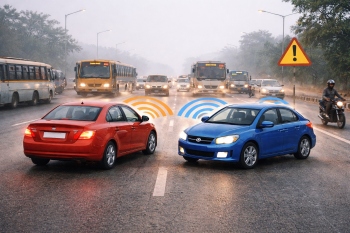
India may soon move toward a future where cars do not just move ” they talk.
The push comes from Union Transport Minister Nitin Gadkari, whose ministry is working on a plan to introduce vehicle-to-vehicle (V2V) communication as a standard safety feature in upcoming automobiles. The idea is straightforward: if vehicles can instantly exchange information, drivers can be warned earlier, react faster and potentially avoid crashes.
Picture driving through dense fog. Visibility drops to a few metres. Ahead, traffic slows suddenly. Today, you realise the danger only when brake lights flash in front of you. In a connected system, your car could receive that warning even before you see the obstruction.
Cars sending live updates
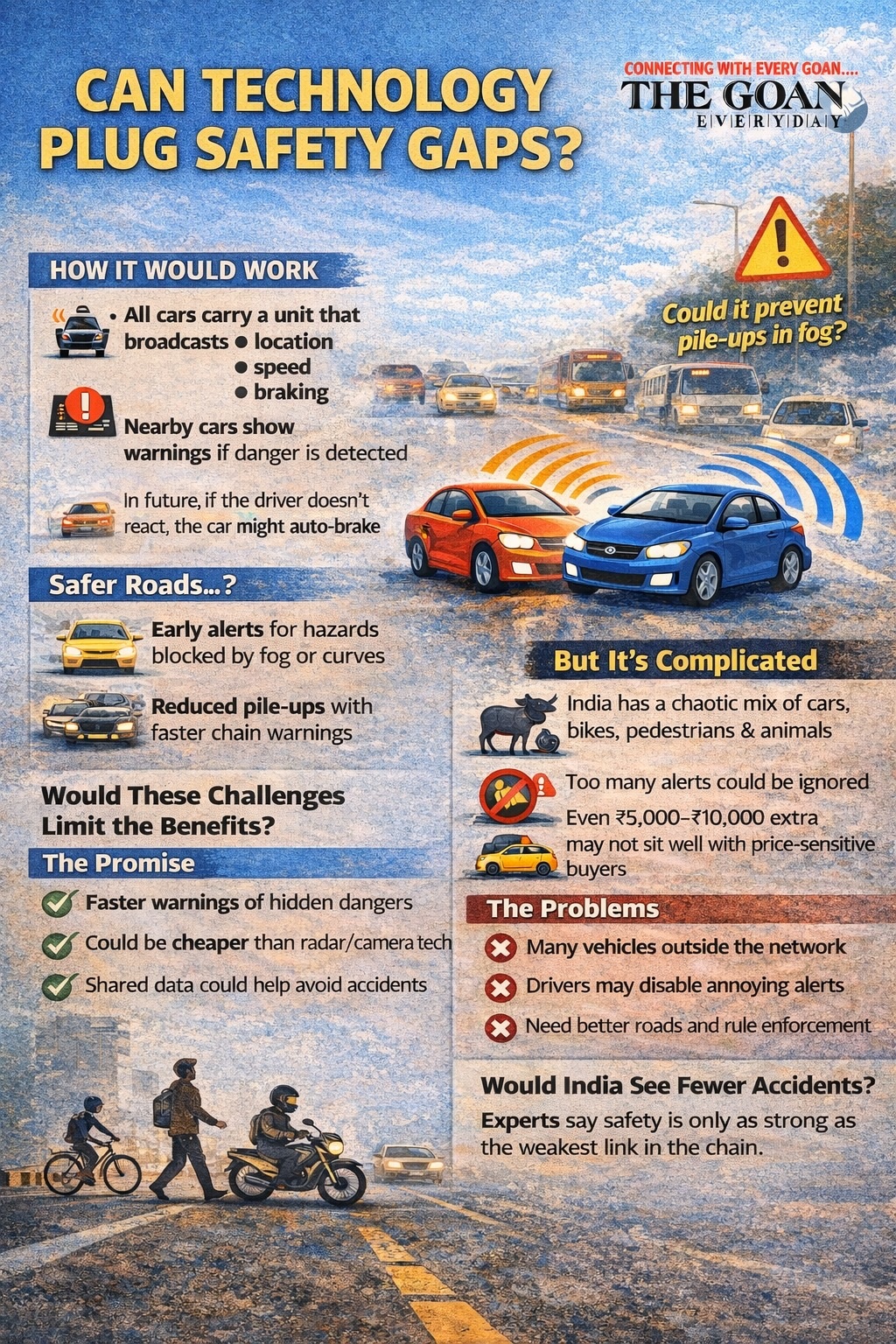
Under the proposal, vehicles would carry compact electronic units that continuously broadcast basic data ” location, speed and braking status. Nearby vehicles would receive these signals and assess potential risks in real time.
If a hazard is detected, the system could alert the driver through dashboard messages or sound warnings. In the future, once regulations and public trust evolve, the same network could trigger automatic braking if the driver fails to respond. Supporters argue that even a few seconds of advance notice can separate a close call from a fatal collision.
Unlike mobile internet-based systems, V2V communication would rely on short-range, direct signals between vehicles, reducing dependence on inconsistent telecom networks and ensuring faster response times.
Why the idea excites many
India records one of the highest numbers of road fatalities globally. Sudden braking, blind turns, stalled vehicles and chain collisions are common causes. A connected grid of vehicles could transmit warnings backward through traffic almost instantly ” like a digital whisper travelling at speed.
Since the hardware required is lighter and simpler than advanced sensor suites involving multiple cameras and radars, costs are expected to be comparatively moderate. Advocates believe this makes large-scale adoption feasible once production ramps up.
Where reality intrudes
However, challenges emerge outside controlled environments. Indian roads are shared not only by cars but also by motorcycles, pedestrians, buses, trucks and even stray animals. If many road users remain outside the communication network, the system’s effectiveness will be limited.
Human behaviour poses another hurdle. Drivers often disable features that produce frequent alerts. If warnings become excessive, they risk being ignored. An overlooked system offers little protection.
Cost sensitivity is another concern. In a price-conscious market, even modest increases can influence buying decisions. Carmakers worry that customers may hesitate to pay for benefits that are not immediately visible.
Beyond hardware
Policy questions also remain. Will transmitted data stay within vehicles, or be accessible to authorities? How will privacy be safeguarded? Can different brands communicate seamlessly? Clear standards are essential before implementation can begin at scale.
Perhaps the deeper question is whether technology can compensate for weak rule enforcement. Alerts may reach drivers, but they cannot prevent reckless behaviour by others.
Still, optimism persists. In low visibility or at blind junctions, early warnings could prevent major pile-ups. Over time, smart signals and roadside infrastructure might integrate into the system, strengthening safety.
Cars that speak may soon become common. Whether drivers listen ” and whether the broader traffic ecosystem adapts ” will determine how many lives this innovation ultimately saves.