PANAJI
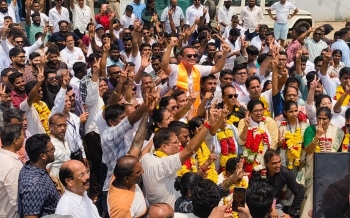
The Corporation of the City of Panaji (CCP) elections have once again reaffirmed the dominance of Revenue Minister and Panaji MLA Atanasio “Babush” Monserrate in the capital’s civic politics. His BJP-backed panel stormed to victory, winning 27 of the 30 wards, leaving the rival Ami Panjekar panel with just three seats.
The verdict, delivered on Friday after counting at the Shyama Prasad Mukherjee Stadium, was decisive. By noon, early trends had already pointed to a Babush sweep. The turnout stood at 69.07 per cent, slightly lower than the 2021 polls, but the result was emphatic: Panaji had once again placed its trust in Monserrate’s leadership.
Historic fifth win
This marks the fifth successive time Monserrate has steered his panel to victory and wrested control of the CCP since it was first formed in the early 2000s. In 2006 and 2011, he won majorities while serving as a Congress minister. In 2016, he repeated the feat as an unattached MLA. In 2021, his panel triumphed under the BJP’s Pramod Sawant government. And now, in 2026, Monserrate has made it five in a row, cementing his grip on Panaji’s civic body.
Chief Minister Pramod Sawant hailed the verdict as a vote for the “triple-engine” of governance. “The people have once again reposed faith in our commitment to Panaji’s development. We remain dedicated to good governance, progress, and public service,” Sawant said at the victory celebration held at the BJP State headquarters on Friday.
At this celebration, Monserrate himself was quick to thank the BJP for backing his leadership.
Oppn crushed
The rival Ami Panjekar panel, backed by Utpal Parrikar, managed only three seats. The most symbolic defeat came in Ward 9, where veteran councillor Surendra Furtado ” who had never lost a civic election since 1985 ” was beaten by Babush panel candidate Kabhir Makhija.
There was some consolation for the Furtado family and the rival Ami Panjekar panel, though. Leonido, who is Furtado’s younger son, won comfortably in Ward 7, and another notable candidate of the panel, Jack Ajit Sukhija, who is the grandson of Goa’s iconic political figure Dr Jack de Sequeira, won from Ward 17, albeit by a wafer-thin two-vote margin. The third winner of the Ami Panjekar panel was Liberta Mendes e Achari, who won from Ward 29 in the Ribandar area.
The contest in Ward 17 was particularly dramatic. Jack Sukhija edged out incumbent Edward Jorge of the Babush panel by just two votes after two recounts. Sukhija secured 343 votes to Jorge’s 341, underscoring the intensity of his battle even in an election that the other side swept.
Numbers behind the sweep
The highest tally was recorded by Tukaram Chinnannavar in Ward 11, who polled 713 votes and won by a margin of 457. At the other end of the spectrum, Independent candidate Shivdas Raikar in Ward 24 polled just 12 votes.
Recounts were held in three wards ” 10, 17, and 29 ” but the Babush panel’s dominance remained intact. With 27 seats under his control, Monserrate’s team is set to steer Panaji’s municipal affairs for another term, with his son Rohit tipped to return as mayor.
The mandate and message
Speaking in a televised interview after the results, Monserrate described the victory as a mandate for development.
“This is not just a win for me, it’s a win for the residents who have stood by us. The result shows that people trust us; they know we will deliver,” he said.
He dismissed criticism that the sweep was driven by political muscle and his influence as a minister over the delimitation and reservation of wards rather than civic issues.
Monserrate outlined his immediate priorities: tackling waste management, fixing drainage, and repairing roads.
“People are fed up with the garbage problem. We will fix it. Every monsoon Panaji suffers. We will make sure that doesn’t happen again. My vision is to make Panaji a model city,” he declared.
Transparency & accountability
The minister acknowledged that residents worry about transparency in civic projects.
“I agree, transparency is important. We will make sure every project is accounted for. People will know what is happening, how much is being spent, and when it will be completed. I want residents to feel confident that their money is being used properly,” he said.
He promised that every project would have clear timelines and budgets, with information shared publicly.
Criticism of leadership style
Monserrate brushed aside criticism that his style of politics is too dominant. “Opposition is welcome, but at the end of the day, the people want development. If we deliver, that’s what matters. I don’t silence anyone, but I won’t let negativity stop progress,” he said.
He insisted that his leadership is about responsibility, not centralisation.
“I consult with my team, with residents, and with stakeholders. But at the end of the day, someone has to take responsibility. People expect results, not endless discussions. I listen, but I also act. That’s leadership.”
Broader message
Monserrate said he believes the verdict carries a message beyond Panaji.
“It shows that people want leaders who solve problems, not leaders who fight for power. This is a message for all of Goa: focus on development, focus on the people, and you will earn their trust,” he said.
His role as Revenue Minister, he argued, strengthens his ability to push Panaji’s agenda. “Being in the Cabinet means I can coordinate directly with other departments. Panaji is the capital; it should set an example. I will make sure our city gets the attention it deserves,” he explained.
Challenges ahead
Despite the emphatic victory, Monserrate acknowledged that the biggest challenge is meeting public expectations.
“The people have given us this mandate; now we must deliver. Waste management, drainage, roads ” these are not small issues. But with proper planning and commitment, we can solve them. The challenge is big, but so is our responsibility,” he said.
He assured citizens that development would not mean burdening them with higher tariffs or hidden costs.
“Development should not mean burdening the people. We will manage resources properly. Transparency will ensure that people know where the money is coming from and how it is being spent,” he promised.
‘Mandate for progress’
For Panaji’s residents, the verdict cements Monserrate’s dominance in civic politics but also raises expectations for delivery. The city’s day-to-day living conditions ” from garbage collection and monsoon flooding to congestion from casino operations and excessive tourist inflow ” remain pressing concerns. “This victory is theirs. I assure them that we will work tirelessly to make Panaji a city they can be proud of. We will not let them down.”