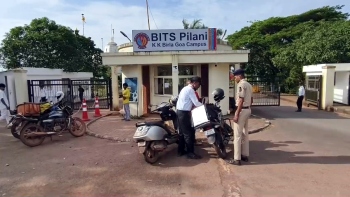
 Security checks have been tightened at the entry point of the BITS Pilani’s K K Birla Goa Campus at Sancoale.
VASCO
The corridors of BITS Pilani’s K K Birla Goa Campus in Sancoale no longer carry the same easy rhythm.
In the weeks following the death of 21-year-old student Rushi Nair ” suspected to have consumed a cocktail of narcotics ” the campus has undergone a sweeping and visible transformation, turning into one of the most tightly monitored educational spaces in the State.
Shift in discipline and oversight
At the centre of this overhaul is a decisive shift in how student discipline, particularly drug-related concerns, is being handled.
The institute has brought in a consultant of the rank of a retired Deputy Superintendent of Police, entrusting him with overseeing cases of indiscipline, with a clear focus on narcotics-related issues. The move signals a direct bridge between campus administration and law enforcement expertise, something rarely seen in academic institutions.
Surveillance has been scaled up dramatically. More than 700 CCTV cameras now cover hostel corridors, keeping a constant watch on movement within residential blocks. Entry points have been reinforced with a baggage screening system, ensuring that items entering the campus are no longer taken at face value.
No unchecked entry points
Every delivery ” from online parcels to food orders ” is now subject to scrutiny. Packages are checked by security personnel, and if required, opened on the spot in coordination with police. The intent is clear: eliminate every possible entry point for contraband.
Campus authorities say the approach is not purely punitive. The presence of experienced former police officers is also aimed at identifying cases where students may have been drawn into drug-related situations without intent. In such instances, efforts are being made to establish external links and coordinate with local police agencies to address the issue at its root.
Awareness alongside enforcement
Parallel to enforcement, awareness has become a key pillar. Regular sessions on drug abuse are being conducted in collaboration with Goa Police, the Narcotics Control Bureau and the Anti-Narcotics Cell, focusing on sensitising students about the risks and consequences of substance use.
Outside the campus, the police presence has intensified. Verna police have stationed additional personnel in the vicinity, with senior officers themselves maintaining late-night vigil. The layered security ” inside and outside ” has effectively created a controlled environment where movement and materials are both under watch.
The developments come against the backdrop of a wider crackdown across Mormugao taluka, triggered by the student’s death. Senior police officials had earlier conducted detailed inspections of the campus, studying entry and exit points and reviewing existing security mechanisms before the new measures were rolled out.
A clear message: Zero tolerance
For students, the change is unmistakable. What was once an open, relatively relaxed campus now operates under sharp oversight. But the message from both the institution and law enforcement is unambiguous ” zero tolerance for drugs, and no room for oversight where safety is concerned.
The tragedy has drawn a hard line, and BITS Pilani appears determined to ensure it is never crossed again.