RAJDEEP SARDESAI
Every time I walk down 18th June Road in Panaji, I am reminded that Goa is a place where history and the present coexist with unusual ease. The bustling street in the heart of the State capital is named after Goa Revolution Day, commemorating the events of June 18, 1946, that sparked a popular movement against colonial rule. Yet, as shoppers move between stores, tourists sip coffee at pavement cafes, and locals go about their daily lives, there is little sense of a society trapped by its past. Instead, Goa seems remarkably comfortable in the present.
Perhaps that is why Goa matters.
 Beyond the postcard
For most Indians, Goa is associated with beaches, holidays and a laid-back lifestyle. There is nothing wrong with that. Tourism is central to the State’s identity and economy. But reducing Goa to a postcard destination misses the larger point. Goa matters not because it is India’s favourite holiday destination, but because it offers a glimpse of what many Indians aspire to — a society that is prosperous without being frenzied, modern without being rootless and diverse without being divided.
In an India increasingly defined by speed, Goa moves to a different rhythm. The State is often caricatured as being relaxed to the point of indolence. Yet beneath that easy-going exterior lies something more valuable: a recognition that quality of life matters.
Goa has long understood that development cannot simply be measured through highways, skyscrapers or GDP numbers. It must also be measured through public spaces, environmental protection, cultural preservation and community life.
Concrete vs character
But there is another Goa that troubles me. Stand on the Panaji waterfront and your gaze is inevitably drawn to the giant casino vessels anchored on the Mandovi river. They dominate the skyline, glittering symbols of a particular model of development. One cannot help but ask: Is this how Goa wishes to define itself before the world? Every society has the right to choose its own economic path, and the casino industry undoubtedly generates revenue and employment. Yet there remains a legitimate question as to whether floating casinos should become the most visible image of a State whose true strengths lie elsewhere — in its natural beauty, its heritage, its culture and its unique way of life.
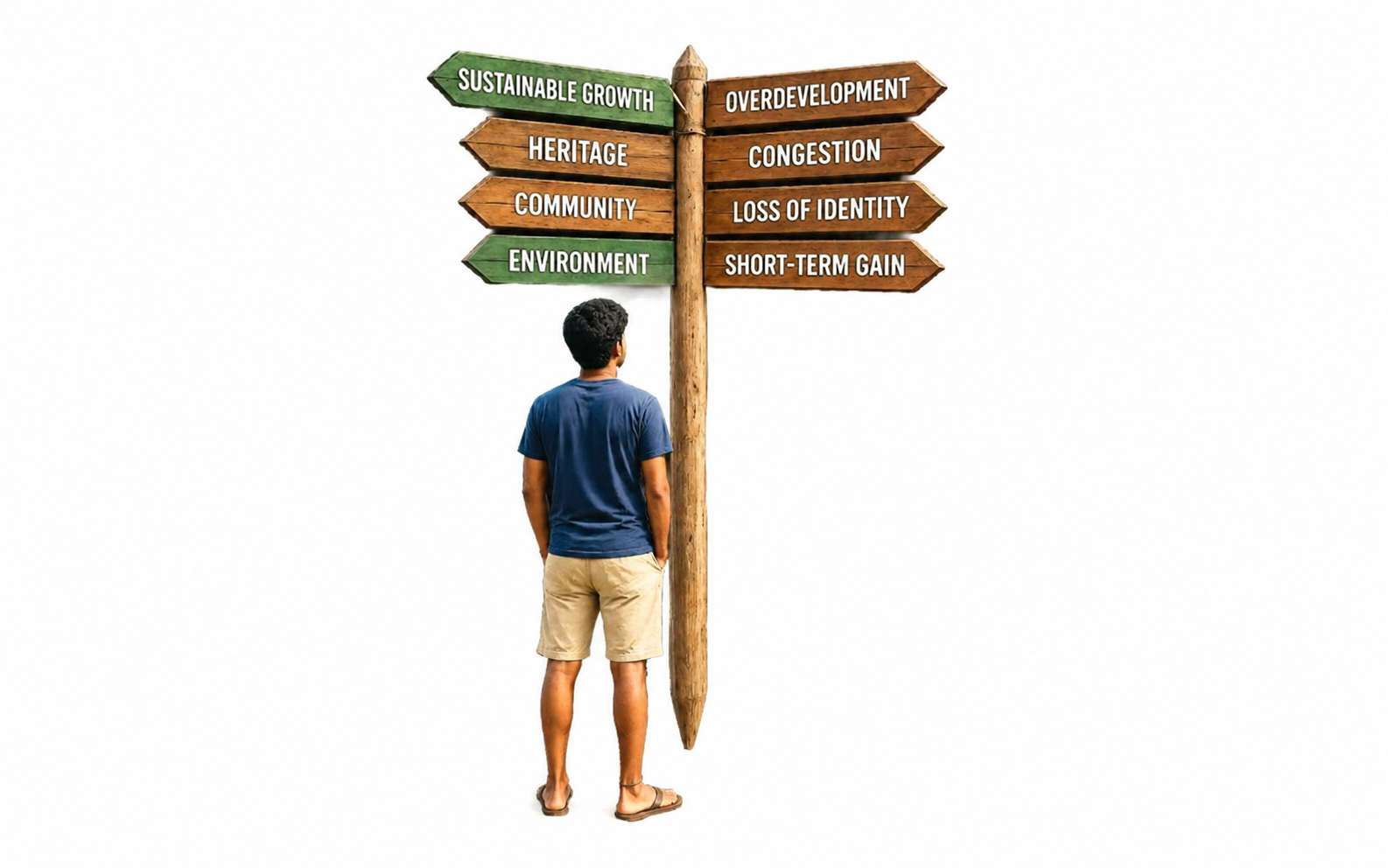
The casino debate is really about a larger challenge confronting Goa. How does the State grow without losing its soul?
That concern is reflected in what I call the “Delhification” of Goa. The very qualities that once made Goa special — its manageable scale, slower pace of life and intimate connection with nature — are increasingly under strain. Traffic congestion has worsened. Construction activity seems relentless. Real estate speculation is transforming villages into investment destinations. The pressures of mass tourism are visible everywhere. Goa cannot and should not be frozen in time. Development is necessary. Young people need jobs and opportunities. But there is a difference between development and overdevelopment.
Across India, cities are struggling with pollution, congestion and declining liveability. Goa still has an opportunity to avoid some of those mistakes. Yet that opportunity will not last forever. If every open space becomes a construction site and every waterfront a commercial zone, Goa risks becoming a smaller, more scenic version of the very urban sprawl from which many visitors seek refuge.
With elections now only months away, Goa’s politicians face a simple question: are they trustees of Goa’s future or merely managers of its assets? The State’s beaches, rivers, villages and heritage are not commodities to be traded for short-term political or commercial gain. Goa’s future cannot be sold to the highest bidder or mortgaged for instant gratification. Once lost, the character of Goa will be far harder to reclaim than any election victory.
The Goa exception
Goa also matters because it remains one of India’s most successful examples of cultural coexistence. Here is a State where different faiths, traditions and influences have mingled for centuries. Churches and temples stand within walking distance of one another. Local festivals often become community celebrations. The Goan identity has historically been broad enough to accommodate multiple affiliations without demanding rigid conformity.
In an era when public discourse often rewards polarisation, Goa’s social compact deserves closer attention. It is not perfect. No society is. But there is a moderation in Goa’s public culture that feels increasingly rare. Differences exist, yet they do not always have to become divisions.
There is another reason Goa matters. It is one of the few places in India that has managed to engage with the wider world without losing its local character. Tourism has brought the world to Goa’s doorstep. Generations of Goans have travelled abroad and built global connections. Yet despite these influences, Goa retains a strong sense of place. Its cuisine, music, language and traditions remain distinctive. It demonstrates that openness to the world and pride in local identity are not contradictory impulses.
Indeed, Goa’s greatest strength may be its confidence. Confident societies do not fear outside influences because they know who they are. Goa has often displayed that confidence better than many larger and more powerful States.
The defining choice
That is why a road named after a revolution remains relevant today. The spirit of any revolution is ultimately about creating a better future. The challenge before Goa is not whether it should modernise. It is whether it can modernise without becoming a smaller, more scenic version of Delhi.
As Goa marks another Revolution Day, perhaps the question is not what happened on June 18, 1946, but what kind of Goa its citizens want in 2046. A Goa defined by casino ships, unchecked construction and short-term commercial gain? Or a Goa that remains true to its heritage while embracing sustainable job-creating growth?
The answer matters not just to Goa, but to India. Because if Goa can show that development and liveability, modernity and heritage, openness and identity can coexist, it will offer a lesson for the rest of the country. And if Goa loses its soul, India will lose something precious too.
(The writer is a senior journalist and author)