TEAM AUTO I THE GOAN
Modern cars are becoming increasingly intelligent. They can warn drivers about obstacles, detect vehicles in blind spots, apply brakes when a
collision appears imminent and even assist with steering. Some can park themselves, monitor tyre pressure and alert drivers when they drift out of their lanes. Yet, despite all this technological progress, driving on Indian roads remains a challenge.
This raises an interesting question: while automobile manufacturers are investing heavily in making vehicles smarter and safer, are our roads keeping pace?
Technology takes the wheel
The modern automobile is no longer just a machine that takes us from one place to another. It is increasingly becoming a computer on wheels. Features that were once restricted to luxury vehicles are gradually finding their way into more affordable models.
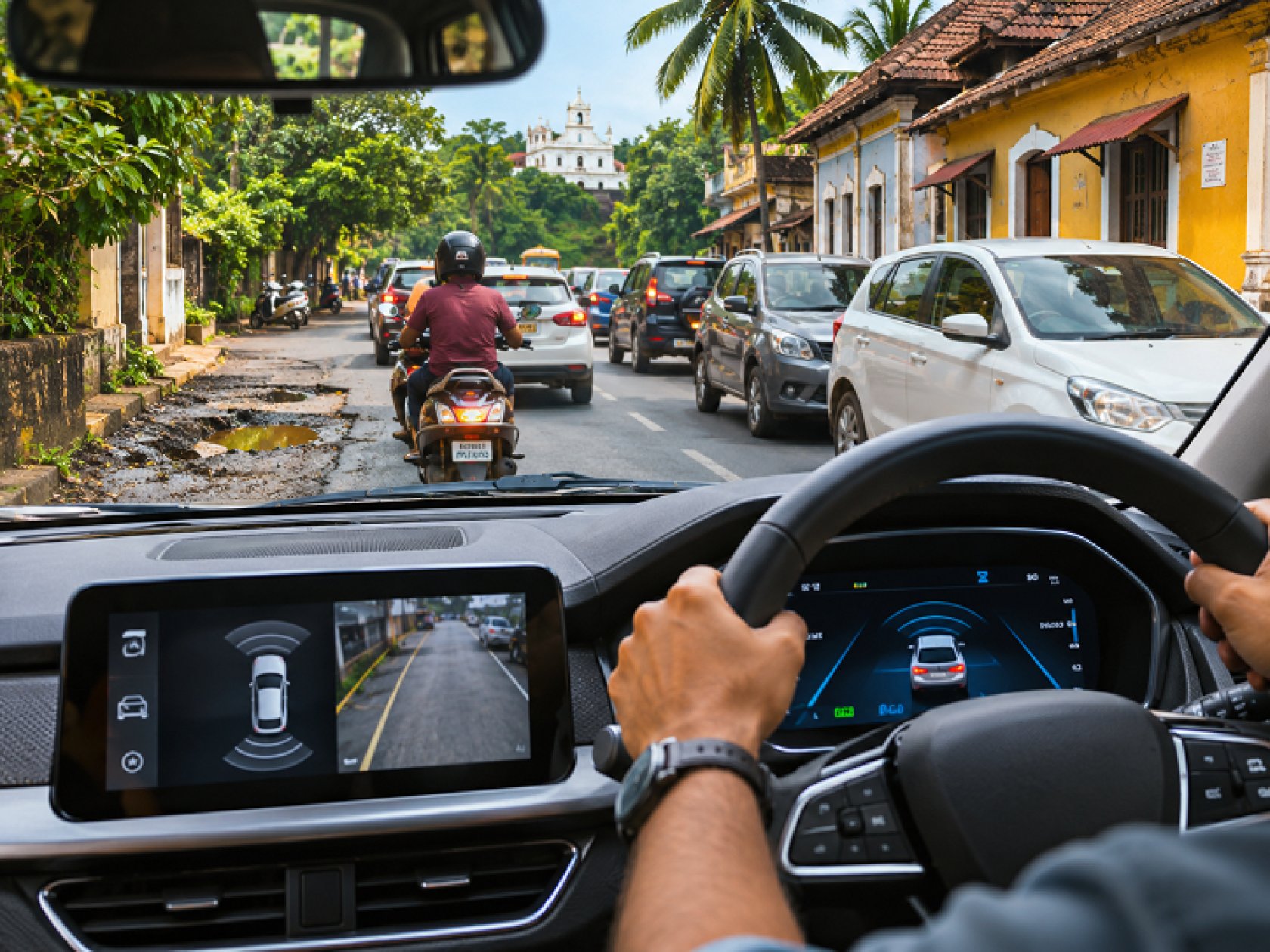
Advanced Driver Assistance Systems (ADAS) are among the biggest developments in this transformation. These systems use cameras, sensors and radar to help drivers identify potential dangers. Features such as automatic emergency braking, lane departure warnings, adaptive cruise control and blind-spot monitoring are designed to reduce the chances of accidents.
For instance, automatic emergency braking can apply the brakes if the system detects an impending collision and the driver fails to respond in time. Blind-spot monitoring can alert motorists about vehicles approaching from areas they may not easily see.
Such technologies can make driving safer, but they are not substitutes for attentive driving. The driver remains responsible for controlling the vehicle.
Indian road challenge
Here is where things become complicated. Many of these technologies work best when roads have clearly marked lanes, predictable traffic movement and well-maintained surfaces.
Indian roads, however, present a very different environment. Motorists frequently encounter two-wheelers squeezing through narrow gaps, pedestrians crossing unexpectedly, stray animals, sudden diversions and vehicles moving without following lane discipline.
A lane-keeping system, for example, relies on visible road markings to identify the correct lane. What happens when those markings are faded or missing? Similarly, sensors designed to detect obstacles may face difficulties when traffic is highly unpredictable.
This does not mean such technology is unsuitable for India. Instead, it highlights the importance of developing and testing these systems for actual Indian driving conditions.
Goa’s growing concerns
The issue becomes particularly relevant in Goa, where increasing vehicle numbers, limited road space and parking difficulties have made everyday driving increasingly demanding.
Panaji is a familiar example. Traffic congestion, inadequate parking and vehicles occupying already limited road space have made commuting difficult for residents. A recent report on the city’s mobility challenges highlighted how congestion has become a regular problem, with traffic restrictions and parking issues affecting several parts of the capital.
The situation is not limited to the state capital. Concerns have also been raised about damaged roads, inadequate pedestrian facilities and dangerous junctions along the route to the Peddem Sports Complex in Mapusa.
These are problems that no amount of automobile technology can independently solve.
A car may have sophisticated suspension systems, parking sensors and cameras, but it cannot compensate for a badly maintained road or the absence of a safe pedestrian footpath. A vehicle may warn its driver about an approaching obstacle, but it cannot create discipline among motorists sharing the road.
Safety is a shared responsibility
Automobile manufacturers certainly have a responsibility to make vehicles safer. Governments and road authorities must ensure that infrastructure meets basic safety requirements. Motorists, meanwhile, need to understand that technology is meant to assist them, not replace their judgement.
There is also a tendency among some buyers to treat a long list of safety features as a guarantee against accidents. This is a dangerous assumption. Even the most advanced braking system has limitations, and a reversing camera cannot replace checking mirrors and surroundings before moving a vehicle.
Basic habits such as maintaining a safe distance, following speed limits, using indicators, wearing seatbelts and avoiding distracted driving remain essential.
Looking beyond the vehicle
India’s automobile industry is moving towards a future where vehicles will become increasingly connected, automated and technologically advanced. The proposed introduction of mandatory automatic emergency braking requirements for new passenger car models from October 2030 is another indication of the direction in which vehicle safety regulations are heading.
However, technological advancement must go hand in hand with infrastructure development.
Better road surfaces, visible lane markings, functioning streetlights, properly designed junctions, pedestrian facilities and organised parking are equally important components of road safety.
Ultimately, a smarter car cannot fix an unplanned road network. Nor can advanced sensors compensate for irresponsible driving.
The future of mobility should not be measured only by how much technology is packed into a vehicle. It should also be measured by how safely and efficiently that vehicle can travel on the roads it is expected to use.
Perhaps it is time we stopped asking only how intelligent our cars are becoming and started asking whether our roads are becoming intelligent enough to accommodate them.