TEAM AUTO | THE GOAN
There is something almost irresistible about a new car brochure. More power. Bigger wheels. A larger touchscreen. Faster acceleration. A panoramic sunroof. The list of features seems endless, and manufacturers are understandably keen to tell us why each one is worth paying for.
But after spending enough time driving around Goa, I have come to a slightly different conclusion: some of the best features in a car are the ones that barely get mentioned.
Horsepower figures might make for good conversation, but how often do you actually use all those horses? Unless you regularly find yourself racing from Panaji to Margao, probably not very often. What you do use, sometimes several times a day, are the little conveniences that make living with a car easier.
Here are five that have gone from seeming like luxuries to features I genuinely appreciate.
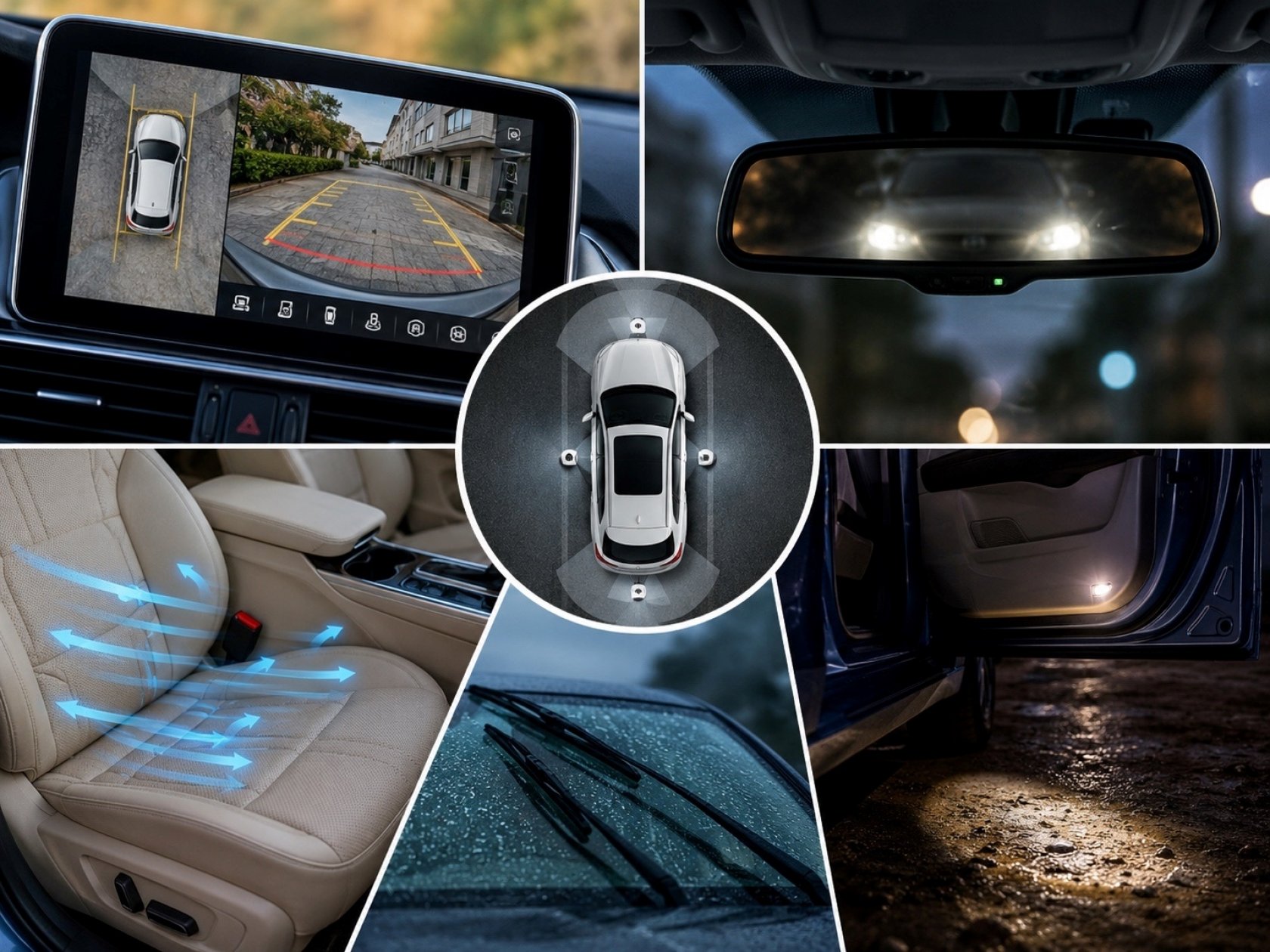
360-degree camera
The first is the 360-degree camera, and Goa is probably one of the best places to appreciate it.
A large SUV can be perfectly manageable on an open road, but the story changes when you have to squeeze it into a tight parking space or negotiate one of Goa's narrower roads. There are walls, pillars, parked scooters, low kerbs and the occasional obstacle that seems to appear from nowhere.
The 360-degree camera gives you a bird's-eye view of the car by combining images from cameras positioned around it. It is particularly useful when parking in cramped spaces, where judging the distance between your bumper and an obstacle from the driver's seat can be difficult.
It doesn't replace looking around properly. Cameras have blind spots and can distort distances. But as an additional pair of eyes, they are enormously useful.
And once you've had one, going back to a car without it can feel surprisingly inconvenient.
Door lights
Another feature I once considered little more than a styling flourish is the light mounted on or around the door that illuminates the ground when you open it.
It sounds trivial. Until you park somewhere dark.
Goa has plenty of places where the area immediately outside your car isn't particularly well lit. You might be parked beside a narrow road, on an uneven shoulder, near a muddy patch or simply under a tree where the street light doesn't quite reach.
At night, opening the door and immediately stepping out can become a small game of chance. Is that a puddle? A pothole? Mud? A kerb? Something else?
A ground or puddle light gives you a quick look at where your feet are going before you step out.
It is hardly a headline feature, but it is exactly the sort of thoughtful detail that makes a car feel better designed. And during the monsoon, when a perfectly dry-looking parking spot can turn out to be anything but, it becomes even more useful.
Auto-dimming rear-view mirror
Then there is the humble interior rear-view mirror.
For decades, it has done essentially the same job: showing you what is behind the car. But an auto-dimming internal rear-view mirror adds a small bit of technology that can make night driving considerably more comfortable.
Anyone who drives after dark knows the problem. You are cruising along and a vehicle behind you has headlights aimed directly into your mirror. You adjust the mirror, use the manual night setting or simply put up with the glare.
An auto-dimming mirror detects the bright light and automatically reduces the reflection.
This is especially welcome on roads where motorcycles and cars frequently approach from behind with bright LED headlights. Modern headlights can be extraordinarily powerful, and what is perfectly useful for the driver of the vehicle behind can be rather unpleasant for the person in front.
It is not a feature that makes for an exciting sales pitch. But after a long drive at night, your eyes will probably appreciate it more than another inch of touchscreen.
Rain-sensing wipers
Goa's rain has a personality of its own. One minute the windscreen is dry; the next, you are driving through a shower heavy enough to make you wonder whether someone has opened a tap above the road.
That makes rain-sensing wipers one of those features that can quickly become indispensable.
The system uses a sensor, generally mounted near the top of the windscreen, to detect moisture and adjust the wiper operation accordingly. Depending on the intensity of the rain, the wipers can operate intermittently or continuously and change their speed as conditions change.
Of course, manually operating wipers isn't exactly difficult. But the convenience becomes obvious when rain intensity keeps changing.
Instead of repeatedly reaching for the stalk, you can concentrate on the road.
There is also something reassuring about a feature that simply does its job in the background. You don't notice it when everything is working correctly. You only notice how useful it was when you drive a car without it.
Ventilated seats
Finally, we come to a feature that may be dismissed as a luxury but makes an enormous difference in a warm and humid climate: ventilated seats.
Leather or leatherette seats can become uncomfortable after a car has been sitting in the sun. Even with the air-conditioning running, your back can remain warm against the seat for quite some time.
Ventilated seats use small fans to draw air through perforations in the seat surface, helping to reduce that sweaty, sticky feeling.
In Goa's climate, this isn't merely about showing off a premium feature. It is about comfort.
It is particularly appreciated when you get into a car after it has been parked outside in the afternoon. Air-conditioning cools the cabin, but ventilated seats tackle a different problem: the heat trapped between you and the seat.
Again, it's not something you necessarily think about when buying a car. But once you've experienced it, you start wondering why every car doesn't have it.
What really matters
None of these features will win a drag race. They won't make a car faster, and most won't look particularly impressive in a television advertisement.
But buying a car is not about spending all your time admiring its specification sheet. It is about living with the vehicle.
In Goa, that means navigating narrow roads, squeezing into imperfect parking spaces, driving through sudden downpours, dealing with bright headlights at night and getting into a car that has been sitting in the tropical heat.
That is why the features I increasingly value are not necessarily the ones with the biggest numbers attached to them.
A 360-degree camera won't add horsepower. A puddle light won't make the car faster. A rain sensor won't improve its 0-100 km/h time. Ventilated seats won't make the engine more powerful.
But they can make the daily drive easier, safer and more comfortable.
And perhaps that's the real test of a car feature: not how impressive it sounds when the salesperson lists it, but how much you miss it when you don't have it.