TEAM AUTO | THE GOAN
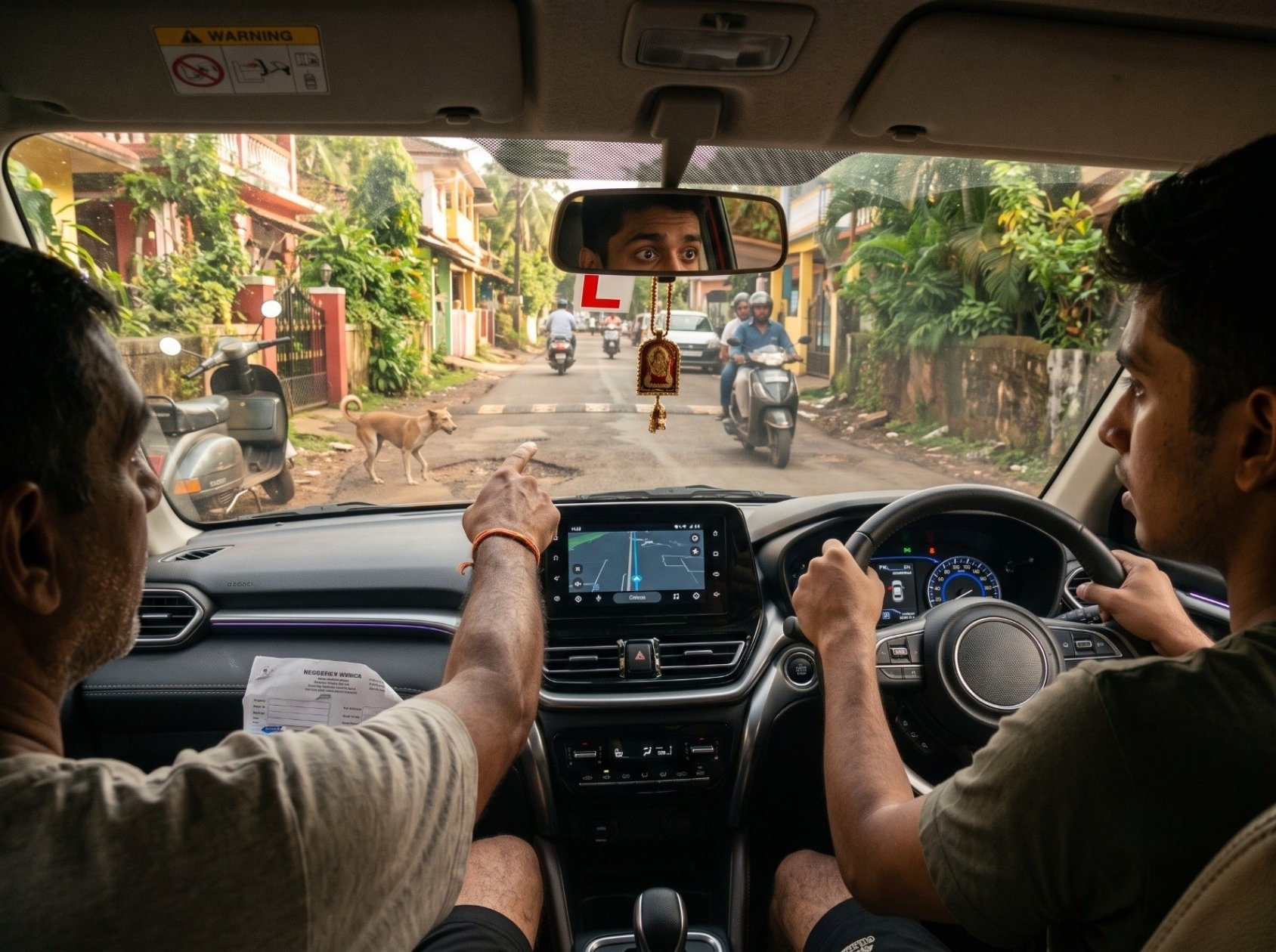
There's a particular kind of panic every new driver knows. You're crawling along at 20 kmph, feeling rather proud of yourself, when a stray dog wanders out from behind a parked scooter. Your brain screams "STOP," your foot slams the brake, and the car lurches to a halt like it's hit an invisible wall. Everyone in the car jerks forward. Your heart is doing something it shouldn't. Welcome to driving.
Nobody tells you this in the RTO test or the driving school's neat little circuit. The real lessons — the ones that actually shape how safely and cheaply you drive for the rest of your life — happen in your first two or three weeks on actual roads. And in Goa, where the roads throw in narrow lanes, sudden speed bumps, monsoon-cracked tarmac, and two-wheelers appearing from nowhere, that learning curve is steeper than most.
Here's the part that doesn't get talked about enough: that learning curve has a price tag.
The panic-brake tax
That sudden stop isn't just uncomfortable — it's expensive. Hard, late braking wears your brake pads and tyres faster than smooth, anticipatory braking. Do it often enough over a year, and you're looking at an earlier trip to the mechanic than you budgeted for. The fix isn't complicated: new drivers who consciously practice "cover braking" — resting a foot lightly near the pedal and easing off early — save themselves both the fright and the repair bill. It takes about two weeks of deliberate practice to build the habit. Nobody teaches this in class, but it's one of the cheapest financial habits you'll ever form.
The reverse-parking dent
Ask any insurance agent which claims come from first-year drivers, and reverse-parking dents top the list. It's not a driving-skill problem so much as a spatial-judgment problem — depth perception through a mirror or camera takes far longer to click than forward driving does. Each small scrape might feel minor, but claim it on your insurance and you lose your No-Claim Bonus (NCB), which can be worth 20–50% off your premium after a few claim-free years. A Rs 3,000 dent repair paid out of pocket is often far cheaper than the NCB you'll lose for the next several years. This is the single most overlooked money lesson for new drivers: sometimes paying for the small damage yourself is the financially smarter move.
The pothole gamble
Every Goan driver eventually learns to read the road ahead like a script — where the monsoon has eaten away the tarmac, where a speed bump appears without warning near a school. New drivers haven't built that internal map yet, and it shows up as either jarring wheel alignment issues or, worse, a blown tyre at the wrong time. A simple Rs 500 wheel alignment and balancing check every few months, especially post-monsoon, is one of those unglamorous expenses that quietly saves you from a much bigger one.
The zero-dep question nobody explains properly
If you're a new driver, or buying a car for one, this is the moment to seriously consider a "zero depreciation" add-on to your motor insurance. It costs more upfront — typically 20–30% extra on your premium — but during the accident-prone learning phase, it covers the full cost of parts without deducting for wear, which matters enormously when dents and scrapes are still a when, not an if.
The horn isn't rudeness, it's communication
This one's not financial, but it saves you from becoming a financial statistic. New drivers often go two ways — over-using the horn out of nervousness, or feeling too polite to use it at all. On Goan roads, where two-wheelers weave unpredictably and blind curves are common, a short tap of the horn before a bend is safety, not bad manners. Skipping it out of politeness is how minor scrapes turn into real accidents — and real accidents are the ones that actually hurt your wallet.
The real lesson
None of this shows up on the RTO syllabus, and none of it shows up on your insurance policy's fine print either. But every new driver pays this "learning tax" in some form — whether in brake pads, dents, alignment bills, or lost no-claim bonus. The only choice you actually have is whether you pay it knowingly, in small, manageable amounts, or unknowingly, in one large bill after an avoidable accident.
So if you know someone who just got their licence — or if that someone is you — the best gift isn't a fancy dashboard camera or a lucky charm for the rearview mirror. It's ten minutes explaining NCB, zero-dep cover, and why easing off the brake early is worth more than any driving school lesson ever taught.