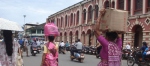
The Goan tries to find out if the trend is fading fast in modern times with a vehicle in every home and a supermarket in every town offering free home delivery
The day begins at six am for 66-year-old Rosalia Almeida andends 12 hours later. She and the other ‘bhadelis’ (female coolies), like herreach their usual spot in a busy lane at New Market in Margao by 8.30-9am.Throughout the day, the women sit in a group, waiting for customers who needtheir luggage or shopping carried, to their hotels, houses “ all this for aminimum of five rupees, which is the nominal rate for a reasonable distance. Themaximum they get paid per trip is Rs 20.
Not many know how the bhadelis came into this profession,but it was over 100 years ago, when the market in Old Goa, shifted to Margao,that the bhadelis were in demand, ferrying baggage and good to and fro and evenminding shops while the owners went home for lunch.
Though the custom bars an unmarried woman from embracingthis profession, Rosalia Almeida, now 66, seems an exception to this generalrule. Her mother Celestina was a ‘bhadeli’ and they were five siblings,including a mentally challenged younger sister and an alcoholic father.Initially Rosalia worked in the fields. When she had no work, she accompaniedher mother to the market to help her. “I became a ‘bhadeli’ when I was 25 andunmarried,” she says, explaining that she never got married because she had tocare for her mentally challenged sister.
Today, Rosalia lives all alone. All her other brothers andsisters are married, while the sister she cared for over the decades is no more.Being a ‘bhadeli’ is all she knows. “We never went to school. Nobody ever sentus. We use our ‘bot’ (thumb) for signatures,” says Almeida, holding out herthumb. “Many come and take our thumb impressions, our photos and documents, butfew return with any help or money.”
The bhadelis got Rs 25,000 from the previous government inthe form of aid. Rosalia paid her debts but needs more money to repair herancestral home, a broken hut near Nagesh Garden at Borda in Margao. Bhadelisdon’t earn much, from Rs 10 to 150 per day. For them, every day is a struggle,with the choice to walk home and save money to spend on food their only optionon most evenings.
Rosalia can afford only the cheapest rice available in themarket. In Rosalia’s case it is ‘balam’, a type of ‘ukdo tandool’ that is Rs 25a kilo. ‘Niste’ or ‘khare’ is a luxury, only if the day is good and earningsare well. Often, even a cup of tea sometimes is unaffordable. “The shopkeepersdo offer us work, but they pay Rs two or five, which is just not enough. Wecarry groceries on our head for Rs 20. Cupboards fetch us Rs 50 each for fourof us. But now we are too old to carry heavy objects,” she shares.
As the shops begin to close their shutters, it’s time forRosalia to walk home and cook the dinner before the night sets in. She is happythat she can take home some ‘tarle’ or ‘bangde’ today, as she has earned Rs 30extra by selling 20 home-grown guavas to a women vendor in the market.
Rosalia lives on carrying the burden life has offered her,with full faith in the almighty. “I go to the Church whenever I find time. I amwaiting for Him to call me,” she points upwards as she gets up to return home.