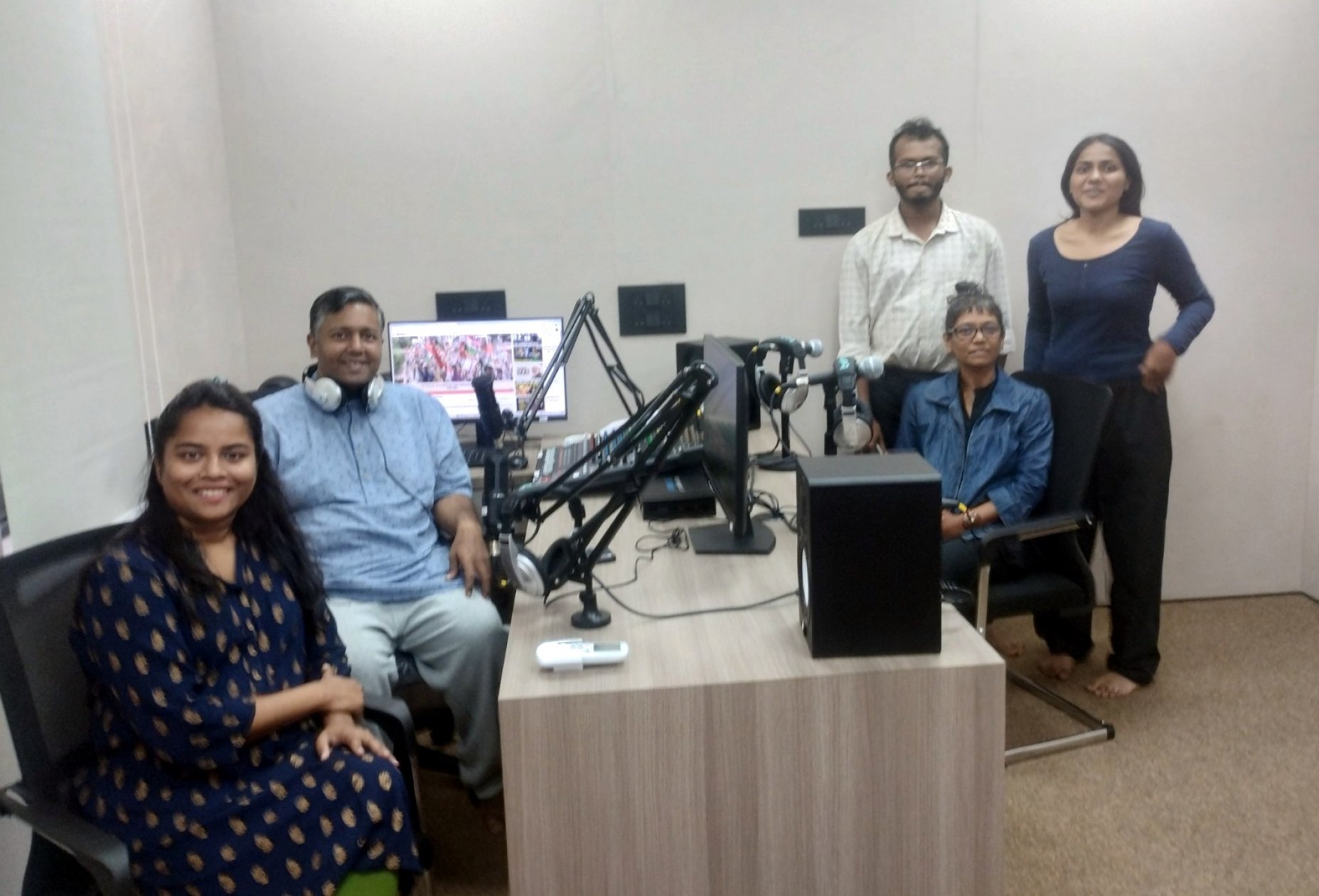
 PHOTO CAPTION: The Radio Mandovi team.
If you stay more than a dozen kilometres away from the North Goa village of Moira, you might not be aware of these sounds on the airwaves. Likewise, if you believe that radio is an old-fashioned and outdated form of communication, you may not care too much about it either.
Some weeks ago, this column looked at the arrival of Radio Mandovi, Goa's first community radio station, in the village surrounded by river(s). Since the media seldom gets commented on by the media itself, it might be worth taking another look at the station a few weeks after it launched into operation.
Around 5 p.m. each evening, it has become a habit to tune in to 88.4 MHz on the FM band. Radio has been a habit for our generation, since struggling to pick up broadcasts from SLBC (Sri Lanka), Radio Kuwait, Radio Australia, the BBC and the Voice of America in the 1970s. Even the more esoteric, and often hardly riveting, Cold War-era broadcasts from Radio Moscow, Radio Bucharest and East Germany's Radio Berlin International would tempt listeners with their 'merch' and other giveaways, which included 'No Neutron Bomb' badges, language-learning textbooks and accompanying record sets. Not to mention the digital broadcaster WorldSpace later.
Back to Goa, radio has played a huge role (though it is now forgotten) in the life of the region. Just the other day, the poet Tanya Mendonca described how she would walk down her Goan village in the past and hear the 'same song' being played on the radio in one home after another!
The late 'Yours Sincerely' Imelda Dias Tavora was a widely known radio announcer. Author Domnic Fernandes, of Anjuna, has described an entire day's radio programme from decades ago, starting with Suprabhat, a rather unpeppy way to get out of a drowsy morning.
Radio Mandovi, in its early days, is bringing back some of that charm to radio. Much now depends on (i) how well it can sustain itself (ii) whether it can reach out to the genuine stories of genuine people who make a real difference (iii) how well it taps into the community to stay relevant and constantly reinvent itself. Are radio clubs too old-fashioned?
Some positive signs here. Its tech-savvy founder, Ashwin Fernandes, was quick to get the station onto Spotify.com, the digital music and podcast streaming platform. That makes programmes listenable anytime, anywhere.
On content, Radio Mandovi appears to be doing a fair to good job. Sometimes, it outdoes itself.
Two things stand out: firstly, its long-form style of programmes, spanning 25-30 minutes. This gives a very wide introduction to any issue.
The other day, when I heard agricultural expert and my frenemy Miguel Braganza give advice to a local woman, Joseline D'Souza, about getting fields back into cultivation, it just blew my mind. It was like a half-hour crash course in horticulture.
It covered issues like government subsidies and how to access them, krishi cards, technology that can automatically water your fields even if you're not present, suitable crops for Goa, the best time for sowing, how to cope with a whimsical market, and more.
What was even more surprising was when I caught myself listening to Ayesha Pathan speaking about acupuncture and someone talking about detecting depression in those near us. I didn't have even a clue that I would be interested in such subjects, but I was really learning something. Valonia Marian Medeira e Miranda has a calm and confident tone in the useful information she imparts too. There are many others. 5C Children's stories (Satish D'Sa and Bookworm), handicrafts, interviews with students, Yogita Mehra visiting gardens... all tell us stories in audio that other media would be hard-pressed to compete with.
R. Mandovi does a good job of highlighting Goa's diversity too, with a slight (and understandable) stress on its backyard of Moira, Aldona and Nachinola. It doesn't leave out the bamboo craftsperson talking about the changing challenges they face.
The focus on women entrepreneurs also gives us a hint of how articulate and focused this (often neglected) section of Goa can be. A young filmmaker, Tanisha Pawar, was very clear about her goals in documentary filmmaking.
The other thing that really struck me about this community radio station was the way it shifted from one language to another without even batting an eyelid.
Official radio in Goa has been struggling to cope with the diversity of languages in Goa and competing claims over them. Radio Mandovi does it as we hear it on the street. One minute it's talking in English, and the next in Konkani. Or even in those dialects from hinterland Goa which sound very close to Marathi. It does so without any problem either.
The mix of voices on the station is also noteworthy. Cutting across religion, dialect, class, background, familiarity with English (or lack of it) and diverse regions of Goa can be a challenge. But R. Mandovi is doing well here.
The staff is a mix of youth (mostly) and experience. Initiatives like this could really build skills and talents, which can then surely go on to greater things, not that such initiatives are not path-breaking in their own way.
Sustainability, and finding ways of achieving it, is perhaps the main challenge as of now. Radio Mandovi, an initiative of the PACT Foundation, gives a hint of how returning expat Goans can plough back their skills (the content lead is Cordelia Francis, a journalist who returned from Kenya not long ago) and some resources too, in a way that benefits Goa.
Lastly, from junior senior citizens like this columnist, a request for some oldies in the form of music. (It is true that young people have been complaining that "Goan music tastes never change...") Also, give at least a few minutes to Goa's other languages, Marathi and even forgotten Portuguese, or even the languages of more recent migrants to Goa (Kannada, for one), with brief summaries in English or Konkani. Why not?