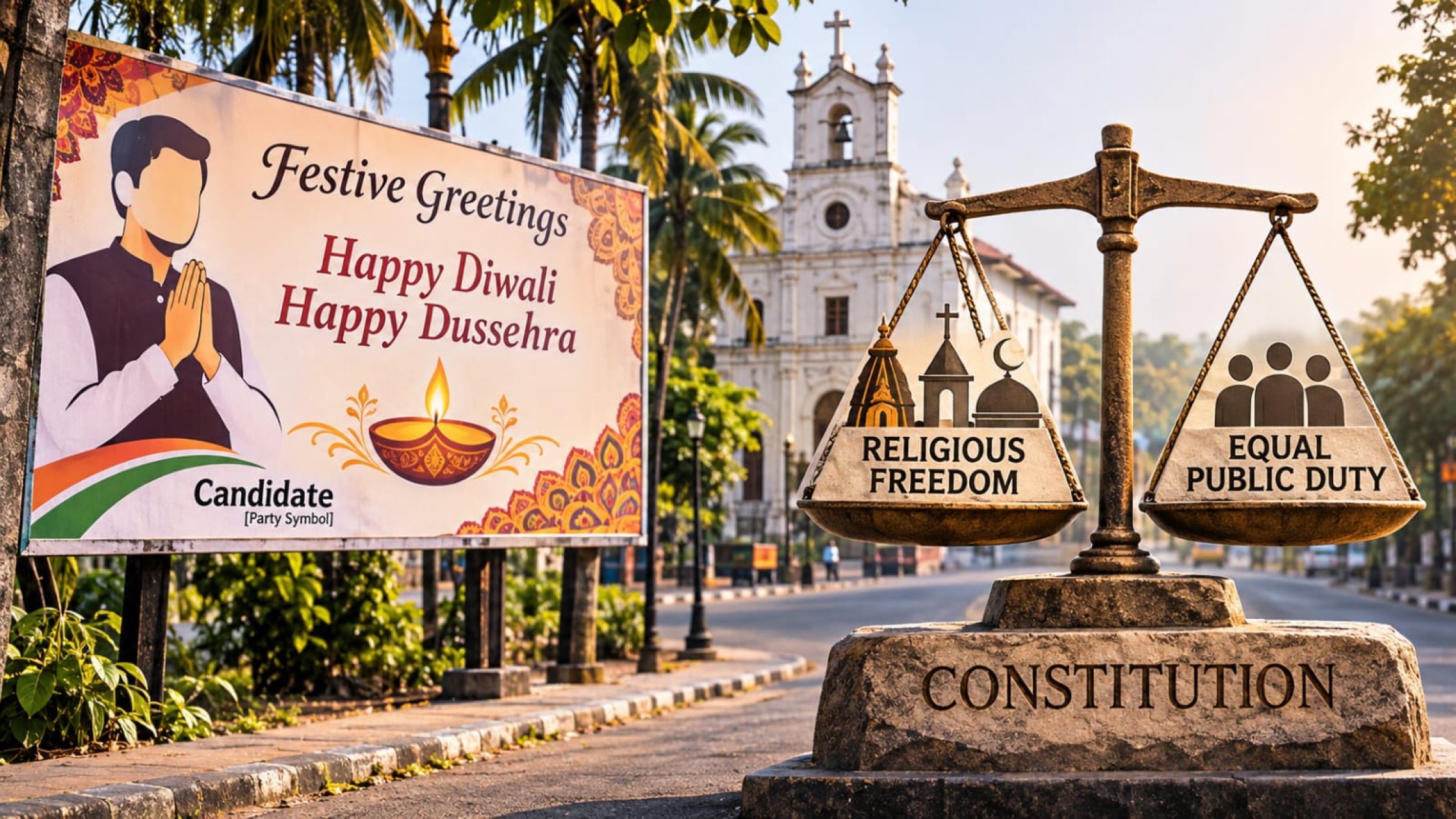
Recent journeys through North and South Goa have brought a recurring electoral feature into view. Candidates have displayed signboards at prominent locations, extending Diwali or Dussehra greetings alongside their names, photographs and party affiliations. The practice is not necessarily objectionable. A person belonging to one faith may sincerely share another community’s celebration. In a society shaped by cultural exchange, such participation may express goodwill rather than religious inconsistency.
Yet the combination of a religious occasion and political branding raises a question worth considering. When does a festive greeting remain an expression of fellowship, and when does it become a means of electoral positioning? The answer cannot be supplied by the signboard alone. Its wording, setting, timing and wider campaign context matter.
Secularism is not
religious isolation
The Constitution does not require a candidate to conceal personal faith or avoid the celebrations of another community. The Preamble promises liberty of belief, faith and worship, alongside equality and fraternity. Article 25 protects freedom of conscience and the right to profess, practise and propagate religion, subject to constitutional limitations. Articles 14 and 15 reinforce the requirements of equality and non-discrimination, while Article 16 addresses equality of opportunity in public employment. They protect religious freedom while requiring public institutions to act without favour or hostility towards any faith or denomination or community.
In SR Bommai v. Union of India (1994), the Supreme Court affirmed secularism as a basic feature of the Constitution. The judgment explained that the State cannot identify itself with, or favour a particular religion. The constitutional concern is therefore not whether a Christian candidate celebrates Diwali, or whether a Hindu candidate joins Christmas festivities. It is whether public authority is exercised impartially, without religious preference.
Symbolism of
the campaign
A festive greeting gains political significance when repeatedly presented with a candidate’s image, party identity and campaign message. This may communicate goodwill and visibility, or seek to reach voters when community participation is especially visible. Neither motive should be presumed without evidence.
The distinction is important in Goa, where interfaith participation is often part of ordinary social life. It would be wrong to portray a Roman Catholic candidate’s presence at Narak Chaturdashi, or a Hindu candidate’s attendance at Christmas celebrations, as evidence of weakened faith. Equally, it would be naïve to assume that every public gesture made during an election period is detached from political calculation. The proper subject of scrutiny is the use made of religious symbolism, not the private conscience of the person displaying it.
Boundaries set
by electoral law
The Representation of the People Act, 1951 places limits on the use of communal identity in election campaigns. Section 123(3) treats specified appeals for votes on grounds of religion, race, caste, community or language as corrupt practices. Section 123(3A) addresses the promotion of enmity or hatred between classes of citizens on those grounds for electoral advantage.
In Abhiram Singh v. CD Commachen (2017), the Supreme Court interpreted Section 123(3) to prohibit electoral appeals based on the religion, race, caste, community or language of the candidate, the elector or another person. The decision does not mean that every religious greeting, festival visit or party-branded signboard is unlawful. Whether the statutory threshold is crossed depends on the communication, its context and the evidence. A greeting should not be labelled a corrupt practice merely because it refers to a religious festival.
The more serious constitutional question arises after votes have been counted. An elected representative serves the entire constituency and participates in institutions exercising authority over all citizens. Public services, welfare measures, administrative attention and public expenditure cannot properly be distributed as rewards for support from one religious community. Nor may citizens who voted differently, or did not support the successful candidate, be treated as less deserving of public consideration.
The constitutional oath is not an undertaking to serve a religious congregation or a political voting bloc. It is an undertaking to discharge public responsibilities under the Constitution. A candidate may seek support from every community; no community’s support can create a superior claim over public resources or governmental attention.
Political loyalty and
constitutional consistency
Goa’s experience of changes in political affiliation and legislative defections has also made political accountability a matter of public concern. The Tenth Schedule provides a constitutional framework addressing specified forms of defection. But political defection and interfaith participation are different matters. Attendance at another community’s festival cannot establish a willingness to change political allegiance, just as observance of one’s own faith cannot establish constitutional impartiality.
The more useful test is consistency between campaign conduct and public duty. A candidate may display messages of goodwill across religious occasions. Once elected, the same commitment to equal regard must be reflected in decisions affecting every resident, irrespective of faith or electoral preference.
Goa’s shared festivities should not be weakened by suspicion of interfaith participation, which may express its plural social character. Yet religious occasions cannot substitute for an account of public service. The electorate is entitled to ask what a candidate proposes for the whole constituency, how resources will be administered and whether equal treatment will continue after the campaign.
The test of secular leadership is not the number of religious festivals attended, nor the identity of the communities whose greetings appear on roadside signboards. It is the absence of religious preference in the exercise of public authority. Political loyalty may be temporary; religious faith remains personal. Constitutional allegiance, however, is obligatory.