Dr Cheryl Venan Dias
Have you ever noticed that nature rarely follows a straight line? Rivers meander. Planets move in predictable orbits, yet never in rigid linear paths. Forests, roots, coastlines, and even the patterns of life itself thrive through complexity rather than symmetry. Why, then, are we so fixated on solutions that demand uniformity when many answers may already be hidden within traditional knowledge and nature's own designs? In our pursuit of progress, we often turn to technologies that require extensive mining, resource extraction, and energy-intensive manufacturing. We seek independence through renewable energy systems, yet may inadvertently create new dependencies on rare earth minerals, batteries, semiconductors, and other materials with high environmental costs.
This perspective may challenge some of the enthusiasm surrounding solar panels and off-grid energy systems. My intention is not to dismiss their value, but to encourage a broader discussion about their complete life cycle. What happens when these systems reach the end of their useful lives after ten, fifteen, or twenty years? More importantly, what legacy will we leave for the generations that follow? Solar energy has to be complemented with robust recycling infrastructure and responsible end-of-life planning that needs to develop alongside adoption.
What if we designed systems inspired by natural cycles, local materials, and regenerative principles that remain useful for generations rather than decades? The goal is not merely to install solar panels and celebrate energy independence. The goal is to think beyond our own lifetimes. The question is not what technology can do for us today, but whether the systems we create will remain an asset for our future generation rather than become a burden they must manage tomorrow.
It is often suggested that artificial intelligence may one day contribute to humanity's downfall. Yet perhaps a more uncomfortable question deserves attention: Are we overlooking the ways in which our own decisions, habits, and short-term thinking may already place us on a self-destructive path? Technology itself is seldom the problem. The greater challenge lies in how wisely we choose to use it. What I am about to share is not merely a long-term solution, but ancient, embedded traditional knowledge that our ancestors used long before the advent of electricity grids and piped water. It is a solution that abandoned the linear and embraced the curve. The use of parabolic mirrors to collect solar energy was researched by the French pioneer Augustine Mouchot.
Imagine, for a moment, how revolutionary and mind-bending this idea was in 1866: The first parabolic trough solar collector using concentrated solar power to generate steam. This concept had already gained traction in the late nineteenth century, long before solar panels, semiconductors, and lithium storage entered the conversation. Abel Pifre collaborated with Mouchot and further advanced these solar-powered systems, which were capable of operating printing presses and other machinery. One may wonder: If the system was so efficient, why did it not evolve further? There were two major bottlenecks. The first was the onset of war, which abruptly halted further research and development. The second was commercial viability. It did not create the type of recurring revenue streams that industries sought to build around. Instead of refining what was close to a self-sustaining system, research shifted towards technologies that relied on components that could be manufactured, sold, replaced, and monetised. This eventually gave rise to solar panels, which depend heavily on semiconductors, rare earth minerals, and battery storage.
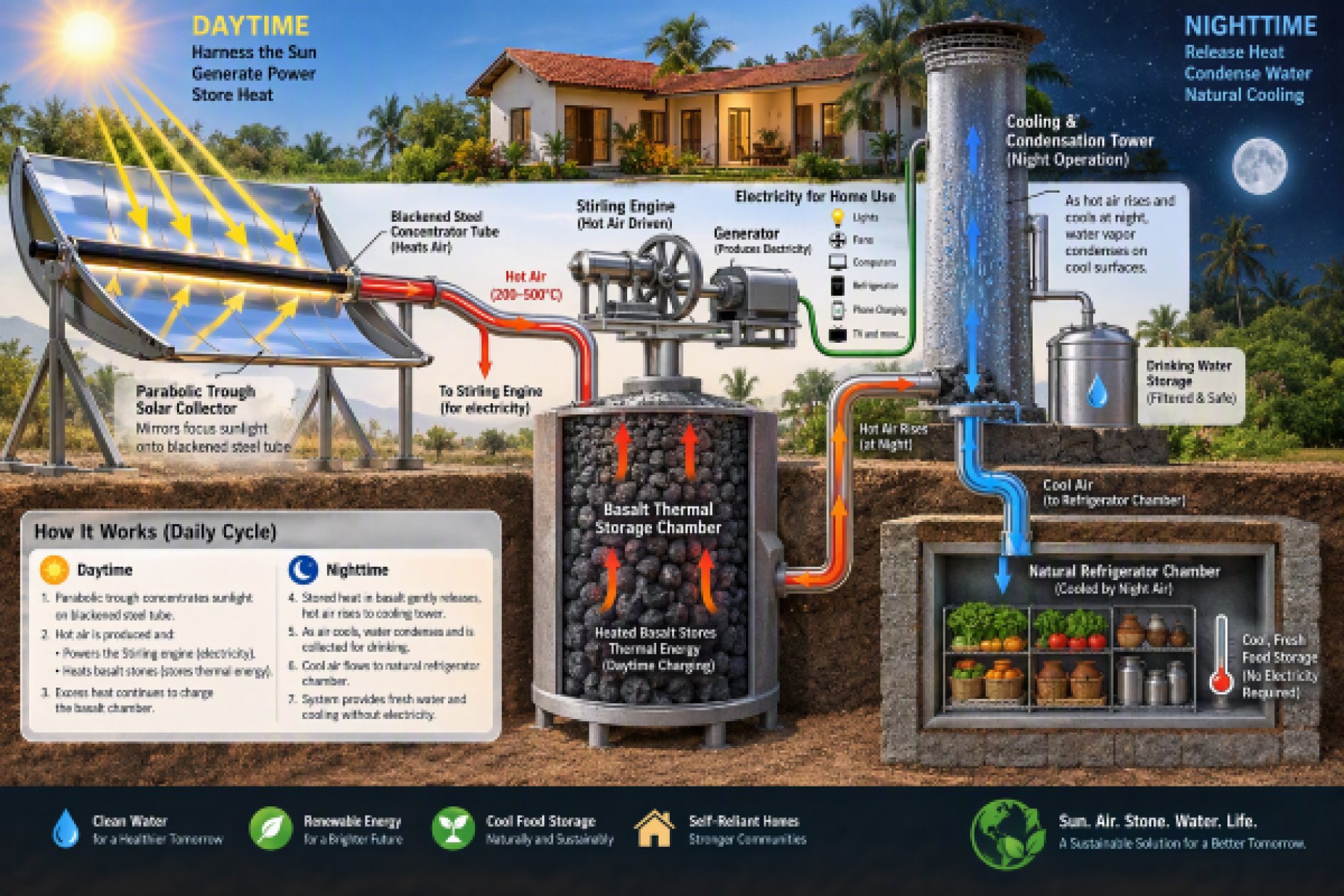
Would you believe that such a Parabolic Trough Solar Thermal System could provide heating for cooking, cool living spaces without an air conditioner, function as a natural refrigerator, deliver a continuous supply of potable water, and even power household appliances? Now that we understand a little of the history behind this form of energy and its utility, let us explore what is required to make it work efficiently within our homes. The system follows four fundamental steps: Energy concentration, generation, storage, and distribution.
The parabolic thermal system harnesses solar energy by concentrating sunlight onto a focal point. The blackened steel absorber tube, or solar concentrator, must be capable of withstanding extremely high temperatures. Hot air is perhaps the most elegant medium for this purpose, although oil, sand, and molten salts can also be considered. A parabolic trough concentrates sunlight onto a blackened steel absorber tube, directing heat to a basalt thermal storage chamber that functions as a thermal battery throughout the day. During daylight hours, a portion of the solar-heated air stream powers a Stirling engine coupled to a generator, producing electricity for household use. After sunset, thermal energy stored in basalt sustains airflow through a condensation tower, where humid air passes over radiatively cooled condenser surfaces, causing atmospheric moisture to condense and be collected as water. The upper section of the tower should incorporate a harvesting mesh and collection gutters allowing filtered water to be stored in an earthen cistern. The outcome is a regular supply of potable drinking water for a small family. Through thoughtful channelling, remaining cool air can be directed into living spaces to reduce indoor temperatures and can also be routed into a natural refrigeration chamber for food preservation. The illustration represents the overall concept and flow of energy rather than a validated engineering design.
Unfortunately, while exploring the availability of Stirling engines, most commercially available options were limited to demonstration or toy models. One possible workaround would be to collaborate with a precision engineering firm to design a custom engine suited to household energy requirements. Ideally, two generators should be considered: One powered by concentrated solar heat from the parabolic trough and another capable of operating on biogas. Such a hybrid arrangement would ensure a continuous supply of electricity even during prolonged rainy seasons. Ultimately, sustainable living is not about adopting more efficient technologies, but about designing systems that work in harmony with nature.