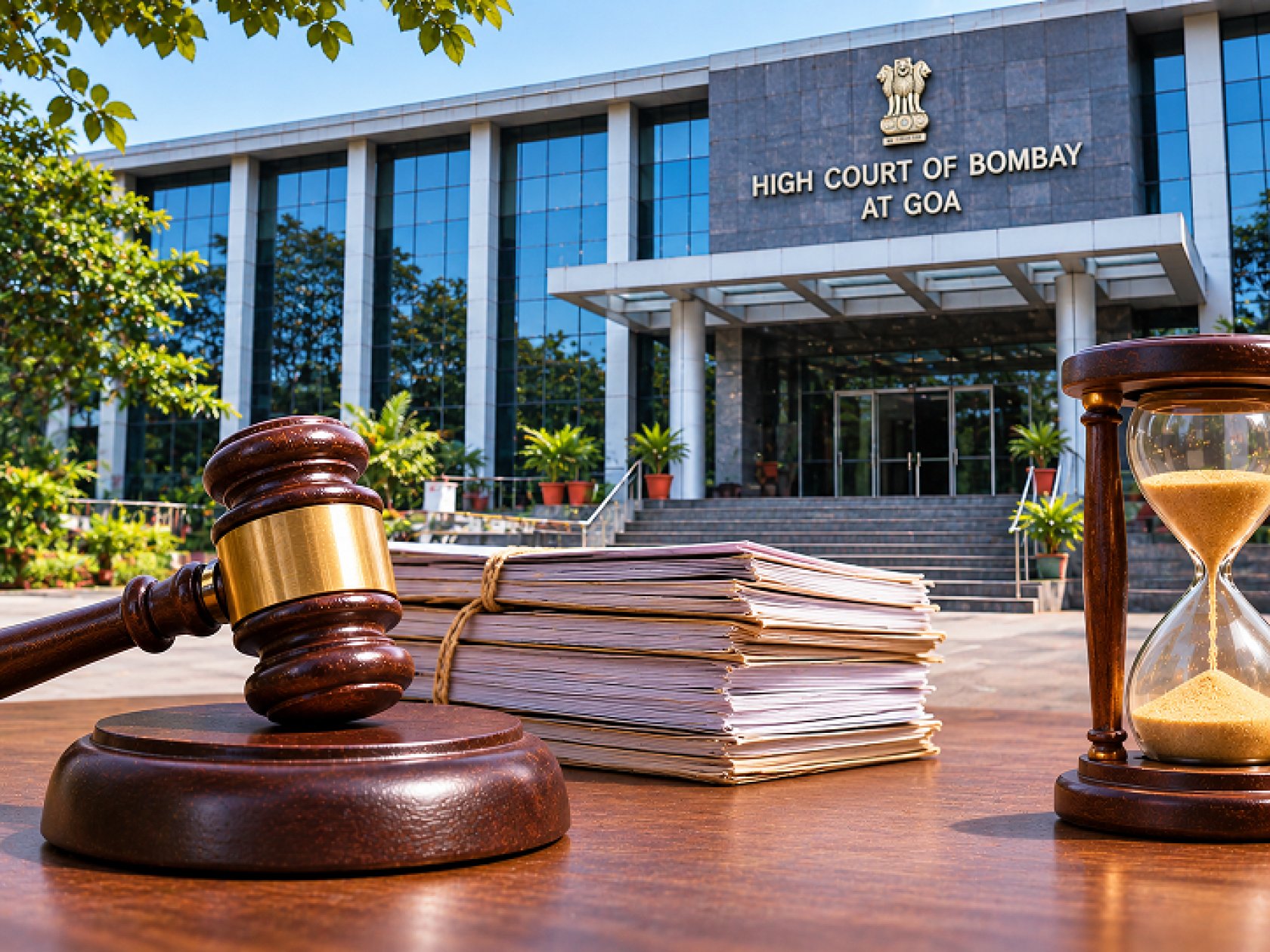
The Bombay High Court at Goa has stayed the official notification estimating the ST population, putting a temporary halt to the delimitation process intended to carve out four ST-reserved Assembly constituencies. The petition argued that Articles 170 and 332 of the Constitution of India require political representation and constituency representation to be governed by officially published census data rather than mathematical projections or executive formulas. This sudden development has cast serious doubt on the timely completion of the statutory process, given the extremely limited time remaining.
When the Union government notified the law enabling political reservation for the ST community, it was supposed to fast-track an overdue constitutional right. But with no official communication or progress on the process, except for the statement of the Chief Minister, the ST community appears to have been left high and dry and risks missing the bus entirely. What was hailed as a historic milestone has rapidly descended into familiar administrative inertia. Despite Parliament clearing the enabling legislation, the ground reality remains uncertain.
The ink on the central government notification regarding the reservation of four ST Assembly constituencies has long dried, but on the ground in Goa, the clock is ticking loudly. It has been months since the legal path was cleared to give the State’s tribal population its rightful voice in the 40-member House. Yet, as political parties begin mapping out their campaigns for 2027, the map of the four reserved constituencies is nowhere to be found. While the State government took more than two months to furnish demographic data to the ECI, and with not a single statutory notification issued till date, whether the entire statutory process can be completed in the remaining period of two months is a million-dollar question. The ST community feels that the governments and administrative machinery are dragging their feet and testing their patience.
In this context, it is appropriate to recall the answer given by the Government to Unstarred LAQ No. 34, stating that ‘Government will take necessary steps to reserve the Goa Assembly seats for the ST Community in the ensuing Assembly elections, in 2027’. Recently, the Chief Minister stated that the State Government had completed its required work on the process and handed over the matter to the Election Commission of India. While there is no clarity on the work completed by the State government, naturally, the State may have furnished the data on the ST population in the format required by the Election Commission of India. Pursuant to the state-wide agitation contemplated by ST organisations, the Chief Minister gave reassurance on October 28 regarding the likely completion of the reservation process and notification of constituencies in December. It is also a fact that the process lies entirely within the domain of statutory bodies; neither the Central government nor the State Government can issue any directions, except to monitor the progress on a war footing.
The legal framework mandates a sequential progression before any seat is officially reserved for Scheduled Tribes. We are still at the first statutory step of notifying the ST population for Assembly constituencies by the Census Commissioner of India (CSI). The ECI cannot calculate ratios until this figure is formally gazetted. If the State Government has furnished the required data, then there is a possibility of a gazette notification by the CSI shortly, provided the furnished data is in order. Once the official population metrics are available, the ECI needs to evaluate the data to identify the four constituencies with the highest proportion of ST residents. The ECI is then required to draft an official proposal amending the existing delimitation order. As public consultation and hearings are mandatory legal requirements, the ECI needs to place the draft proposal in the public domain, formally inviting suggestions and objections from political parties, tribal groups and the general public, and subsequently hold public hearings to address grievances. After considering public feedback, the ECI needs to finalise the draft proposal, execute the formal amendments to the delimitation order and publish the final gazette notification reserving four Assembly constituencies for STs.
Thus, another scenario is: what if the formal reservation process is not completed before the 2027 election notification? The ruling dispensation would then face a difficult question about how to respond to the disappointment of a community that has pursued political reservation for more than two decades. One possible political response by the BJP would be to announce that the party intends to field at least four ST candidates in the Assembly election, while reiterating its commitment to completing the statutory reservation process after the election. On the other hand, the larger question would be whether ST leaders remain united during the elections or get divided along traditional party lines. Even if they remain united, would they decide to vote against the BJP just to punish it? Another important dilemma for the ST community may be whether, considering the advantage of a double-engine sarkar, changing the government in Goa would necessarily improve the prospects of reservation after the election. More importantly, if a non-BJP government assumes office, can the community reasonably expect it to deliver what the present government has not? While it may be a tough call for ST leaders to decide on their electoral approach, it remains to be seen how the BJP would cross the bridge.
It is interesting to see that the opposition parties are silent on the issue, possibly hoping that the non-completion of the reservation process would be a political advantage for them in the elections. But the real question before the ST community is not merely whom to vote against, but how to ensure that political reservation becomes a constitutional reality, irrespective of which party governs Goa.
(The author is a retired bureaucrat)