Ishan Joshi and Yamini Chowdhury
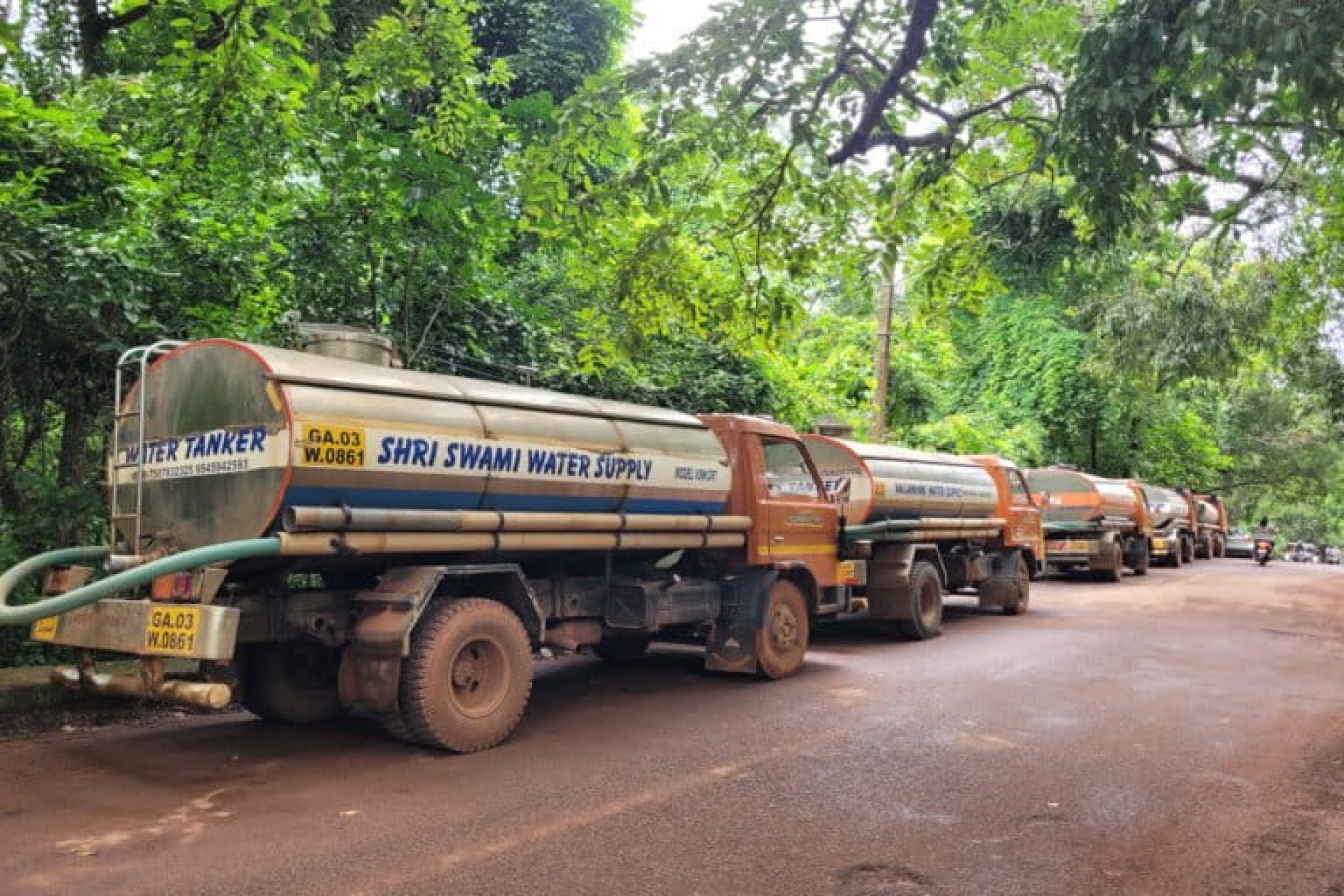
Every year, Goa performs the same ritual. In July, the Mandovi and Zuari rivers swell, paddy fields vanish beneath floodwater, and the heavens empty themselves over one of the wettest corners of India. By March, the taps run dry and private tankers queue up at the gates of housing colonies.
The paradox is stark. Goa receives roughly 8,000 million cubic metres of rain a year, many times what its homes, farms, hotels, and industries could ever need. Yet fewer than one drop in ten is captured or stored.
The rest flows down Goa’s steep terrain and disappears into the Arabian Sea. We are living off an inheritance and spending it carelessly. Per capita water availability has fallen from about 4,500 cubic metres in 1980 to around 2,200 today. Against a drinking water demand of 695 million litres a day, government data records a shortfall of 62 million. The hilly, eastern talukas of the State feel it first, when weak pressure cannot push water uphill between March and June. By 2040, projections suggest, Goa could face chronic water stress.
Failing to meet
quality standards
Meanwhile, the water we do have is turning against us. The Mandovi, Sal, Zuari and Tiracol fail to meet acceptable quality standards. Bacterial counts at some of our most celebrated beaches are unsafe. Silt is slowly strangling our perennial rivers.
Groundwater is drawn faster than it can recharge, and tanker operators sell it to hotels that can’t service guest needs without it. Seawater may be creeping into coastal aquifers, while deforested hillsides can no longer feed them.
None of this is nature's doing. It is a failure of management. Goa is not short of water; it is short of clean, usable, water and an integrated, well-governed water distribution system. This is no longer merely an environmental concern. It is a public health emergency waiting to happen.
For too long, we have treated water as a free gift to be drawn down rather than an asset to be stewarded. That mindset must end.
Water economy
necessary
Goa needs a water economy: That conserves, recycles and accounts for every drop, and that creates economic value without putting access beyond the reach of ordinary citizens.
The world offers instructive models. Israel built a formidable industry around desalination and water technology. Singapore turned scarcity into self-reliance through NEWater, its recycled supply.
Even the UAE, in the middle of a desert, treats water as a strategic asset. Goa has the rainfall and untapped reserves of water. If the policy ecosystem can get its act together, what might that look like?
First, fix the foundations. That means serious investment in sewerage, firm action against illegal discharge, protection of wetlands and recharge zones, regulated groundwater extraction, and de-centralized treatment in the tourism belts.
Connect abundance
to people's need
Secondly, connect abundance to need. The flooded mining pits and reservoirs of eastern Goa hold enormous volumes of water, while the populace in the west goes thirsty. A pilot project for carrying that water through a modern distribution network, deserves rigorous technical and financial scrutiny.
Thirdly, make water the test of every development. Industrial, residential and tourism projects should be judged on their water footprint before approval, not after the borewells run dry.
Fourth, close the loop. Treated wastewater can sustain inland aquaculture, create rural livelihoods and release fresh water for drinking.
Water-tech start-ups, IoT monitoring, smart irrigation and incentive-based water credits can make every litre visible. Housing societies, hotels, and households must become stakeholders in this effort, not merely consumers.
Only then should Goa dare to think bigger. Local needs come first, along with a scientifically estimated strategic reserve, held as nations hold gold.
Measuring Goa's
prosperity
Once those are secure, surplus water could serve neighbouring states and, in time, perhaps even the Middle East under the India-Middle East-Europe Economic Corridor. Water-hungry industries such as AI data centres might also be drawn to a state with water to spare. These are ambitions for tomorrow, not excuses for delay today.
The choice before us is plain. Goa's prosperity will not be measured by how many tourists land or how many villas rise, but by how much clean water it can store, protect and put to work. No tourism campaign can sell a paradise whose rivers are fouled and whose taps are dry.
Goa can yet become India's first truly water-smart state. But the window is narrowing, and the monsoon will not wait for us.