
Gaurav Kenkre
For The Goan
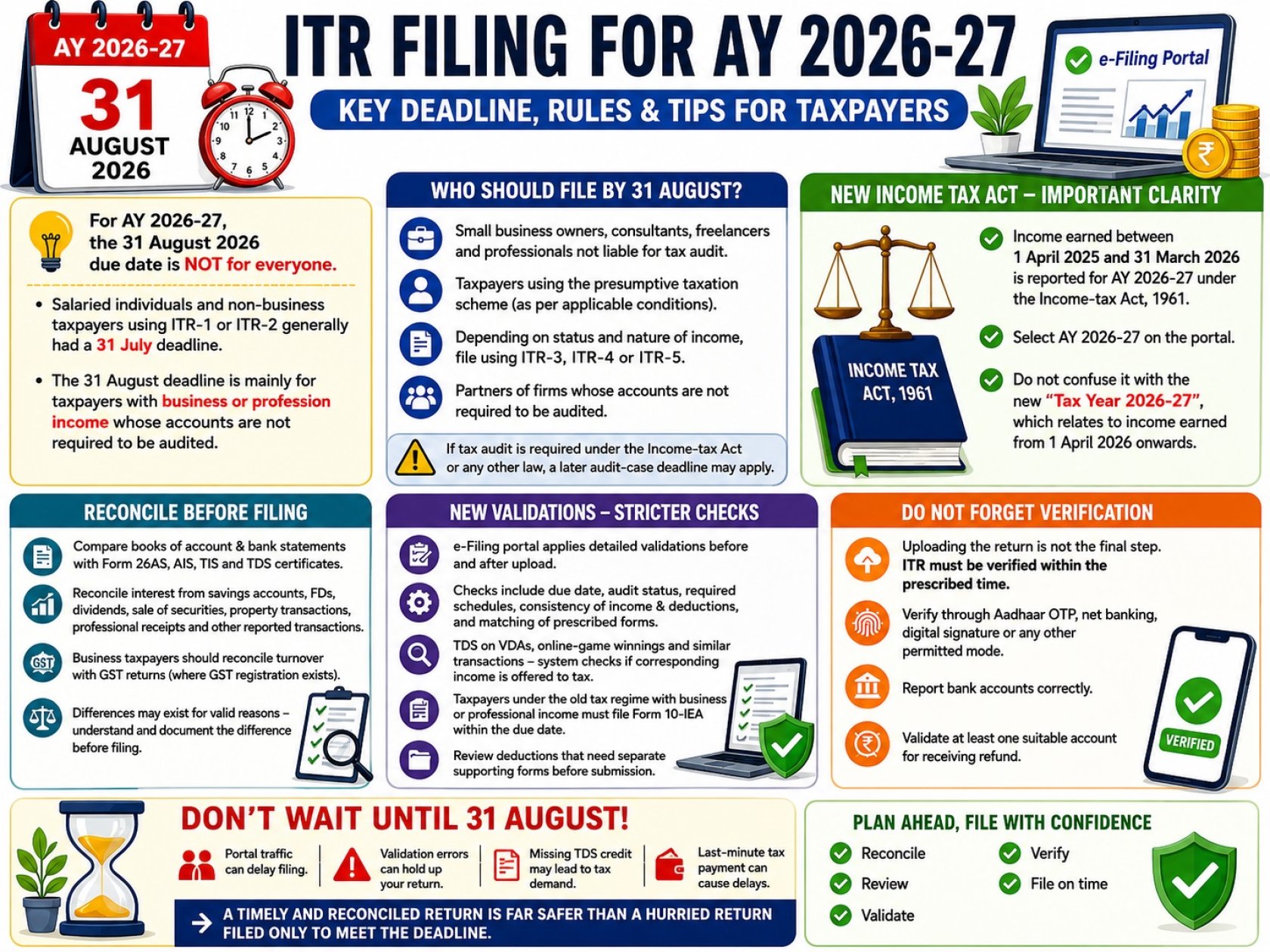
For Assessment Year 2026-27, taxpayers should first identify the correct filing deadline. The 31 August 2026 due date does not apply to every individual taxpayer. Salaried individuals and other non-business taxpayers using ITR-1 or ITR-2 generally had a July 31 deadline. The August 31 deadline is mainly meant for taxpayers having income from business or profession whose accounts are not required to be audited.
Who should file by August 31?
This category commonly includes small business owners, consultants, freelancers and professionals who are not liable for tax audit. It also covers taxpayers using the presumptive taxation scheme, subject to the applicable conditions. Depending on the status and nature of income, such taxpayers may use ITR-3, ITR-4 or ITR-5. Partners of firms whose accounts are not required to be audited also fall within the August 31 timeline. However, if the taxpayer or firm is required to undergo a tax audit under the Income-tax law or any other law, a later audit-case deadline may apply.
One important point this year is the transition to the new Income Tax Act. Income earned between 1 April 2025 and 31 March 2026 is still being reported for Assessment Year 2026-27 under the Income-tax Act, 1961. Taxpayers should therefore select AY 2026-27 on the portal and should not confuse it with the new “Tax Year 2026-27”, which relates to income earned from April 1, 2026 onwards.
Reconcile before filing
The most important filing exercise is reconciliation. Taxpayers should compare the books of account and bank statements with Form 26AS, the Annual Information Statement (AIS), the Taxpayer Information Summary (TIS) and TDS certificates. Interest from savings accounts, fixed deposits, dividends, sale of securities, property transactions, professional receipts and other reported transactions should not be ignored merely because the return is pre-filled.
Business taxpayers should also reconcile turnover with GST returns wherever GST registration exists. Differences are not always wrong, because GST turnover and income-tax turnover may differ for valid reasons, but the difference should be understood and documented before filing.
New validations are becoming stricter
The e-filing system now applies detailed validation rules before and after upload. Some errors can prevent the return from being uploaded, while other mismatches may allow filing but can later result in a defective-return notice or disallowance of a claim.
For business and professional taxpayers, the portal checks matters such as the selected due date, audit status, filing of required schedules, consistency of income and deductions, and matching of certain prescribed forms with the return. Where tax has been deducted on income such as virtual digital assets, online-game winnings or similar transactions, the system may also check whether the corresponding income has actually been offered to tax.
Taxpayers opting for the old tax regime and having business or professional income should pay special attention to the requirement of filing Form 10-IEA within the prescribed due date. Deductions that require separate supporting forms should also be reviewed before the return is submitted.
Do not forget verification
Filing is not complete merely on uploading the return. The ITR must also be verified through Aadhaar OTP, net banking, digital signature or another permitted mode within the prescribed time. Bank accounts should be correctly reported and at least one suitable account should be validated for receiving a refund.
Finally, do not wait until August 31. Portal traffic, validation errors, missing TDS credit or a last-minute tax payment can delay filing. A timely and reconciled return is far safer than a hurried return filed only to meet the deadline.
(The writer, a Fellow Chartered Accountant (FCA), specialising in Goods, Services tax, Transfer Pricing and Income tax, is the co-author of the book ‘Comedium of Industrial Policy for MSMEs in Goa’ released by ICAI)