MARGAO
Hazard a guess at the total number of pending mutation cases in Salcete taluka alone in the South Goa district.
Strange as it may seem, a staggering 1,208 cases, both offline and online, are pending in South Goa’s most populous taluka, where the administration is headed by a Mamlatdar, assisted by seven joint Mamlatdars.
A glance at the figures reveals that mutation cases are pending with almost all the presiding officers, from the Mamlatdar to the joint Mamlatdars. The highest number of pending cases, around 286, is with the office of Joint Mamlatdar-2, followed by 172 with Joint Mamlatdar-6 and 169 with Joint Mamlatdar-4. Around 160 mutation cases are pending with the Salcete Mamlatdar.
Pending mutation cases with the Salcete Mamlatdar and the joint Mamlatdars have come under the spotlight after city-based lawyers, under the banner of the South Goa Advocates Association, staged a protest at the South Goa Collectorate, demanding streamlined disposal of mutation and partition cases and alleging corruption.
The protest prompted immediate action from South Goa Collector Egna Cleetus, who ordered the dismantling of the Mutation Cell and the reshuffling of upper- and lower-division clerks (UDCs and LDCs) at the Mamlatdar and joint Mamlatdar offices.
While a special mutation camp held last week in South Goa district saw 210 cases disposed of, another camp is scheduled for this weekend to clear the backlog of cases pending with the Mamlatdars and joint Mamlatdars.
Collector reiterates 2024 SOP; mamlatdars told to clear cases beyond office hours
MARGAO: South Goa District Collector Egna Cleetus has called for the implementation of the standard operating procedure (SOP) dated December 24, 2024, for processing and disposing of mutation applications under the Land Revenue Code, 1968.
A circular issued by the District Collector has reiterated that all Mamlatdars and joint Mamlatdars in South Goa district are authorised to process, certify and dispose of mutation applications on Saturdays, Sundays, public holidays and after office hours.
The SOP lays down a uniform procedure for the receipt, scrutiny, processing and disposal of mutation applications, including the issuance and service of notices, hearings on objections, maintenance of records, adherence to prescribed timelines for online processing, and grievance redressal.
The circular directs Mamlatdars and joint Mamlatdars to regularly review pending mutation applications and take measures to ensure their timely disposal. It further directs the concerned Deputy Collectors and Sub-Divisional Officers to monitor compliance with these instructions.
The circular also directs all concerned officers to ensure that mutation applications and other revenue matters are dealt with strictly in accordance with the prescribed procedure and that no unauthorised interference in official proceedings is permitted. “All officers concerned shall ensure strict adherence to the enclosed SOP, without compromising the statutory requirements and principles of natural justice. Any procedural deviation, wherever legally permissible, shall be duly justified and recorded,” the circular states.
Lawyers’ association questions disposal of 210 cases in a day, threatens stir over delays
MARGAO: Questioning how the taluka Mamlatdars in South Goa district managed to dispose of 210 mutation cases in a single day at the special camp held last Saturday, the South Goa Advocates Association (SGAA) has threatened to intensify its agitation to streamline mutation and partition cases if the administration fails to demonstrate seriousness in addressing the issue.
The lawyers questioned whether the action initiated by the South Goa Collector to streamline the mutation system was mere eyewash, given that no concrete action had been taken against the officials responsible.
At an extraordinary general body meeting chaired by president Adv Antonio Clovis Da Costa, members of the Association offered suggestions for the standard operating procedure (SOP) to be issued by the district Collector to streamline the disposal of mutation cases.
Briefing the media later, Clovis lamented that officers were not being held accountable for delays in the mutation process.
“Today, advocates have decided that the district Collector ought to be the authority to hear grievances regarding mutation cases. The present system authorises the Mamlatdars to hear these grievances, even though they are the real problem,” he said.
He questioned how the taluka Mamlatdars had cleared 210 cases in a single day when some had been pending for months, if not years. He said the SGAA had received support from advocates’ associations in Vasco, Canacona and Sanguem, as the issue was affecting litigants not only in Salcete but across all taluka Mamlatdar offices.
The members unanimously resolved to file a writ petition before the High Court seeking the appointment of separate Mamlatdars exclusively for judicial work, so that revenue-related judicial proceedings could be handled efficiently and without delay.


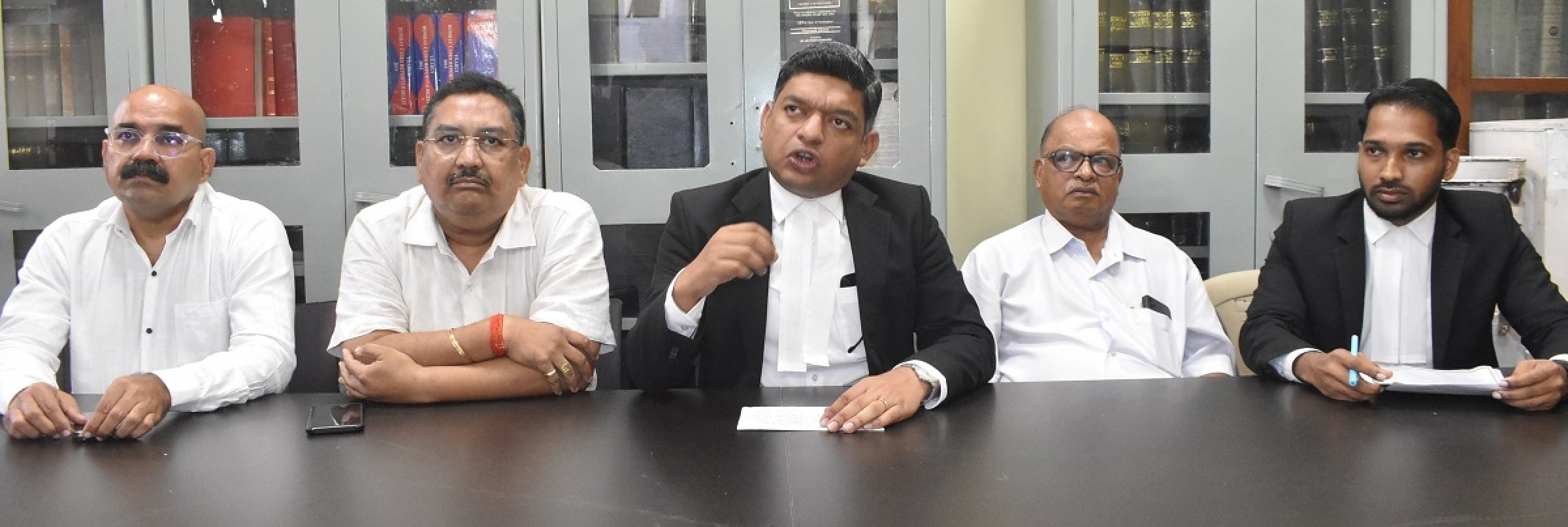 South Goa Advocates Association President Adv Antonio Clovis Da Costa making a point on the backlog of mutation cases in Salcete taluka. Santosh Mirajkar