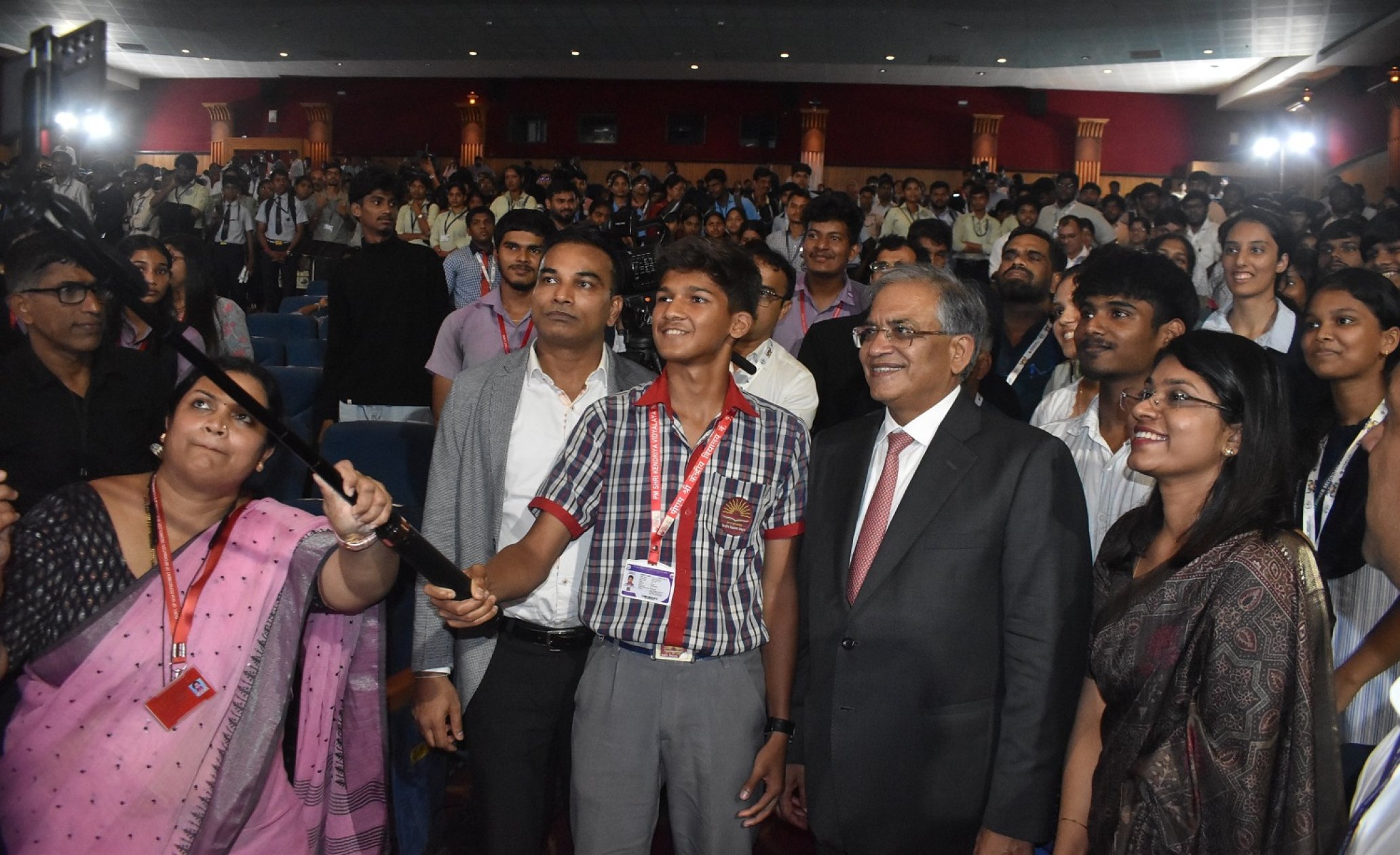
 A student attending the Electoral Literacy Clubs interaction takes a selfie with CEC Gyanesh Kumar and State election officials at the Ravindra Bhavan, Margao on Thursday. Santosh Mirajkar
MARGAO
Chief Election Commissioner Gyanesh Kumar on Thursday said the upcoming Goa Assembly elections would be held as scheduled, while urging the State to target a 95 per cent voter turnout.
Expressing satisfaction over the commitment made by district election officials, Kumar said every citizen had a responsibility to strengthen democracy by exercising the franchise.
“If Goa promises 95 per cent polling, democracy will be more vibrant. It is immaterial who wins or loses in an election,” he said.
Asked repeatedly whether the Assembly elections would be advanced to December, the CEC replied briefly: “Samay par hoga” (it will be held on time).
During an interaction with members of Electoral Literacy Clubs at Ravindra Bhavan, Margao, Kumar referred to West Bengal’s high voter turnout after the Special Intensive Revision (SIR) exercise and asked students and election officials what Goa’s target should be.
“It should not be lower than West Bengal’s 93 per cent. Isn’t it?” he said.
The North Goa Collector committed to achieving over 90 per cent polling, South Goa Collector Egna Cleetus promised 94 per cent, while the Kushavati district Collector pledged to achieve 95 per cent.
Sources told The Goan that Kumar urged election officials to work towards pushing Goa’s polling percentage beyond 94 per cent.
Explaining West Bengal’s high turnout, Kumar credited the efforts of Booth Level Officers (BLOs), who met voters personally during the SIR exercise.
“This made voters feel they were important and motivated them to vote,” he said.
On criticism of Electronic Voting Machines (EVMs), Kumar described them as “simple calculators” that cannot be connected to the internet or Bluetooth.
“They only tell us how many times a particular button has been pressed,” he said, adding that EVMs had “come out with flying colours” 41 times when tested in the Supreme Court between 1996 and 2026.
On NOTA (None of the Above), Kumar clarified that it was merely an option for voters who did not wish to support any candidate and could not itself become an MLA.
Responding to a question on whether candidates should have a minimum educational qualification, Kumar said neither the Constitution nor existing electoral laws prescribed such a requirement.
“Any such change would require Parliament to amend the Constitution and electoral laws,” he said.
The CEC declined to comment on the ‘One Nation, One Election’ proposal, saying it was premature because the concept finds no mention in the Constitution.
On the possibility of online voting, Kumar said most democracies did not favour the system and reiterated that elections would continue to be conducted according to the law in force.
His visit to Margao formed part of an outreach programme aimed at promoting electoral awareness among students and encouraging greater voter participation ahead of Goa’s next Assembly election.