PANAJI: Chief Minister Pramod Sawant on Monday called for greater use of university research to develop solutions to local challenges, as Goa University launched Matsya Sandhan Kshetram, a Potential Fishing Zone (PFZ) guidance application developed specifically for Goa’s fishing community.
The application uses satellite observations and oceanographic data to identify areas where fish aggregation is more likely, helping fishermen make informed decisions before venturing into the sea.
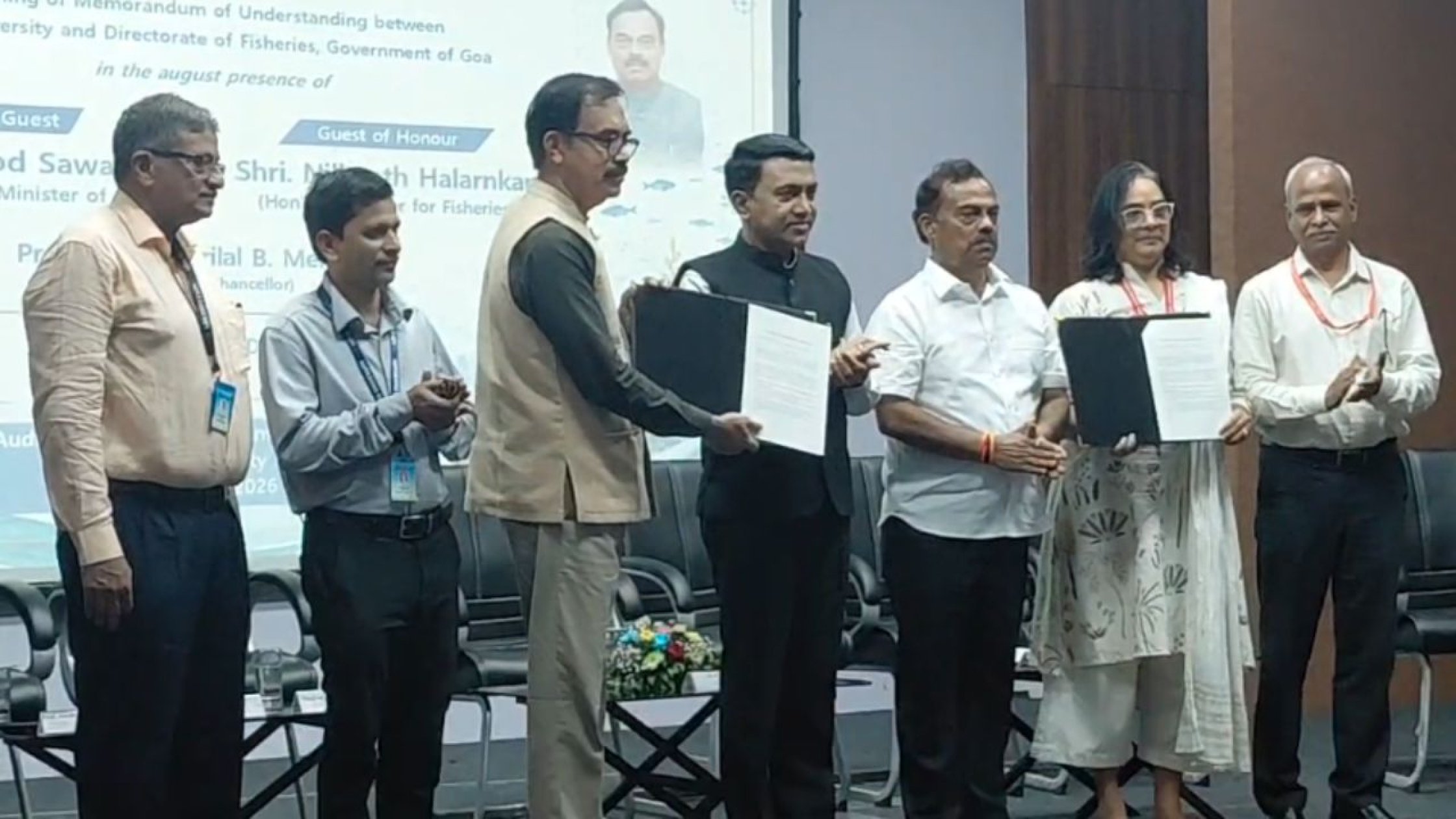
The app was launched at Goa University in the presence of Fisheries Minister Nilkanth Halarnkar, Fisheries Secretary Prasanna Acharya, Directorate of Fisheries Director Dr Sharmila Monteiro and Goa University Registrar Prof Sunder Dhuri. An MoU between Goa University and the Directorate of Fisheries, Government of Goa, was also signed and exchanged during the programme.
Sawant said universities should play a greater role in addressing real-world challenges faced by different sectors and reduce dependence on external consultants.
“When government departments face hurdles, we must ask: Can our educational and research institutions find a solution?” Sawant said.
Questioning the reliance on outside consultants, he said local students and researchers should be encouraged to develop solutions suited to Goa’s needs.
“Why shouldn't our own students generate these solutions instead?” he said.
Sawant said the approach should extend beyond fisheries to sectors including agriculture, horticulture, pisciculture, dairy farming, floriculture, tourism, healthcare, renewable energy, water resources and disaster management.
He said the fishing sector supports thousands of families and continues to face uncertainty due to changing weather conditions and the difficulty of locating productive fishing grounds.
“Every sea voyage carries both opportunity and uncertainty due to changing weather and the difficulty of locating productive fishing grounds,” Sawant said.
The Matsya Sandhan Kshetram app seeks to reduce this uncertainty by identifying Potential Fishing Zones using satellite observations and oceanographic data, including sea surface temperature, ocean colour and other indicators associated with fish aggregation.
“By minimising search time, we reduce fuel consumption, lower operational costs and increase the likelihood of a higher-quality catch,” he said.
Sawant said the initiative was an example of research moving beyond laboratories to directly benefit citizens.
“Research must never remain confined to the four walls of a laboratory; its true value lies in improving human lives,” he said.
He also said Goa has the potential to emerge as a leader in the Blue Economy, covering sustainable fisheries, marine research, seafood value addition, coastal tourism and responsible marine resource management.
Fisheries Minister Nilkanth Halarnkar said the application could provide scientific guidance to thousands of families dependent directly and indirectly on the fishing sector.
“Our fishing community faces challenges like escalating fuel costs, fluctuating catches, changing ocean conditions, operational expenses and extreme weather events. To navigate these challenges, timely and reliable scientific guidance is essential,” Halarnkar said.
He said the app analyses satellite observations such as sea surface temperature, ocean colour and chlorophyll concentration to identify areas where environmental conditions favour fish aggregation.
For fishermen, he said, the benefit would be the ability to navigate towards potential fishing grounds instead of spending excessive time searching for fish.
The application also provides a seven-day warning forecast, including significant wave height, wind and other sea conditions.
Halarnkar said the Directorate of Fisheries would work with Goa University to conduct awareness programmes, demonstrations and training sessions at fishing harbours, jetties and landing centres.
He also encouraged fishermen to provide feedback on actual catch conditions and species encountered so researchers can continuously improve the algorithm.
At the same time, he cautioned fishermen to use the application alongside official weather and navigation advisories and their own experience.
“Nothing is more valuable than human life; always pay heed to official safety warnings during adverse sea conditions,” Halarnkar said.
Goa University Vice-Chancellor Prof Harilal D Menon said the application was the culmination of years of research into satellite observations, ocean characteristics and the bio-optical properties of Goa’s coastal waters.
“Today's function is not merely the inauguration of a fishery app or the signing of an MoU between the Fisheries Department and the University. Rather, it is the culmination of a journey,” Menon said.
He said the research eventually led to the development of the Goa University Case 2 Water Algorithm (GC2), which processes satellite data to generate Potential Fishing Zone maps.
The algorithm analyses variables such as sea surface temperature, ocean colour and ocean fronts to identify areas with a higher probability of fish aggregation.
Menon said the application was developed exclusively for Goa’s coastal waters and fishermen from the state.
The app is available in Konkani, Marathi, Hindi and English and uses OTP-based registration. Access is currently restricted to phone numbers registered in Goa.
The PFZ map categorises areas according to their potential. Menon said PFZ 1 could indicate a potential catch probability of around 70 to 100 per cent, while PFZ 2 could indicate around 50 per cent.
The application also provides the distance and coordinates of identified zones, allowing fishermen to navigate directly towards potential fishing grounds and reduce fuel consumption.
Menon said the project would now be taken forward as a potential blue-tech startup through the Goa University Research Park Unit (GURPU).
“This is only an initiative. This is going to be a startup through our GURPU,” he said, adding that the project could create opportunities for students to become job providers.
He described the initiative as a transition “from satellite and space to the hands of the fisherman” and said the university would explore expanding the technology beyond Goa’s coastal waters in the future.