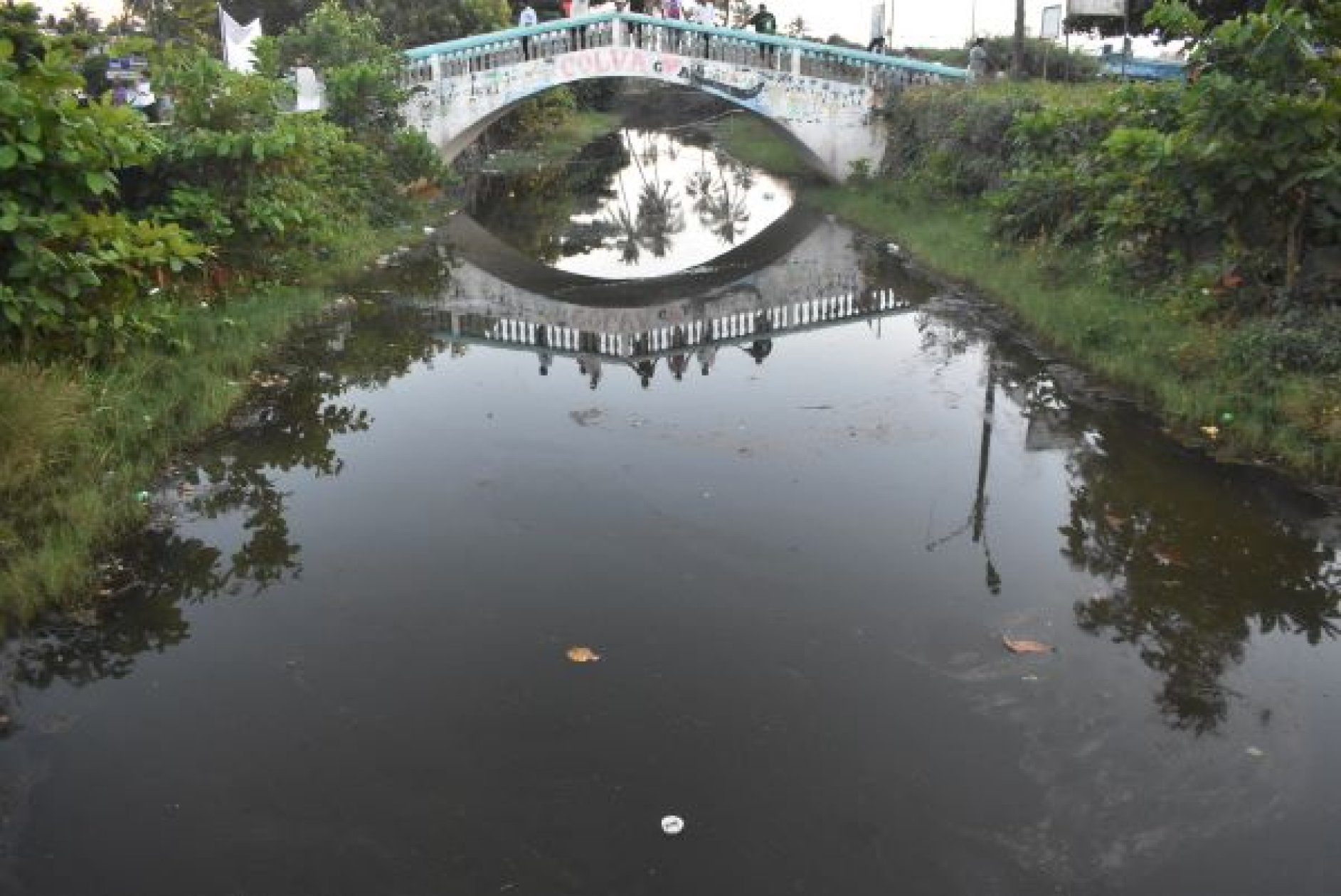
 The contaminated Colva creek at the world famous tourist destination. Santosh Mirajkar
MARGAO
Around 15 months after the High Court expressed satisfaction with the measures taken by the Goa State Pollution Control Board (GSPCB) to curb waste disposal into Colva Creek, troubling questions remain over the creek’s actual condition and the authorities’ efforts to keep this world-famous tourist destination pollution-free.
Is Colva Creek, located alongside one of Goa’s world-famous tourist destinations, really free from sewage and wastewater contamination? And what about the plastic bottles and other waste routinely dumped into the water body by visitors and others?
These questions assume significance in the wake of the August 2025 order of the High Court, which disposed of a 14-year-old Public Interest Litigation (PIL) filed by Colva Civic and Consumer Forum secretary Judith Almeida. While disposing of the petition, the High Court observed: "Since we are satisfied that all necessary steps have been taken by the Goa Pollution Control Board to address the grievances raised in the petition—filed more than a decade ago—and given the follow-up action over the years, we deem it appropriate to dispose of the petition, expressing our satisfaction with the measures undertaken to curb the menace of waste disposal into the sea, particularly the Colva Creek."
But have things really changed for the better in the 15 months since the High Court disposed of the PIL, expressing satisfaction with the steps taken by the GSPCB to address the problem?
A visit to Colva Beach on Wednesday to cover a mock drill presented a rather disturbing picture. Black-coloured water was seen stagnating in the creek, while plastic bottles floated across the water body.
Ironically, while a team of revenue officials, including three Mamlatdars, closely watched fire personnel demonstrate their fire fighting skills as part of the mock drill, the adjoining Colva Creek appeared to have its own environmental emergency demanding attention.
The sight of plastic bottles floating across the creek did not go unnoticed. Domestic tourists and other visitors appeared aghast at the condition of the water body, raising some pertinent questions.
Leave aside the larger issue of preventing the discharge of sewage and wastewater into the creek. Is there any authority specifically responsible for collecting and disposing of plastic bottles and other dry waste dumped into the water body?
Who monitors the creek? Who is responsible for its upkeep? And, more importantly, what concrete measures are in place to prevent visitors and others from turning this natural water body into a dumping ground?
Many unanswered questions
over 7.5 MLD STP
The condition of Colva Creek has also brought the spotlight back on the Goa State Pollution Control Board (GSPCB) and the Sewage Infrastructure Development Corporation of Goa Ltd (SIDCGL), with several critical questions arising over the functioning and operational status of the 7.5 MLD Sewage Treatment Plant (STP).
The Rs 56-crore STP was commissioned by Chief Minister Pramod Sawant on January 16, 2025. However, nearly 22 months after its inauguration, the public deserves clarity on its actual performance and the extent to which it has helped address the sewage pollution problem in Colva.
Will SIDCGL place the latest status of the 7.5 MLD STP in the public domain? How much sewage is the plant actually treating every day against its installed capacity of 7.5 million litres per day? How many commercial establishments, including hotels and restaurants, have been connected to the sewerage network? How many households have availed of the facility?
Is the entire sewerage project complete, including the necessary network and household and commercial connections, or are significant components still awaiting completion?
These questions assume particular significance because, after the commissioning of the long-delayed Rs 56-crore STP, the Chief Minister had issued a stern warning to commercial establishments and households, making it clear that their water supply connections would be disconnected if they failed to obtain sewerage connections.
In fact, the Chief Minister had fixed March 31 as the deadline for commercial establishments and households in the tourist village to avail themselves of the sewerage facility wherever the network was ready, failing which they would face disconnection of their water supply.
The warning was not without reason. At the time, it had reportedly emerged that the PWD had received fewer than 30 applications for sewerage connections from both domestic and commercial consumers.