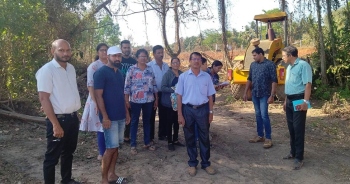
 The Joint inspection carried out at the Majorda fields to ascertain the damage left behind by the dumping of debris by the RVNL.
MARGAO
A joint inspection held to ascertain the damage done to the bio-diversity at Majorda fields along the railway tracks has revealed that debris, mud and trees can still be seen in the fields, raising fears that this will find its way towards the water culvert in monsoon and block the flow.
The inspection was conducted by Zonal Agriculture Officer, Margao Sheriff Furtado, along with Panch members of Majorda-Utorda-Calata panchayat, Bio-Diversity Management Committee members and local farmers.
The Rail Vikas Nigam Limited (RVNL) is building a wall parallel to the railway tracks and a lot of construction debris, mud and trees have been dumped in private fields and on the pathway of water. Residents and farmers had requested the South Goa Collector and other authorities to get this cleared immediately, as during monsoon this debris will restrict the water flow and flood the fields and villages.
In a statement, the residents claimed that though the South Goa Collector had verbally instructed RVNL officials to clear the debris by March 20th, still lot of debris, mud and trees can be seen and this will flow toward the water culvert in monsoon and block the flow.
Bio-Diversity Management Committee is continuously pursuing the matter with concerned authorities and Wednesday's inspection was part of the efforts on how to further prevent destruction and restore the surrounding bio-diversity.
“South Goa Collector office has twice instructed the Dy Collector Mormugao to conduct a site inspection, but no action in this regard has been taken by Dy Collector Mormugao,” the statement said.
The statement further said that it has been observed that a number of trees have been cut along the track from Majorda towards Utorda section and all have been dumped into private properties. “Reports are that railways have encroached and dumped mud into private fields. Locals have complained to government authorities about this matter and they are of opinion that RVNL officials, Supervisor and contractors need to be penalised for such encroachment,” the statement read, adding “It has been observed that no concrete ground action is been taken by the administration to restore the fields to its original state."