MARGAO
Welcome to Margao. The State’s commercial capital plays host to two state-of-the-art sewage treatment plants, commissioned exactly four years ago in June 2017.
Sewage water, however, continues to flow in the river Sal even as these two plants remain under-utilised.
Against the backdrop of the Water Resources Department launching the Rs 16 crore River Sal Rejuvenation project on Goa Statehood Day, questions have come to the fore whether river de-silting and de-weeding alone would restore Sal to its pristine glory when thousands of litres of sewage finds its way in the river every day.
Consider this. Taken together, the two STPs “ the 6.7 MLD and 20 MLD plants, has a capacity to treat a whopping 26.7 MLD of sewage a day, including sewage generated in the city as well as in immediate neighbourhood.
The ground reality, however, paints a grim picture. Officials in private say the 6.7 MLD plant presently treats less than 2 MLD of sewage, around 1.5 MLD to be precise. And, the 20 MLD plant, which was planned to cater not just Margao, but neighbouring Navelim constituency, hardly treats 6 MLD sewage, bringing to the fore the same old question, that the city’s sewage continues to find its way in Sal, leaving the river, polluted and contaminated.
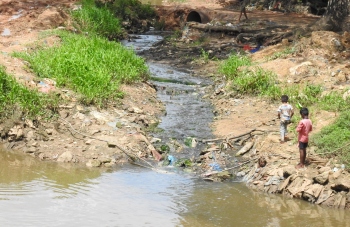
A walk down the river course along Khareband, revealed the grim ground reality -- thick-black coloured sewage water found its way into the river from a water nullah, a stretch de-silted and de-weeded only recently. Sources say this is just the tip of the iceberg with sewage water gushing into the river at numerous points, right from Old Market to Sirvodem, and beyond for want of a full-proof network to channelise sewage into the treatment plants.
The situation is further compounded by the fact that citizens are still not forthcoming to take the sewerage connections despite the fact the underground line passes through their backyard.
A senior PWD engineer, who is also associated with the Sewage Corporation, attributed a host of factors for the under-utilisation of the two sewage treatment plants.
“One, there are many areas where the line is already laid, but house connections are comparatively less. Secondly, the 20 MLD plant was designed to cater to Navelim constituency as well, but networking issues have delayed treatment of sewage from these areas,” he said.
The engineer cited another major issue behind the under-utilisation of the STPs “ the non-completion of the replacement of the North main line, running from Fatorda to the Sirvodem treatment plant. “This has been the problematic stretch and we intend to at least connect part of the old line to the new trunk line by May end next year to stop the sewage flow into the river.
WRD Minister Filipe Neri Rodrigues said the river Sal rejuvenation project has been taken up by his department following directions from the National Green Tribunal. “What the WRD has taken up is de-silting and de-weeding of the river course. As far as the sewage flow into the river is concerned, the issue falls in the domain of another department,” he said.
Says senior WRD official Ankush Gaonkar: “The Sal river has been identified as the most polluted in the country and falls under the Category III. The NGT Court has directed to take up the matter on urgent basis. Due to discharge of large quantity of sewage waste, besides dumping of solid waste, silt has accumulated along the Khareband-Varca stretch. The weeds have grown up, leaving the water stagnated, due to which the Dissolve Oxygen Content (DO) has dropped and the Bio-Chemical Oxygen Demand (BOD) has increased beyond the permissible limit.”