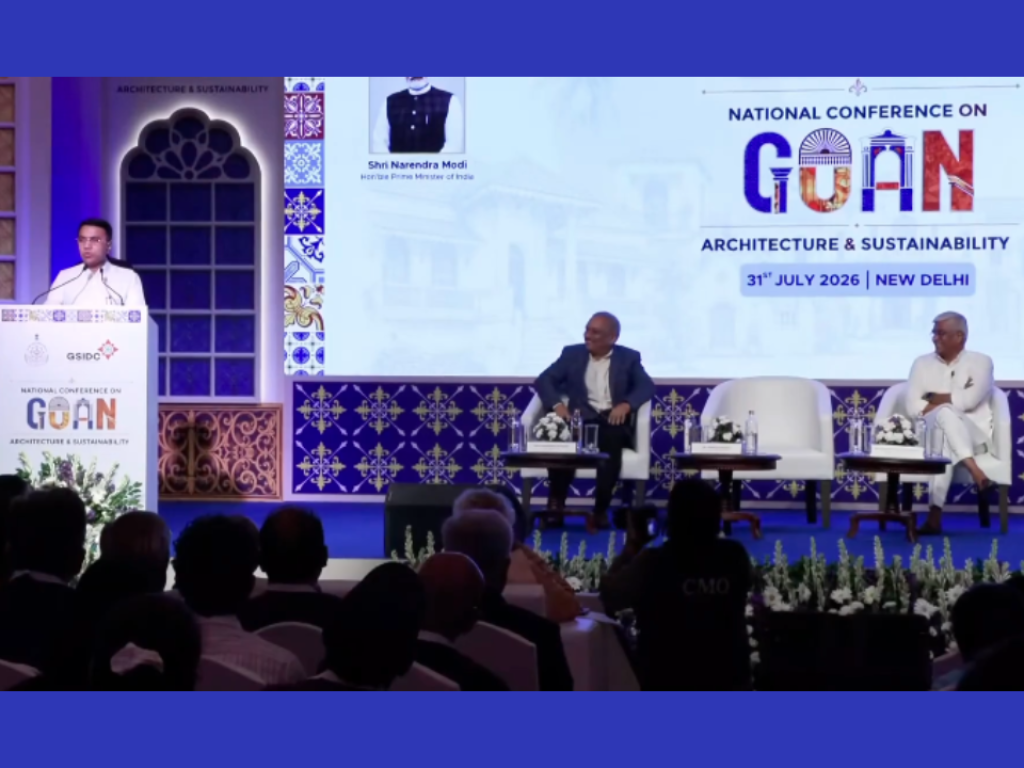
PANAJI: Goa’s traditional architectural practices offer a blueprint for sustainable development, said Goa Chief Minister Pramod Sawant while inaugurating the National Conference on Goan Architecture & Sustainability in New Delhi on Friday. Calling Goa a “living laboratory for sustainable architecture”, Sawant said the state’s heritage, climate-responsive designs and modern infrastructure can guide India’s future urban development.
The conference organised by the Goa State Infrastructure Development Corporation (GSIDC), brought together architects, urban planners, conservationists, policymakers, engineers, researchers, academicians and industry experts to discuss the role of traditional knowledge in shaping sustainable infrastructure.
“Architecture is not merely about constructing buildings. It is about building culture, communities and civilisation,” Sawant said, adding that structures reflect how generations understood nature, organised societies and lived in harmony with their surroundings.
Highlighting the Union government’s vision of development along with heritage conservation, Sawant said, “Let us build modern infrastructure but never at the cost of our identity. Let us embrace the latest technology but never lose sight of the traditions that have shaped our civilisation.”
He said Goa’s centuries-old architectural practices already embody principles that the world is now adopting in the form of climate-resilient architecture and sustainable construction.
“The laterite stone walls, lime plaster, sloping Mangalore tile roofs, shaded verandas and central courtyards were not merely architectural choices. They were scientific responses to our geography,” he said, adding that these features helped reduce indoor temperatures, conserve energy, maximise natural light and respond to Goa’s heavy monsoon conditions.
“Goa has been practising green architecture which the world is discussing today. We are not merely preserving history; we are preserving knowledge,” Sawant said.
The Chief Minister said the state government has adopted a comprehensive approach towards heritage conservation through initiatives such as GIS-based heritage mapping, digital inventories and scientific conservation efforts.
He highlighted restoration projects at historic forts, development of heritage villages and initiatives to promote temple heritage, saying these efforts aim to strengthen local identity, support traditional craftsmen and create livelihoods.
Sawant also stressed the need for future public infrastructure to follow sustainable principles.
“Buildings we construct today must consume less energy, conserve more water, maximise natural light and ventilation, and minimise their environmental footprint,” he said.
He said Goa plans to encourage green building principles in government projects, including schools, hospitals, offices and tourism facilities, through passive cooling techniques, rainwater harvesting, renewable energy solutions, energy-efficient systems and integrated building management systems.
Calling technology a partner to tradition, Sawant said tools such as artificial intelligence, digital twins, building information modelling, laser scanning, drone documentation, GIS mapping and climate simulation can help preserve heritage more effectively.
“Technology should become the strongest ally of tradition,” he said.
The Chief Minister said every government building should reflect Goa’s climate, culture and identity while meeting global standards.
“Every new government building in Goa should not only be modern but also Goan in character. Let our buildings reflect our climate, respect local materials, conserve energy and remain rooted in Goa while embracing global standards,” he said.
Speaking about climate change and architecture, Sawant said architects today have a larger responsibility as every design decision impacts energy consumption, carbon emissions and ecological resilience.
“Our coastline, biodiversity and fragile ecosystems demand architecture that is intelligent, resilient and environmentally responsible,” he said.
He added that Goa aims to become “India’s living laboratory for sustainable architecture”, where heritage conservation, climate resilience, technology and public infrastructure evolve together.
“Aspiration is simple. We want Goa to become a place where traditional wisdom guides future innovation, where the world comes not only to admire Goa’s beauty but also to learn from Goa’s experience,” Sawant said