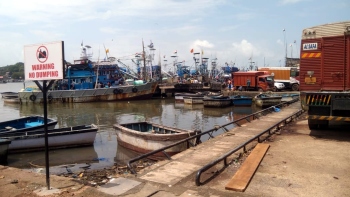
Old and unused vessels lying at the Cutbona jetty.
MARGAO
Total mechanized fishing boats “ around 350. Boats presently operational “ around 280. Labourers employed on the fishing vessels as crew “ a whopping over 4,000 workers with each boat employing over 25 workers on an average depending on the vessel size.
The sheer numbers of men and vessels involved in the fishing activity has bestowed the status on Cutbona fishing jetty as Goa’s largest fishing hub.
Now, consider the sanitation and hygiene amenities provided at the fishing jetty. A lone Sulabh toilet block is all the sanitation facility available for the thousands of workers. Installation of the bio-toilet did not prove to be of much help to improve the sanitation facilities. In the absence of adequate toilet facilities, the migrant workers were left with no option than to answer nature’s call in the adjoining open fields and water bodies.
Strange it may seem, water facility needed to cater to the growing requirement of the fishing activity is met by water tankers procured by the fisheries societies. A proposal to lay a dedicated water supply line to the jetty could not see light of the day for want of funds.
This glaring mismatch between the basic requirement of sanitation and hygiene and the ground reality has been the order of the day until the fishing jetty was struck by cholera and dengue since mid-August last.
As on Friday, the number of workers affected by cholera is pegged around 172, including five deaths, throwing up an oft-repeated question as to who’s responsible for the outbreak of the disease at the jetty.
As the authorities are searching for answers to a host of questions arising out of the outbreak, the Directorate of fisheries need to do a lot of explanation over the poor sanitation amenities at the state’s largest fishing jetty. The department needs to explain why a proposal to install a 50-seater toilet block in the year 2013 is yet to see light of the day at the jetty, only throwing up a question whether sanitation was never an issue on the department’s priority list.
A visit to the Cutbona jetty would reveal that the jetty plays host to almost all the issues contributing to a messy situation at the state’s other fishing jetties, including the issue of parking, business establishments operating sans licenses et al.
Chief Minister's
visit and action
If the Cutbona fishing jetty is witnessing hectic activity to clean up the Cutbona fishing jetty post-inspection by Chief Minister Pramod Sawant and Environment Minister Alexio Sequeira, why was similar action not forthcoming over the last several months and years from the Fisheries Minister Nilkanth Halarnkar and outgoing Fisheries Director Dr Shamila Monteiro.
For an answer, consider this. The 222-metre extended portion of the Cutbona fishing jetty has been playing host to unused and old vessels, besides scrap material, including fish nets and dingy boats, since 2019. Boat owners have been knocking the doors of the Fisheries Minister and the Director to remove the old vessels and clear the jetty of the scrap items.
Post-CM’s visit, the process has been set in motion to clean up the fishing jetty, including the 222-metre extended portion and to tow away the unused and old vessels.
At the first review meeting chaired by Minister Aleixo Sequeira post-CM’s visit, a fisheries official dished out statistics pointing out that around 46 vessels lay anchored at the extended jetty, out of which four vessels did not display the registration number, again throwing up a question “ why was the department dragging its feet to crack a whip when the statistics backed the complaints made by the boat owners that unused vessels have not only been blocking vessels from docking at the jetty, but have been the sources of vector borne diseases.