


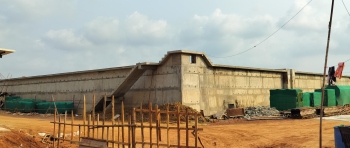
 The construction of a sewage treatment plant is underway in the Sangolda-Guirim fields. Captured by : Agnelo Pereira
MAPUSA
The residents of Guirim village are bracing for a potentially catastrophic monsoon season as various construction activities and delayed pre-monsoon preparations threaten to exacerbate the annual flooding issue.
Concrete mixing elements and machinery for the elevated corridor project on NH-66 have been indiscriminately dumped in the low-lying fields. Additionally, the construction of a sewerage treatment plant in the Guirim-Sangolda fields has intensified local concerns.
Historically prone to severe flooding, Guirim village could face its worst deluge yet.
The delay in pre-monsoon desilting of rivulets and nullahs, critical for managing rainwater runoff, has compounded fears. The work, yet to commence, is vital to prevent the blockage of natural water pathways.
Rampant landfilling in the panchayat area, intended to facilitate various construction projects, threatens to worsen the flooding.
Rajendra Singh Bamboo Infra Pvt Ltd (RSBIPL), contracted to build the elevated corridor in Porvorim, has established a casting yard in the fields along NH-66.
Residents report that machinery and concrete mixing elements have been dumped into the fields, obstructing the nullah that channels rainwater from Sangolda and Saligao.
Former sarpanch Fondu Naik voices the community's anxiety: "Every monsoon, parts of Guirim, especially St Anthony ward and the panchayat area, face flooding. This year, half of the village could be threatened with floods. Nearly 10,000 square metres of low-lying fields have been filled for the corridor work at Porvorim."
Naik highlights that the Sangolda nullah, essential for rainwater drainage, has been blocked by these activities.
The construction of the sewerage treatment plant on the Sangolda-Guirim border, achieved by filling low-lying fields, is another point of contention. Residents fear it will exacerbate the flooding issue.
Naik points out the government’s accountability: "If any grave incidents occur during the monsoon, the government will be solely responsible."
He recalls the severe flooding three years ago when water inundated homes in St Anthony ward and fields along both sides of NH-66.
Despite Chief Minister Pramod Sawant and Public Works Department (PWD) officials inspecting the area and proposing short and long-term solutions, little has been implemented.
One critical long-term suggestion was to inspect and desilt the Tar river. However, three years on, no action has been taken.
Guirim Sarpanch Babaji Gadekar cites the code of conduct as a reason for the delay in pre-monsoon works.
"We have requested a JCB to desilt water channels along the river and major nullahs. If the departments fail, the panchayat will do what it can," he says, acknowledging the insufficiency of these efforts.
Gadekar admits that the construction materials dumped in the fields could cause significant problems during heavy rains.
As Guirim faces another monsoon, the combination of ongoing construction, blocked waterways, and inadequate preparation poses a severe risk. The community's concerns underscore a pressing need for immediate and effective action to mitigate the impending flood crisis.
BASTORA: As the monsoon season approaches, all eyes are on the 100-metre road near Bastora junction and the internal road passing through the fields.
The road at Bastora junction was overhauled and even got a coat of hotmix, but faces scrutiny regarding its drainage system.
Last monsoon, rainwater accumulated along this stretch, causing difficulties for motorists and pedestrians.
Aldona MLA Carlos Ferreira inspected the problematic stretch last year, prompting administrative repairs. The local panchayat also undertook patchwork and beautification efforts.
However, the other internal road perennially floods during heavy rains, largely due to landfilling by local field owners. Additionally, a tributary of the Tar River running through the village exacerbates the flooding.
CALANGUTE: As the monsoon approaches, the coastal village of Calangute prepares to face the season with renewed measures to combat vector-borne diseases.
Last year, a surge in dengue cases prompted the local panchayat to set up a medical testing facility in the panchayat office, making it easier for residents to get tested.
The outbreak caused significant alarm in the beach village, raising questions about the authorities' preparedness for the upcoming monsoon.
Sources indicate that the panchayat has implemented several measures to avoid a repeat of last year's crisis.
The presence of stagnant water is a potential breeding ground for mosquitoes, which could undermine the efforts to prevent another dengue outbreak.
While the panchayat's proactive measures are a positive step, the lingering issue of water stagnation highlights the need for more comprehensive and effective drainage solutions.


