MARGAO
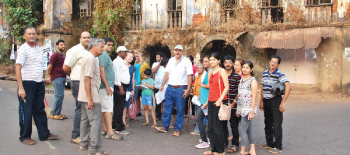
Historians and heritage lovers commemorated the 240 years when Margao was elevated from a village to the category of a town as they participated in a series of walks planned to mark the historic occasion, beginning with the Church Square Walk on Sunday.
The participants were explained the heritage value of the structures around the Church Square, including the Comunidade building, the chapel adjoining the Comunidade building, and the Camara de Salcete building,
which was the seat of municipal power, before it was shifted to the existing building around 1905.
Margao was elevated as a town through a royal decree of the Portuguese Queen Dona Maria I. This proclamation was signed after receiving a petition from the Senate of the Chamber of the Province of Salcete by Feleciano Ramos Nobre Mourao on behalf of the Queen of the Palace of Nossa Senhora of Ajuda on April 3, 1778.
While the crumbling building was the seat of municipal administration since the time Margao was elevated as a town, the existing municipal building was inaugurated way back on April 30, 1905, two years after the foundation stone was laid on September 27, 1902.
It was revealed that before the municipal administration was shifted from Old Market to the existing building, the civic affairs were carried out in a private house at the New Market as a stop-gap arrangement since the old building showed signs of decay.
The participants were explained that the old municipal building was sold to two persons, Ligorio Araujo and Ramchandra Vishnu Keni, who later sold his share of the property to Ligorio, who was an entrepreneur involved in illuminating the streets with kerosene lamps. The September 21, 1890, massacre around the Church Square over a rigged election was explained to the history lovers. Around 23 people had lost their lives in the incident, when people had protested over attempts to rig the election in favour of the pro-Portuguese government group. The army was called from Panjim to the Old Market via Rachol. In the incident, around 23 people were killed.
The bullet marks are still conserved on the façade of a house near the church building. As news of massacre spread around the world, authorities held a re-election giving justice to the people who were opposed to the dispensation.
Explaining the significance of the chapel located adjoining the Margao Comuniade building right opposite the Holy Spirit Church building, the particants were told that the chapel was built in memory of the 23 people killed in the massacre.