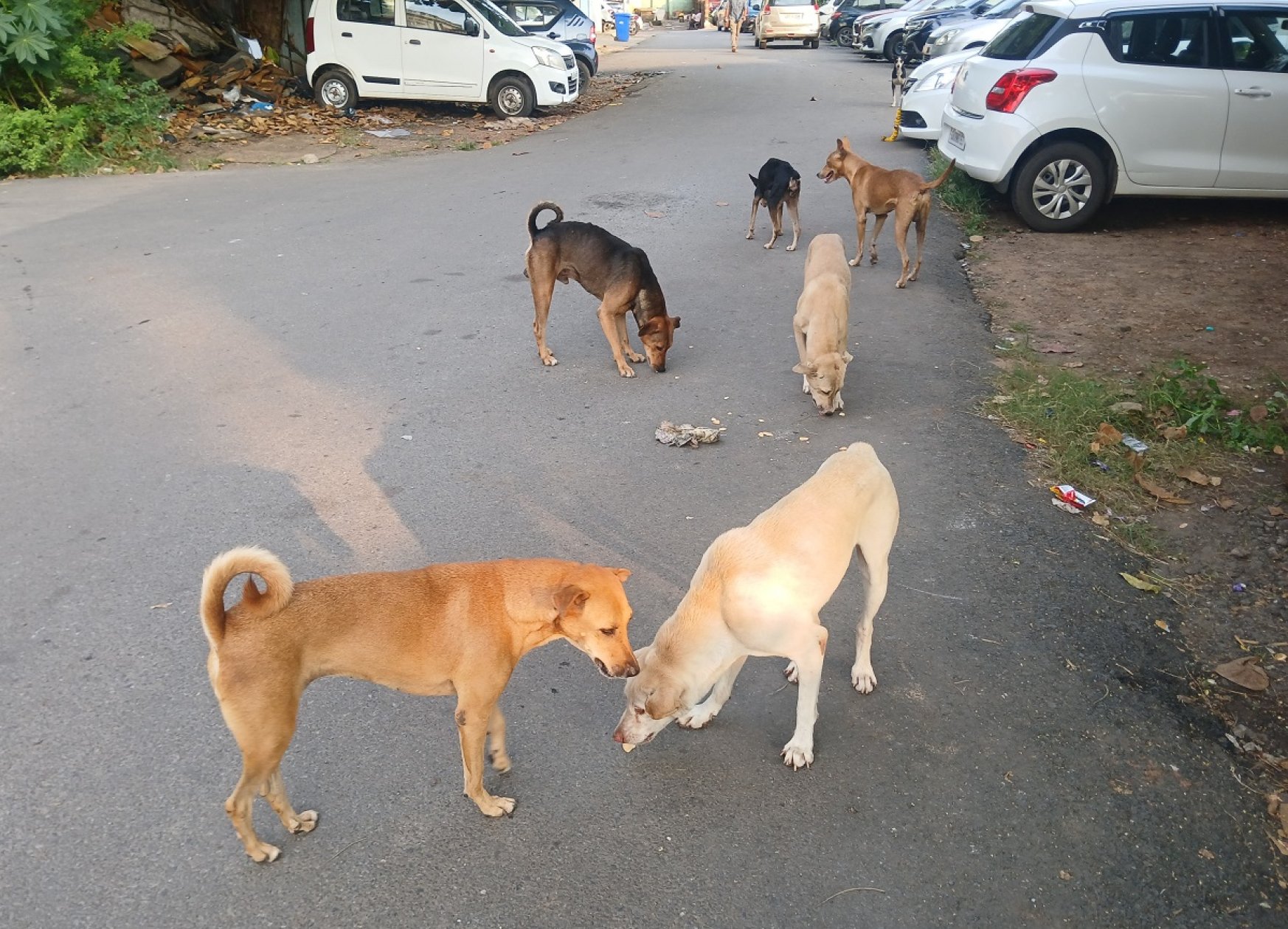
 File photo of stray dogs in Margao.

File photo of stray dogs in the PDA wholesale fish market.
MARGAO
A survey conducted by the Margao Municipal Council (MMC) has officially pegged the stray dog population in the commercial capital at 4,474, triggering a debate over whether the figure accurately reflects the actual number of stray dogs roaming the streets of the city.
While the survey has provided an official estimate of the canine population within the jurisdiction of the civic body, questions are being raised over the possibility of the actual number being considerably higher, with many believing that Margao could already be home to more than 5,000 stray dogs.
The debate assumes significance, particularly in view of the methodology adopted by the Municipal Council to conduct the exercise. Unlike surveys undertaken with the assistance of animal welfare organisations or NGOs, the Margao dog census was carried out by municipal workers, who were assigned two to three municipal wards each to enumerate the canine population.
This has prompted questions over whether the civic body took the assistance of animal welfare organisations, dog feeders and local animal lovers before undertaking the exercise. Those familiar with the ground situation believe that inputs from these individuals and groups could have helped the survey team arrive at a more comprehensive assessment, particularly in areas where stray dogs tend to congregate around markets, residential localities, commercial establishments and food waste disposal points.
According to the survey figures, the total canine population in Margao, including pet dogs, stands at 4,579. Of these, 4,474 have been identified as stray dogs, while pet dogs account for 105.
A break-up of the figures reveals that the municipal workers identified 2,905 adult male dogs and 1,497 adult female dogs. The survey figures, however, have also drawn attention to the gender-wise distribution of the stray dog population, with male dogs accounting for a considerably larger share of the recorded numbers.
A closer look at the ward-wise data compiled by the Municipal Council shows that as many as 14 of the 25 municipal wards have reported a three-digit stray dog population, indicating the widespread presence of dogs across different parts of the commercial capital.
Ward No. 3 has emerged as a significant hotspot, recording the highest number of adult male dogs, with the survey putting their number at 324.
Interestingly, the first four municipal wards (Wards 1 to 4) have all reported three-digit figures, suggesting that the concentration of stray dogs is not confined to any one particular pocket of the city. A similar pattern is evident in Wards 8 to 16, where the recorded stray dog population has also crossed the 100-mark.
The ward-wise figures are likely to provide the Municipal Council with an important baseline for planning future measures related to stray dog management, sterilisation, vaccinations and public health interventions.
However, the larger question remains whether the survey has succeeded in capturing the actual ground reality. With concerns being voiced over the possible undercounting of stray dogs, the civic body may have to consider a verification exercise involving animal welfare groups, local feeders and residents to establish a more accurate picture.
Did the dog survey cover PDA wholesale fish market?
A question doing the rounds in the corridors of the Margao Municipal Council (MMC) is whether the recent stray dog survey covered the SGPDA wholesale fish market and accounted for the dogs inside its premises.
According to sources, MMC workers are believed to have taken cognisance only of the stray dogs spotted outside the market, leaving out those residing within the premises.
A visit to the wholesale fish market reveals dozens of stray dogs that appear to have made the premises their second home. With the redeveloped market awaiting commissioning, the newly constructed platforms and open spaces have already been occupied by these strays.
An MMC official said that if the survey had not covered the dogs inside the wholesale fish market, the workers would be asked to revisit the area to ensure that they are also accounted for.
Only five aggressive, sick or injured dogs identified
The findings of the stray dog survey could also raise eyebrows, particularly over the surprisingly low number of aggressive, sick and injured dogs recorded across Margao.
According to the survey, MMC workers identified just five aggressive, sick or injured dogs in the entire city. Of these, two each were found in Ward Nos. 3 and 20, while only one was recorded in Ward No. 21.
The figures are likely to raise questions among citizens about whether the survey has adequately captured the ground reality, especially given the concerns surrounding the stray dog population in various parts of the city.